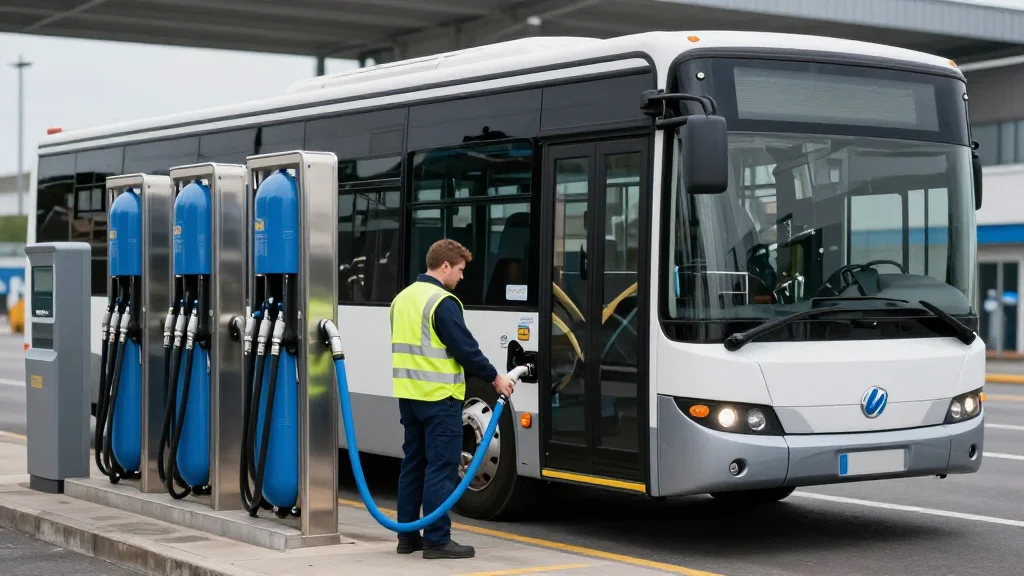
When 28 Hydrogen Buses Have To Carry A €7.6 Million Refueling Station
Why It Matters
Transit agencies often evaluate hydrogen projects on vehicle price alone, but the hidden refueling‑station cost can add a sizable operating‑expense premium, reshaping the economic case for zero‑emission transit.
Key Takeaways
- •Saarbahn built an $8.2 M hydrogen refueling station for 28 buses.
- •Station adds roughly $9 /kg to hydrogen cost, raising total to $23 /kg.
- •Hydrogen energy cost per km ($1.8) exceeds diesel ($0.95) and battery‑electric ($0.32).
- •80% reliability assumption reduces useful throughput, inflating per‑kg infrastructure cost.
- •Doubling fleet or extending station life could cut per‑kg cost by half.
Pulse Analysis
Hydrogen‑fuel‑cell buses have attracted attention as a zero‑emission alternative for routes with steep grades, long blocks and short layovers. Saarbahn’s $8.2 million depot‑based refueling station marks a shift from a procurement story to an operating system, exposing the full cost structure that many planners overlook. The station’s three 350 bar dispensers, storage tanks and safety systems represent fixed capital that must be amortised over the kilograms of hydrogen dispensed, a factor that dramatically raises the per‑kilogram price compared with the fuel alone.
When the station’s capital cost is spread over an assumed 176,000 kg of hydrogen per year (accounting for 80 % reliability), the infrastructure adds about $9 /kg to the fuel price. Combined with a realistic delivered hydrogen price of $13.5 /kg, the total reaches roughly $23 /kg, translating to $1.8 per kilometre of bus travel. By contrast, diesel at $2.19 per litre costs about $0.95 per kilometre, and battery‑electric buses consume electricity at $0.25 per kWh, or $0.32 per kilometre. The energy‑only premium of hydrogen therefore represents an 11‑12 % increase in total operating cost, a non‑trivial amount given that fuel typically accounts for 10‑15 % of bus operating expenses.
The Saarbahn case offers a cautionary template for other transit agencies. Without expanding the fleet beyond the initial 28 vehicles or extending the station’s service life, the denominator of kilograms dispensed remains too small to dilute the fixed costs. Policymakers and operators should therefore model hydrogen scenarios with realistic utilisation, reliability, and refurbishment timelines, and benchmark them against battery‑electric solutions that incorporate depot charging, opportunity charging, or in‑motion charging. Public subsidies can offset capital outlays, but they do not eliminate the ongoing cost of maintaining compressors, storage and safety systems. A transparent, data‑driven approach that includes per‑kg and per‑km cost breakdowns will help agencies decide whether hydrogen truly offers a competitive pathway to decarbonised public transport.
When 28 Hydrogen Buses Have To Carry A €7.6 Million Refueling Station
Comments
Want to join the conversation?
Loading comments...