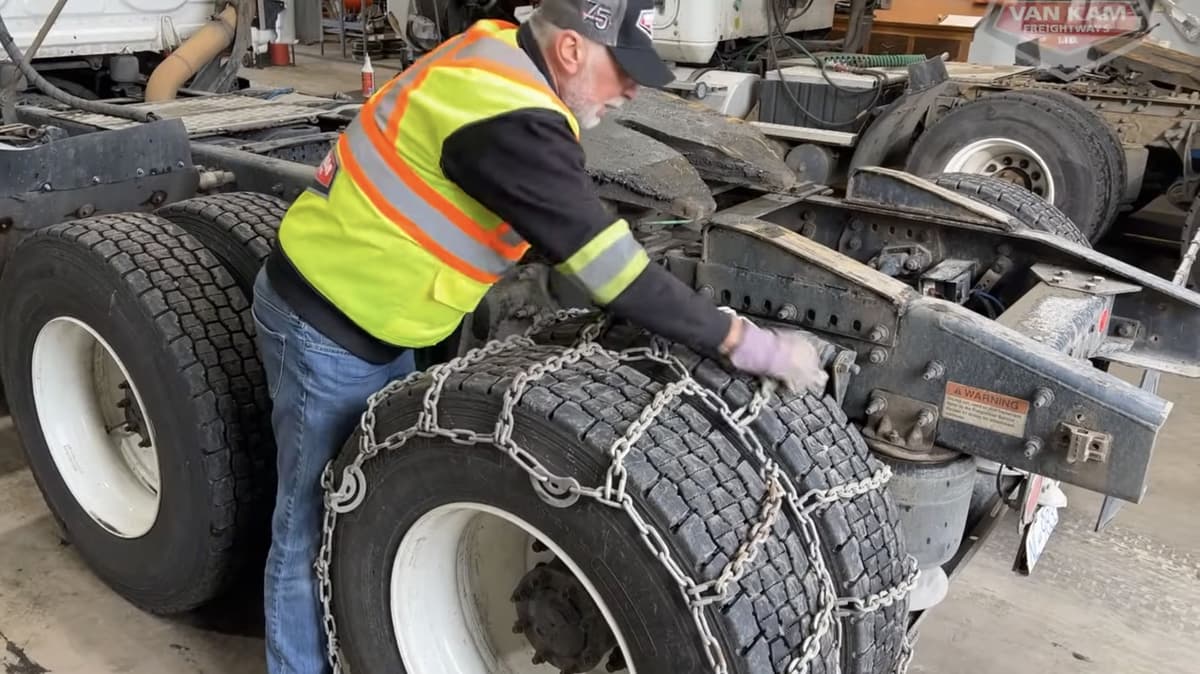
Why Do Most Truckers Choose Snow Chains Over Winter Tires?
Why It Matters
Regulatory compliance and operational economics force fleets to choose chains, directly affecting haul schedules, safety, and bottom‑line costs in winter logistics.
Key Takeaways
- •California requires chains for all trucks over 6,500 lb in any R‑level
- •Washington forces chain carriage on vehicles over 10,000 lb from Nov 1 to Apr 1
- •Chains provide mechanical grip on ice where winter tires lose traction
- •Full winter‑tire swap can exceed $10,000 per truck, versus $300‑$500 for chains
- •Chains limit speed to 25‑30 mph and can damage pavement if misused
Pulse Analysis
State regulations shape the winter‑driving strategy for heavy‑duty carriers. California’s tiered R‑1 to R‑3 system leaves no exemption for trucks above 6,500 lb, compelling fleets to stock chains year‑round. Neighboring states such as Washington and Colorado enforce even stricter thresholds, mandating chains on vehicles over 10,000 lb and 16,001 lb respectively, with hefty fines for non‑compliance. These rules create a uniform operational baseline, forcing logistics planners to factor chain inventory, inspection protocols, and checkpoint delays into route optimization and cost modeling.
Beyond legal mandates, the physics of traction give chains a decisive edge. Metal links bite into ice and compacted snow, delivering consistent mechanical grip where winter‑tire rubber compounds falter on glazed surfaces. For a typical 80,000‑lb semi, the added friction translates into safer braking distances and reduced wheel slip on steep mountain passes. Financially, the differential is stark: a full set of winter tires can top $10,000 per truck, while a quality chain kit costs a fraction of that, often under $500, plus minimal installation labor. When multiplied across a fleet, the savings on tire wear and mileage‑based expenses become significant.
However, chains impose operational trade‑offs. Speed limits drop to 25‑30 mph, extending transit times and potentially affecting delivery windows. Improper use on dry pavement accelerates tire wear and can damage road surfaces, prompting additional maintenance costs. Fleet managers must balance compliance, safety, and efficiency, often employing hybrid strategies—retaining a limited set of winter tires for milder routes while deploying chains for high‑risk corridors. Emerging technologies like advanced tire compounds and automated chain‑deployment systems may shift this calculus, but for now, chains remain the pragmatic choice for heavy‑truck winter mobility.
Why Do Most Truckers Choose Snow Chains Over Winter Tires?
Comments
Want to join the conversation?
Loading comments...