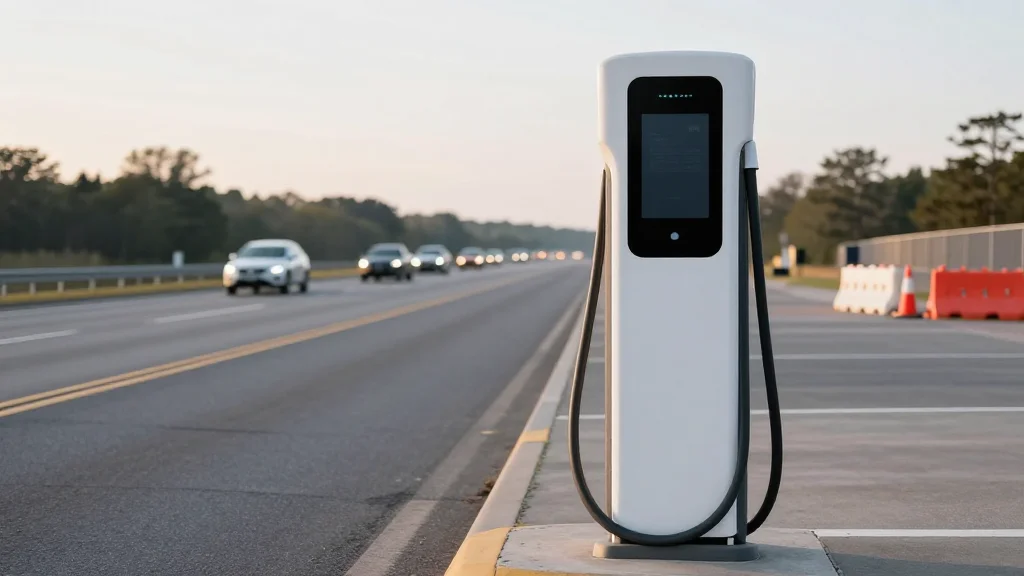
Why Is Massachusetts Sitting on $64M in EV-Charger Funding?
Why It Matters
The delay undermines Massachusetts’ effort to ease range anxiety, meet aggressive EV adoption targets, and fully capitalize on federal infrastructure dollars, risking its climate goals and economic competitiveness.
Key Takeaways
- •Massachusetts has $64 M NEVI funds unspent, no highway chargers installed.
- •Only two of three selected vendors have signed contracts; third remains pending.
- •Vendors have spent $4 M on engineering, permitting, not on hardware.
- •Planned sites in Greenfield, Newburyport, Lancaster, Wrentham, Raynham slated for July‑August construction.
- •Procurement disputes and limited competition delay NEVI rollout, lagging behind neighboring states.
Pulse Analysis
The National Electric Vehicle Infrastructure (NEVI) program, a $5 billion component of the 2021 bipartisan infrastructure law, was designed to create a reliable network of fast chargers along America’s interstate corridors. By allocating $64 million to Massachusetts, the federal government intended to accelerate the Commonwealth’s transition to electric mobility, reduce range anxiety, and attract private investment in charging infrastructure. While other states have already operationalized NEVI sites, Massachusetts remains an outlier, prompting questions about the effectiveness of its implementation strategy.
Massachusetts’ rollout has been hampered by a convoluted procurement process. After a 2022 vendor selection, only Applegreen and Global Partners secured contracts; the third vendor, Weston & Sampson, remains in limbo. The two active firms have expended about $4 million on engineering, permitting, and equipment ordering, yet no chargers are live. Ongoing disputes between Applegreen and Global Partners over unrelated highway plaza contracts have further strained the timeline, illustrating how limited competition and legal challenges can stall critical infrastructure projects even when funding is secured.
The lag has tangible consequences for the state’s climate agenda. With roughly 2,000 charging ports still missing from its projected need, Massachusetts risks falling short of its 2030 emissions‑reduction target and its EV adoption goals, which call for 200,000 light‑duty EVs and 3,200 medium‑heavy‑duty EVs by 2025. Neighboring states such as New York and Rhode Island have already deployed NEVI chargers, giving them a competitive edge in attracting EV owners and related businesses. To close the gap, Massachusetts must streamline permitting, resolve vendor disputes quickly, and consider expanding its pool of qualified contractors, ensuring that federal dollars translate into on‑the‑ground charging capacity.
Why is Massachusetts sitting on $64M in EV-charger funding?
Comments
Want to join the conversation?
Loading comments...