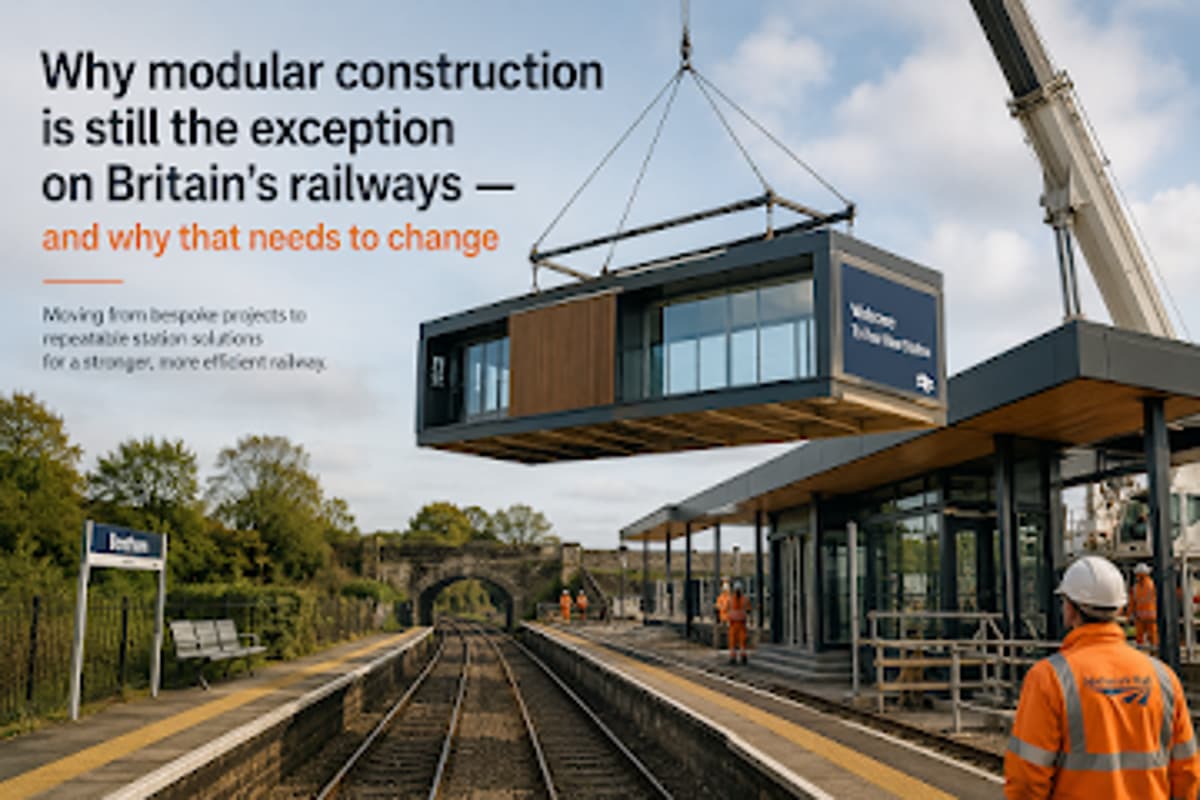
Why Modular Construction Is Still the Exception on Britain’s Railways — and Why That Needs to Change
Companies Mentioned
Why It Matters
Adopting a repeatable modular model would reduce construction risk, lower costs, and improve service continuity for thousands of UK rail stations, aligning the sector with proven efficiencies in other industries.
Key Takeaways
- •Modular footbridges deployed at Greenhithe, Mitcham Eastfields, Uckfield stations
- •Royal Stoke Hospital delivered 12‑bed modular ICU in 24 weeks
- •Clatterbridge Cancer Centre saved 23% program cost using off‑site modules
- •UK Construction Innovation Hub predicts 80% site work shift off‑site
Pulse Analysis
Across Britain, modular construction has moved from niche to mainstream in sectors like healthcare, hospitality and commercial property. Off‑site fabrication of rooms, wards and structural elements shortens build times, cuts on‑site labour and limits disruption to existing operations. The success stories at Royal Stoke University Hospital and the Clatterbridge Cancer Centre illustrate how integrated modules can deliver critical capacity quickly while achieving double‑digit program savings. These outcomes set a benchmark that rail infrastructure could emulate, especially for the thousands of small stations that share similar layout and service requirements.
Railway projects, however, remain trapped in a procurement model that treats each station as a bespoke contract. While individual components such as footbridges or platform slabs are prefabricated, the surrounding services—lighting, communications, power—are still installed through separate site visits. This fragmented approach prevents the economies of scale and learning‑curve benefits that other industries capture through system‑level modularity. Network Rail’s own design guidelines acknowledge that past modular attempts fell short because they were delivered as isolated items rather than as part of a coordinated programme.
If the rail sector shifted to an integrated modular delivery framework, the impact would be profound. Off‑site production could shift up to 80% of site activity away from active railway corridors, dramatically reducing passenger disruption, safety exposure and project uncertainty. Repeating standardized station modules would accelerate supplier learning, drive down unit costs, and enable rapid installation within short possession windows. Realising these gains will require reforming procurement contracts to favor repeatable, programme‑wide deployments rather than one‑off bespoke projects, unlocking the efficiency gains already proven in other parts of the UK construction ecosystem.
Why Modular Construction is Still the Exception on Britain’s Railways — and Why That Needs to Change
Comments
Want to join the conversation?
Loading comments...