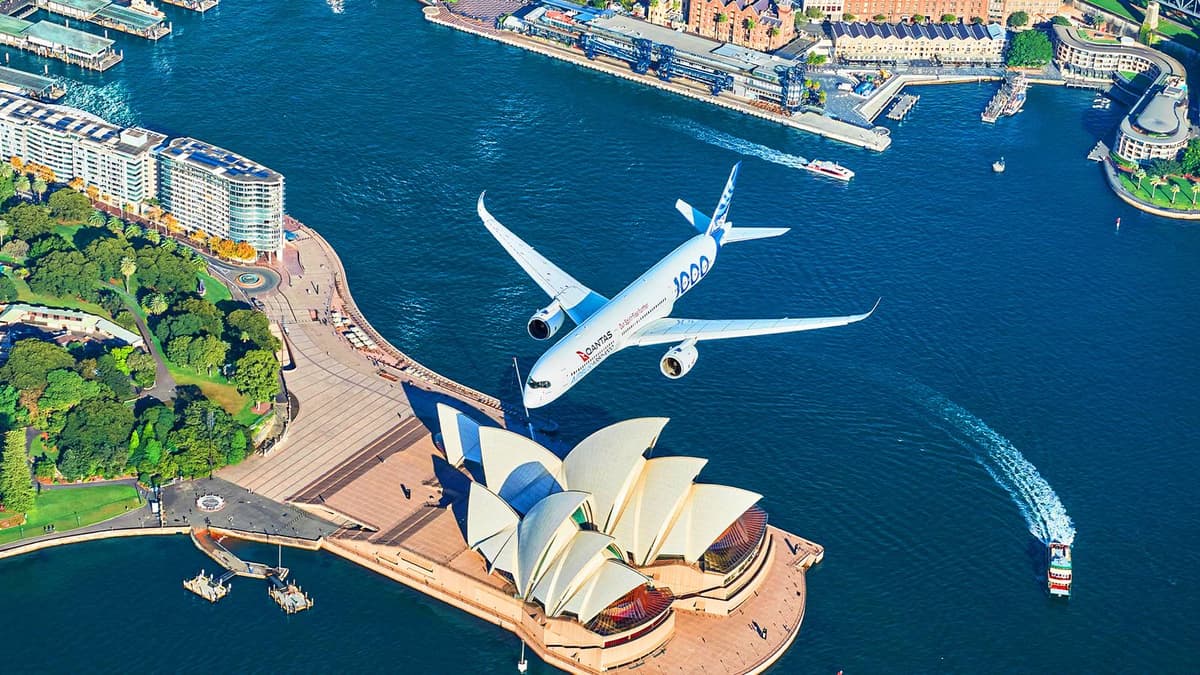
Why The Airbus A350-1000 Is The Only Jet That Can Fly Sydney To London Nonstop
Companies Mentioned
Why It Matters
The service showcases the commercial viability of ultra‑long‑haul flights, creating a premium, time‑saving product that reshapes long‑distance air travel economics.
Key Takeaways
- •A350‑1000ULR carries 48,893 gal fuel, enabling 9,800 nm range.
- •Qantas will seat 238 passengers, far fewer than standard 350‑410.
- •Boeing 777‑8 maxes 8,745 nm, insufficient for Sydney‑London nonstop.
- •Launch delayed to late 2027; three aircraft needed for daily service.
- •Premium fares justified by up to four‑hour time savings.
Pulse Analysis
Project Sunrise represents a bold shift in airline strategy, targeting the 9,188‑nautical‑mile Sydney‑London corridor with a single‑aircraft solution. Airbus’s A350‑1000ULR was engineered for this challenge, adding a permanent rear centre tank that lifts usable fuel capacity to nearly 49,000 gallons. The extra weight necessitates a low‑density cabin layout—238 seats across four classes—allowing the aircraft to stay within its maximum take‑off weight while delivering the required range. This configuration mirrors Singapore Airlines’ use of the A350‑900ULR on its Singapore‑New York service, emphasizing comfort over capacity for ultra‑long‑haul routes.
From a market perspective, the A350‑1000ULR gives Qantas a unique competitive edge. Boeing’s 777‑8, despite its modern design, tops out at about 8,745 nm, falling short of the distance needed for a nonstop Sydney‑London flight. Consequently, Qantas can command premium fares, leveraging the four‑hour time savings and exclusive nonstop experience. The reduced seat count translates to higher revenue per passenger, while the aircraft’s fuel‑efficient Trent XWB‑97 engines help mitigate operating costs, a crucial factor given the high fuel burn associated with ultra‑long‑haul operations.
The rollout has faced setbacks, with the first delivery now slated for April 2027 and full service expected by the end of that year. Qantas plans to operate three A350‑1000ULRs daily, ensuring schedule resilience. Industry observers will watch the route’s performance closely, as success could spur other carriers to pursue similar ultra‑long‑haul offerings, potentially reshaping network planning and prompting further innovations in aircraft design and sustainable aviation fuels. The Sydney‑London nonstop may thus become a benchmark for future premium, time‑critical air travel.
Why The Airbus A350-1000 Is The Only Jet That Can Fly Sydney To London Nonstop
Comments
Want to join the conversation?
Loading comments...