World’s Largest Container Carrier Plans Route Avoiding Blockaded Hormuz
Companies Mentioned
Why It Matters
The shift highlights how geopolitical tensions can rapidly reshape global container logistics, raising costs and environmental footprints while prompting carriers to diversify routing strategies.
Key Takeaways
- •MSC launches Europe‑Middle East service avoiding Hormuz via Saudi landbridge
- •First sailing departs Antwerp May 10, includes stops across Europe
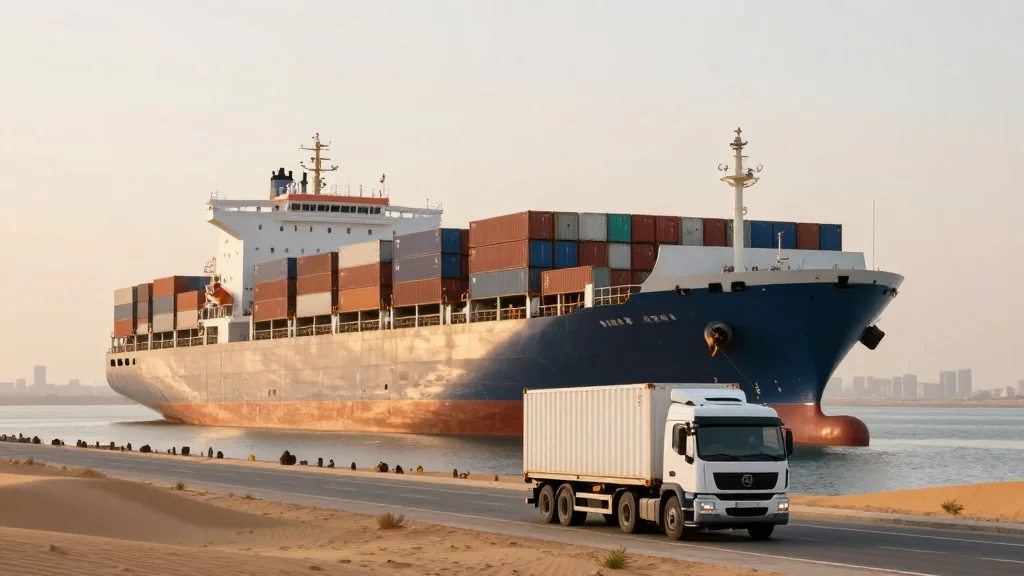
- •Trucks cover 1,300 km from Jeddah to Dammam, linking feeder vessels
- •Alternative route raises transit time, cost, and carbon emissions
- •Hapag‑Lloyd and Maersk also expanding land‑bridge options
Pulse Analysis
The closure of the Strait of Hormuz—one of the world’s most critical chokepoints—has sent ripples through the container shipping industry. Since the February 28 US‑Israel airstrike on Iran, vessel traffic has been severely limited, prompting carriers to seek alternative corridors. MSC’s newly announced service illustrates how operators are re‑engineering routes to preserve supply‑chain continuity, leveraging the Suez Canal and a Saudi Arabian landbridge to keep goods flowing between Europe and the Gulf’s industrial zones.
MSC’s plan combines maritime and over‑land legs to mitigate the Hormuz bottleneck. After crossing the Suez, ships will dock at Jeddah and King Abdullah before a 1,300‑kilometre truck journey to Dammam, where feeder vessels connect to ports in Abu Dhabi, Dubai, Bahrain, Iraq and Kuwait. While this multimodal approach maintains market access, it adds several days to transit times, inflates freight rates and raises carbon emissions due to the extensive trucking segment. Shippers must now weigh higher costs against the risk of further disruptions, prompting a reevaluation of inventory strategies and contract terms.
The initiative also signals a broader industry pivot. Competitors such as Hapag‑Lloyd and Maersk have already rolled out similar land‑bridge solutions across Saudi Arabia and Oman, indicating that alternative routing may become a semi‑permanent fixture. As geopolitical volatility persists, carriers are likely to invest in more resilient, diversified networks, potentially accelerating the adoption of inland logistics hubs and digital freight platforms. This evolution could reshape trade flows, influence port development in the Gulf, and drive regulatory focus on emissions from multimodal transport.
World’s largest container carrier plans route avoiding blockaded Hormuz
Comments
Want to join the conversation?
Loading comments...