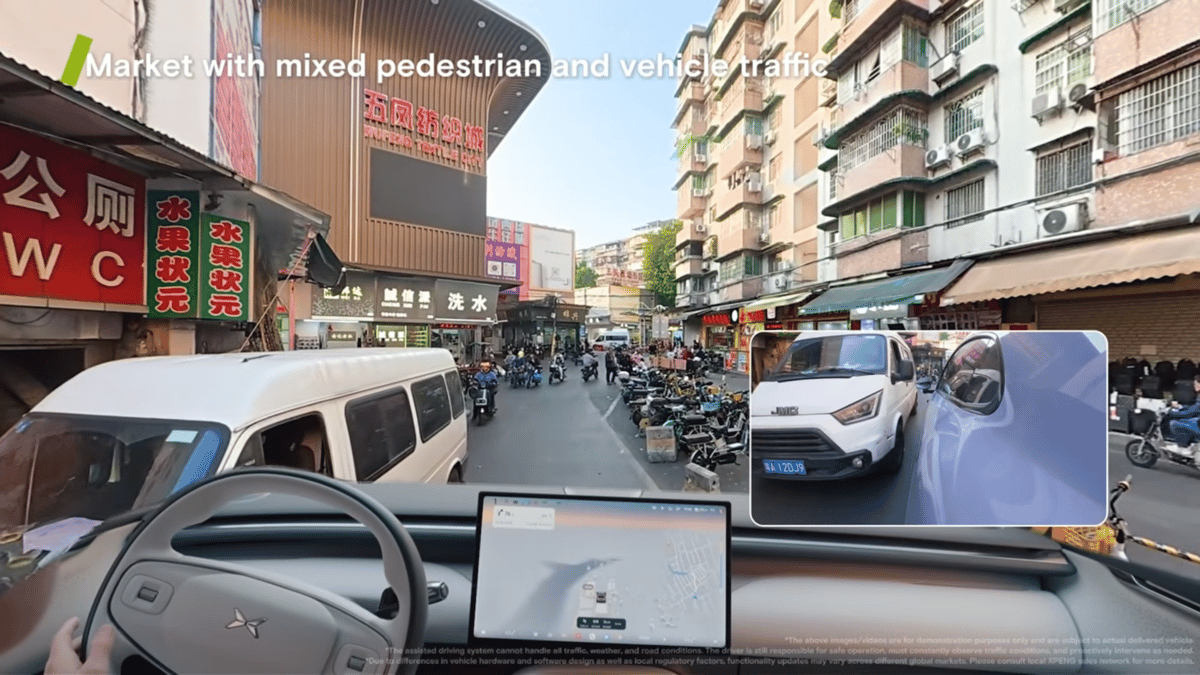
XPENG: Autonomous Driving in Crazy Traffic Conditions
Key Takeaways
- •XPENG's system navigates dense, unpredictable traffic
- •Video reveals sensor fusion handling occlusions
- •In‑house AI stack reduces reliance on third parties
- •Demonstration targets Shanghai and other megacities
- •Regulators monitor safety after high‑risk test
Pulse Analysis
XPENG’s latest autonomous‑driving showcase arrives at a pivotal moment for China’s electric‑vehicle sector. As the nation pushes toward a 2025 goal of widespread Level‑3 and Level‑4 deployments, manufacturers are racing to prove their systems can survive the chaotic streets of megacities such as Beijing, Shanghai, and Guangzhou. The newly released video places XPENG’s in‑house AI at the centre of that competition, positioning the company alongside Baidu’s Apollo and Huawei’s HiSilicon efforts while signaling a shift away from reliance on external software stacks. The video shows XPENG scaling software across models, from G3 SUV to P7 sedan.
The test drive highlights a sensor suite that blends millimeter‑wave radar, high‑resolution cameras, and solid‑state lidar to maintain situational awareness amid erratic lane changes and sudden pedestrian crossings. XPENG’s proprietary neural‑network stack processes these inputs in real time, enabling predictive path planning even when other drivers ignore traffic rules. Such robustness is crucial for meeting upcoming Chinese safety standards requiring 10,000 km mixed‑traffic testing. By demonstrating obstacle detection and decision‑making under such “crazy” conditions, the company addresses a key criticism of early autonomous prototypes: the inability to cope with dense, unstructured traffic common in Chinese cities.
From a business perspective, the footage serves as both a marketing tool and a data‑collection exercise, feeding real‑world scenarios into XPENG’s simulation pipelines. Successful navigation of high‑density traffic could accelerate regulatory approvals, allowing the firm to launch commercial robo‑taxis in Tier‑1 cities by late 2026. Investors will watch how quickly XPENG translates this technical proof point into revenue, especially as global automakers eye partnerships with Chinese AI firms to meet tightening emissions and autonomy mandates. The data may also support European partnerships, offering proven urban autonomy for overseas fleets.
XPENG: Autonomous Driving in Crazy Traffic Conditions
Comments
Want to join the conversation?