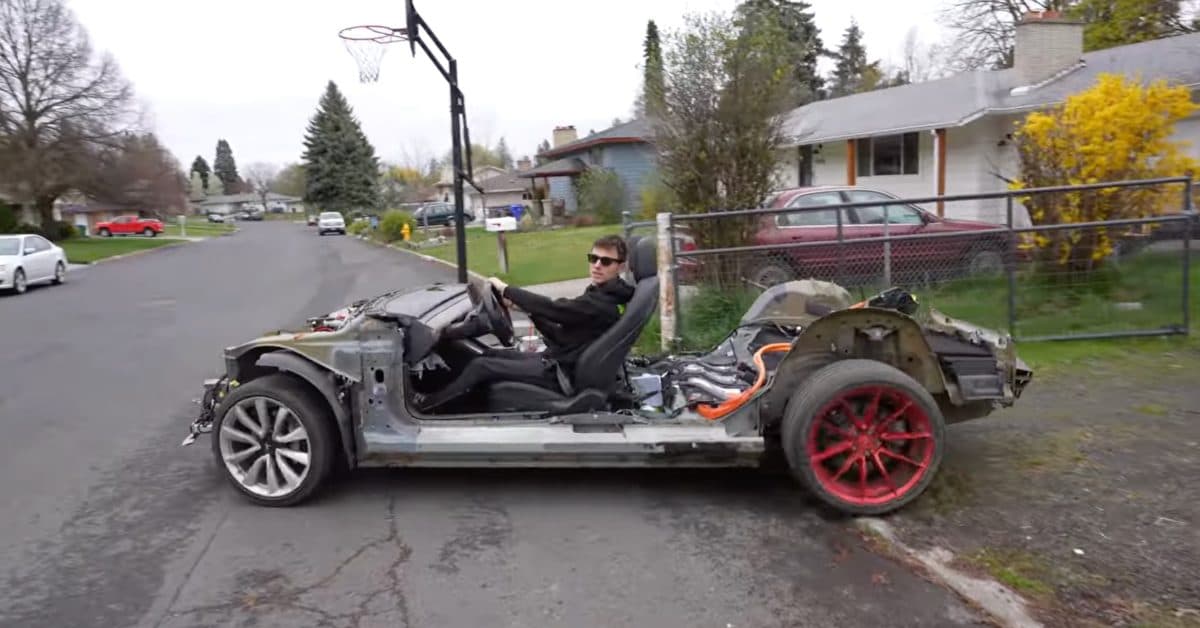
YouTuber Buys Stripped Tesla Model 3 ‘Go-Kart’ for $2,000 — It Still Has 212-Mile Range
Companies Mentioned

Why It Matters
The stunt proves that EV powertrains can operate independently of most vehicle components, underscoring their durability, while also exposing how Tesla’s software safeguards can hinder aftermarket and salvage projects.
Key Takeaways
- •Tesla drivetrain delivered 212‑mile range despite missing body
- •Software logged 78 error codes after safety sensors were removed
- •Fast‑charging disabled without software update, forcing 7‑hour Level 2 charge
- •DIY adapter hack enabled DC charger but risked vehicle warranty
Pulse Analysis
The viral video of a $2,000 stripped Tesla Model 3 shines a spotlight on a growing niche: repurposing EV powertrains for custom builds. As battery costs fall and electric drivetrains prove remarkably robust, companies like EV West are already marketing Tesla crate motors to hobbyists and classic‑car restorers. This trend suggests a future where the electric motor and battery become modular components, much like engines in the internal‑combustion era, potentially opening new revenue streams for manufacturers and aftermarket suppliers.
Yet the experiment also reveals a technical roadblock: Tesla’s tightly coupled software architecture. When critical sensors and cameras are removed, the vehicle floods the driver’s screen with error codes and progressively disables features such as CCS fast‑charging. The over‑the‑air update system, designed for safety, becomes a gatekeeper that can render heavily modified cars inoperable unless owners accept costly service evaluations. This dynamic forces DIY builders to weigh the benefits of raw performance against the risk of losing essential functionality.
For the broader industry, the episode serves as both a proof point and a cautionary tale. Demonstrating a 212‑mile range on a skeletal chassis reinforces the narrative that electric powertrains are inherently durable, bolstering consumer confidence in EV longevity. At the same time, Tesla’s defensive software stance may prompt regulators to consider standards for aftermarket modifications, while competitors could differentiate themselves by offering more open‑source or modular platforms. The balance between innovation, safety, and user freedom will shape the next wave of electric vehicle customization.
YouTuber buys stripped Tesla Model 3 ‘go-kart’ for $2,000 — it still has 212-mile range
Comments
Want to join the conversation?
Loading comments...