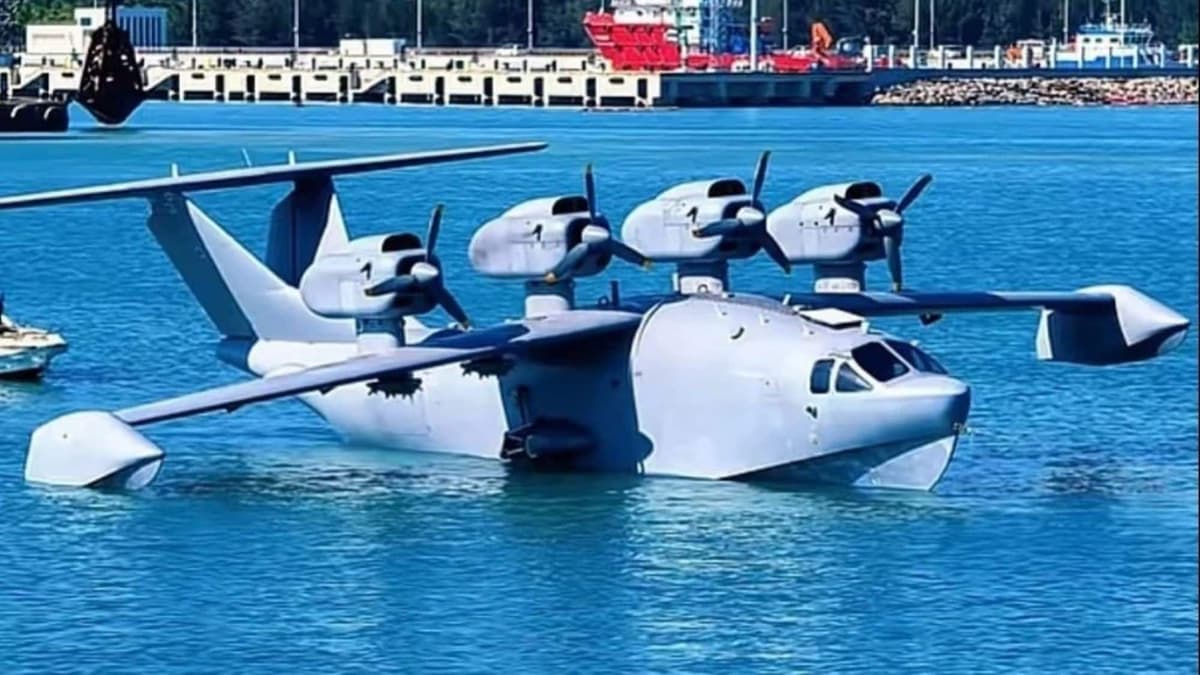
China’s ‘Bohai Sea Monster’ Ekranoplan Emerges in Clearest Images Yet
Key Takeaways
- •Images reveal four underwing hardpoints, likely for anti‑ship missiles
- •Prototype smaller than expected, with three‑blade propellers on four turboprops
- •Crane lift suggests amphibious capability for land‑based operations
- •Planned up‑scale could match Y‑15 size, using same or larger WJ‑10 engines
Pulse Analysis
Ground‑effect vehicles, once a Cold‑War curiosity, are re‑emerging as viable military platforms. By skimming just a few metres above water, they combine the speed of an aircraft with the low radar signature of a ship. China’s renewed interest reflects a broader trend of leveraging niche technologies to offset conventional naval superiority, especially in the crowded littorals of the South China Sea. The latest imagery of the so‑called Bohai Sea Monster underscores how Beijing is moving from concept to tangible hardware, echoing Soviet experiments while integrating modern avionics and propulsion.
The newly released photos reveal a compact airframe powered by four WJ‑10/AEP500 turboprop engines, each driving three‑blade propellers. Under the starboard wing, two visible hardpoints – and likely two more on the opposite side – suggest the vehicle can carry anti‑ship missiles or torpedoes, turning it into a strike platform as well as a rapid resupply craft. The presence of extended landing gear and a crane‑lifted stance indicates amphibious capability, allowing operations from both sea and land bases. Analysts expect the current demonstrator to be scaled up to dimensions comparable to the Y‑15, potentially with larger engines to boost payload and range.
Strategically, a functional ekranoplan could give the PLA Navy a unique tool for delivering weapons and personnel across the archipelagic terrain of the western Pacific with minimal detection. Its ability to operate close to the surface makes it difficult for conventional radar, while its speed outpaces traditional hovercraft. If fielded, the system would complement existing amphibious assets such as Type 075 and Type 076 LHDs, and could complicate defense planning for Taiwan and U.S. allies. The emergence of this technology may spur regional navies to invest in low‑altitude surveillance and develop counter‑measures tailored to ground‑effect threats, heralding a new chapter in littoral warfare.
China’s ‘Bohai Sea Monster’ Ekranoplan Emerges in Clearest Images Yet
Comments
Want to join the conversation?