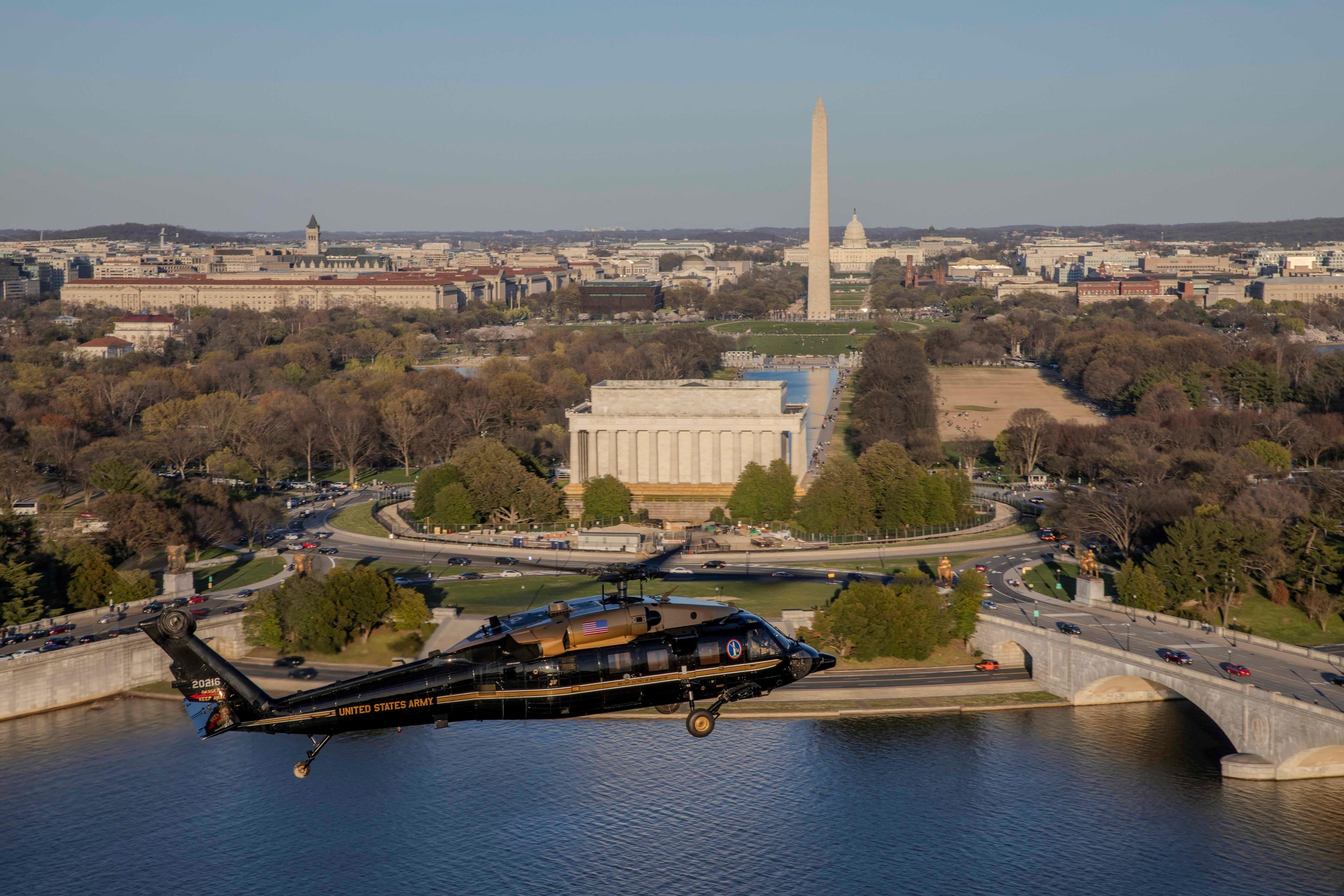
FAA Moves to Codify Existing DCA Helicopter Restrictions Into Law
•January 22, 2026
0
Why It Matters
Permanent restrictions enhance safety in one of the nation’s busiest airspaces and set a regulatory benchmark for managing vertical‑lift traffic near major airports.
Key Takeaways
- •FAA makes DCA helicopter ban permanent
- •Altitude limit reduced to 1,500 feet
- •Only medical, law‑enforcement, security flights exempt
- •Military training flights still subject to approval
- •Powered‑lift aircraft allowed in horizontal flight mode
Pulse Analysis
The January 29, 2025 collision between a U.S. Army Black Hawk and an American Eagle CRJ700 sparked a wave of safety reviews around Washington’s Reagan National Airport. The National Transportation Safety Board issued urgent recommendations, urging the Federal Aviation Administration to tighten vertical‑lift traffic. In response, the FAA imposed temporary flight‑restriction zones that barred non‑essential helicopters and powered‑lift aircraft. Those interim measures proved effective, but the lack of statutory authority left the restrictions vulnerable to legal challenges, prompting the agency to pursue a permanent rule.
The interim final rule published on Jan. 22 codifies a 1,500‑foot altitude ceiling for vertical‑lift operations around DCA, a sharp drop from the earlier 10,000‑foot limit. It distinguishes “essential” flights—medical evacuations, law‑enforcement, national‑security missions, and presidential transport—from “non‑essential” activities such as proficiency evaluations and routine training. While essential flights retain access, fixed‑wing traffic will be rerouted when helicopters are present. Powered‑lift aircraft may still operate in winged or horizontally‑propelled mode, preserving certain commercial and cargo services that rely on tilt‑rotor platforms.
By embedding the restrictions into federal law, the FAA sets a precedent for permanent airspace management near high‑traffic airports. The rule balances public safety with the operational needs of emergency responders and national‑security assets, but it also raises questions about the future of military training flights in congested corridors. Industry groups are watching closely, as similar vertical‑lift bans could emerge around other major hubs if accident risk assessments align. Ultimately, the permanent DCA restriction underscores a shift toward data‑driven, risk‑based aviation policy. Regulators will likely monitor compliance through enhanced ADS‑B tracking.
FAA moves to codify existing DCA helicopter restrictions into law
The Federal Aviation Administration on Jan. 22 moved to permanently codify restrictions on helicopter and powered‑lift flights near Washington’s Reagan National Airport (DCA) that were put into place after the Jan. 29, 2025 midair collision between a U.S. Army Black Hawk helicopter and an American Eagle CRJ700.
The move, described in an interim final rule posted under public inspection, sets up a permanent flight‑restriction area around the DCA airport where “non‑essential” helicopters as well as powered‑lift aircraft “operating in the vertical‑lift flight mode” are banned. When “essential” flights are allowed to use the airspace around DCA, fixed‑wing aircraft are rerouted.
The FAA first moved to restrict these operations immediately following the crash with limited exceptions, and doubled down further after the U.S. National Transportation Safety Board in March issued two urgent safety recommendations on the topic. This interim final rule, which will become effective once formally published on the Federal Register tomorrow, codifies the restrictions into law.
Related: Special Report: The night everything at DCA finally went wrong
The new rule specifically identifies “proficiency evaluation flights, other transportation of personnel not directly involved in an essential operation, and routine training operations” as not essential. Military training flights have been at the center of the debate about helicopter traffic around DCA, given the Army helicopter involved in the January 2025 crash was conducting a proficiency‑evaluation flight.
Medical‑emergency, active law‑enforcement and active national‑security flights as well as transportation of the President and Vice President are considered “essential” activities, exemptions that are the same as those described in the temporary restrictions put in place after the crash.
The rule says, “Continuity activities for the Federal government to ensure the continued operation of essential governmental functions under a broad range of circumstances, including all‑hazard emergencies” can also be considered “essential.” The military unit which was operating the accident Black Hawk on Jan. 29 — Fort Belvoir’s 12th Army Aviation Battalion — is tasked with a wide‑ranging “continuity of government” mission.
The rule also significantly lowers the altitude ceiling for the restrictions, from 10,000 feet in the earlier temporary restrictions to 1,500 feet. “This altitude, while more permissive than FAA‑issued temporary restrictions currently in place, aligns with typical operations by helicopters and powered‑lift operating in the vertical‑lift flight mode near DCA thus it does not pose the same risk for insufficient separation distances,” the FAA said in the rule.
Notably, the agency does not move to restrict powered‑lift aircraft operating in winged or horizontally‑propelled flight.
This final rule is the latest step in a protracted effort to ensure safety at and around DCA airport. Late last year, some lawmakers joined the NTSB in calling for a provision in must‑pass defense‑authorization legislation to be removed, claiming it rolled back FAA restrictions put in place after the crash. In a rare insertion into legislative matters, NTSB Chair Jennifer Homendy held a press conference at the time sharply criticizing the provision, calling it a “safety whitewash.”
The provision, which ultimately became law, says a military “training mission” in the vicinity of DCA to operate with location‑transmitting technology — known as ADS‑B Out — turned on, but provided a pathway to exemption from “the Secretary of a military department, with the concurrence of the Secretary of Transportation.” The accident Black Hawk was not transmitting ADS‑B signals at the time of the Jan. 29 crash.
A spokesperson for the FAA didn’t immediately comment. Spokespeople for the U.S. Senate and House of Representatives Armed Services Committees and the U.S. Army did not immediately respond to a request for comment.
0
Comments
Want to join the conversation?
Loading comments...