
How to Improve UK261 & EU261
•January 28, 2026
0
Why It Matters
Strengthening UK261/EU261 safeguards would close a consumer protection loophole that leaves travelers vulnerable on international flights, especially during weather disruptions. As airlines rely heavily on access to the UK market and codeshare agreements, aligning duties of care with market incentives could improve traveler experience without imposing undue burdens on carriers.
How to improve UK261 & EU261
[
](https://substackcdn.com/image/fetch/$s_!g3Jz!,f_auto,q_auto:good,fl_progressive:steep/https%3A%2F%2Fsubstack-post-media.s3.amazonaws.com%2Fpublic%2Fimages%2F55e7b08e-23c2-4524-91a8-b73ae346e880.heic)
The Air Passenger Rights Regulation 2004 known as UK261 or EU261 is a great friend of travellers. It stands alongside the fully-flat bed and seat-back entertainment screens among the greatest innovations in mass market aviation.
When things go wrong, as eventually they must, consumers travelling on British and European Union airlines can be sure that they will be looked after. The same is true for travellers leaving the UK or EU on a foreign airline.
Depending on the circumstances, travellers can expect anything from a wodge of cash compensation to hotel rooms, alternative transport and general care and attention.
Which is not to say that airlines can conjure up hotel rooms like a rabbit from a hat when whole airports break down. But at least there is duty of care.
Advertisement:
[

](https://substackcdn.com/image/fetch/$s_!GBUK!,f_auto,q_auto:good,fl_progressive:steep/https%3A%2F%2Fsubstack-post-media.s3.amazonaws.com%2Fpublic%2Fimages%2F8b772c90-2b49-48e7-8b03-2fa22b07d135_1000x200.heic)
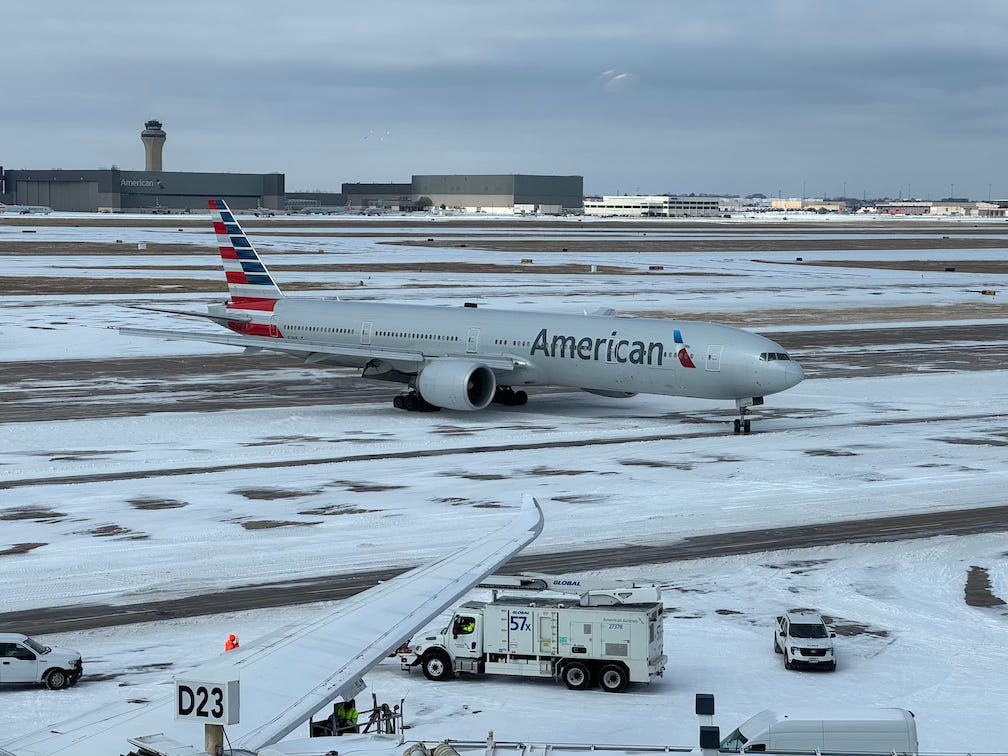
Last weekend your favourite airline revenue economist spent two nights hanging out at Dallas Fort Worth International Airport awaiting a flight to London.
Winter Storm Fern had covered much of the United States in ice, snow and more ice. Luckily I found myself holed up in a runway-facing room at the Grand Hyatt rather than stranded in town or sleeping on the terminal floor.
I spent a day watching the snow ploughs and de-icers trundle up and down through the frost whenever there was a break in the weather.
US airspace shown on FlightRadar24, usually awash with little yellow planes, looked strangely green and blue.
A special shout and thank you to Basudeb, who made the arrangements that got me out of what could have been a sticky situation.
Which all got me thinking about passenger assistance…
Atttentive readers will have noted that in this article last week I said:
“Last weekend I had the good fortune to fly on an American Airlines Boeing 787-9 from London Heathrow to Dallas. It was an excellent flight in every respect.”
No prizes for guessing that it was American Airlines who were scheduled to take me back to London on the day when DFW was covered in the slippery stuff.
As a non-UK and non-EU airline, AA was not obliged to look after me like BA did on the way back from Hong Kong last year.
AA’s Conditions of Carriage state simply and brutally:
“Delays beyond our control (like weather)
If the delay is beyond our control, or you book your own arrangements without written authorization from American Airlines, you’re responsible to pay for your hotel, meals and other expenses. An American Airlines agent may be able to help you find a hotel.”
The agent “may” help. They also may not. The CoC also say:
“If your flight was delayed or cancelled and you don’t accept our alternative arrangements, or none were available, we’ll refund the remaining ticket value and any optional fees according to our involuntary refunds policy. Beyond that, we have no further contractual obligation.”
Note the “or none were available” clause. If flights are full American can leave passengers stranded with a refund of half the fare paid and an expensive hotel bill and one-way flight to fund.
I was worried about this as flights were fully booked for many days after the disruption was expected to be over. There was not enough capacity for everyone to rebook within AA’s fee waiver rules, which required all travel to be completed within five days of the original flight.
I also noted that my travel insurance would not cover me for the hotel bill. Of course when I bought the policy the first thing I looked at was the medical cover. I then noted that there was a disruption clause and thought no more about it.
The insurance actually paid out when I was delayed in Hong Kong – thirty Pounds to cover a meal paid as twenty Pounds for the first twelve hours and ten Pounds for the next. Thank you insurers! They might even pay another twenty or thirty Pounds again as I am certainly covered to that extent. But they will not pay for the hotel.
I bought the second most expensive travel product of the three available on the insurer’s website, which has roughly the same disruption coverage to the most expensive.
The most expensive policy would have given me an extra £15 from Hong Kong and an extra £10 from Dallas. Hardly the stuff of one-way tickets and hotel nights.
I expected to be covered for my extra night’s hotel bill in Dallas. Inspecting the small print showed that I was not.
Clearly British insurers expect British customers to book with British or European airlines. I can understand that – they want to keep their own costs down.
I will certainly think twice about not flying with British or EU airlines again.
So back to improving the passenger assistance regulations. By which I mean strengthening consumer protection at a price that airlines will find acceptable even if they would rather not pay it. I think there are two channels.
First up are regulatory remedies, which I see as coming in three “degrees of freedom”.
The simplest regulatory remedy, or first “degree of freedom”, would be to mandate carriers flying to the UK or EU to adopt the same consumer protections on the flight into those territories as they do on the outbound.
The UK could be on strong ground here as it seems that every carrier in the world wants to fly to London. The EU perhaps less so because British aviation is dominated by London while European markets have many more second- and third-tier cities which airlines can take or leave.
I say that overseas airlines should “pay” for the privilege of London access by providing the same duty of care to passengers returning to London from distant lands as they do to consumers leaving London.
From now on I will stick with the UK for simplicity, but the same arguments could be extended to the EU to some extent.
The next “degree of freedom” is slightly stronger for consumers and harsher for airlines.
It would require airlines to offer British consumers or UK-bound travellers UK261 level protection on all their flights when the traveller is on a ticket that involves at least one sector to or from the United Kingdom.
So for example if a traveller was ticketed London to Dallas to Tucson to Dallas to London on American Airlines with stopovers, the airline would be required to provide hotel accommodation in the event of an overnight disruption on Dallas to Tucson or Tucson to Dallas.
The strongest regulatory “degree of freedom” for consumers and harshest for airlines would be to apply UK261 level protection on all the airline’s codeshares with a British carrier.
So for example all oneworld members who codeshare with British Airways would be required to offer British consumers UK261 protection on all their BA-coded flights.
This might be a BA code on the ticket or it could even be a flight which is in the timetable as a potential BA codeshare, even if the consumer is not ticketed under the BA code.
So if a traveller was on AA3125 from Dallas to Tucson and that flight can be sold as BA4790, UK261 applies.
At this point many readers will be pointing out that this will add cost to airlines. Some of you might even claim that it is unfair. I disagree.
Airlines greatly benefit from their codeshare and alliance memberships. And they benefit greatly when they fly to London. This generates a lot of revenue.
Most of the time passengers are shuttled around the globe without incident. UK261 fortunately only applies to a small number of passengers in the grand scheme of things.
I think that most airlines would consider offering UK261 benefits to British consumers and visitors to the UK a price worth paying to continue having access to UK markets or codeshares with UK airlines. They might rather not if they had the choice, but given a take it or leave it arrangement, many would take it.
Next, let’s take a look at market-based remedies. Airlines could offer UK261 protection as ancillary revenue or loyalty status benefit. Governments could use taxation to drive market incentives.
0
Comments
Want to join the conversation?
Loading comments...