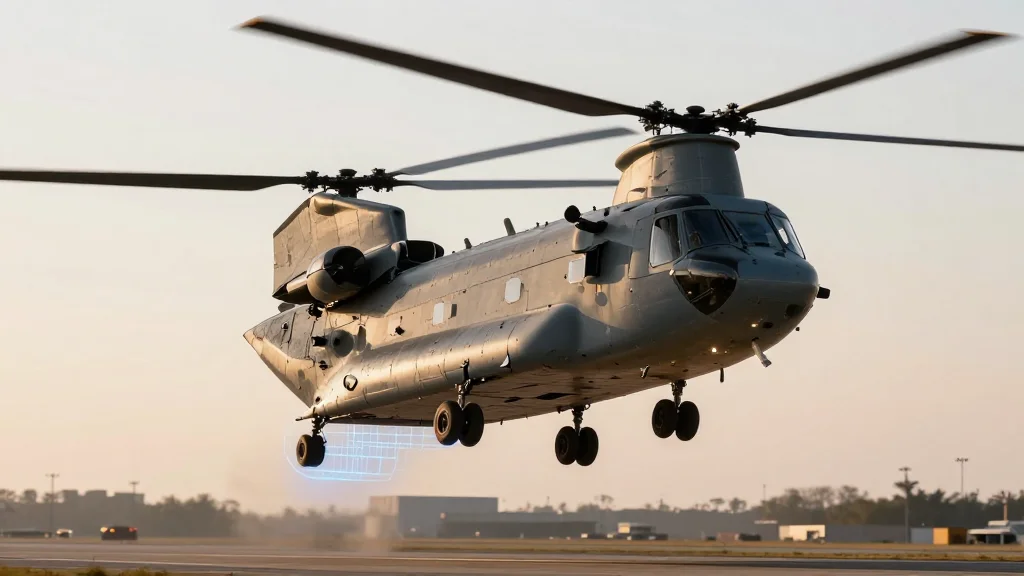
64‑Year‑Old CH‑47F Chinook Lands Hands‑Free Using Boeing’s A2X Software

Companies Mentioned
Why It Matters
The successful hands‑free landing demonstrates that mature, high‑value military platforms can receive transformative capability upgrades through software rather than costly new airframes. For the U.S. Army, this means faster, cheaper enhancements to its heavy‑lift fleet, preserving operational readiness while reducing lifecycle costs. Moreover, the A2X system showcases a pathway for integrating autonomous functions into crewed aircraft, a trend that could extend to other rotorcraft and fixed‑wing platforms, reshaping doctrine and training across the defense aerospace sector. If the technology proves robust in contested environments, it could lower crew workload, improve safety, and enable more aggressive mission profiles in dense urban or mountainous terrain. The broader defense community will watch closely, as the approach may inform similar upgrades for legacy assets in NATO allies, potentially standardizing a new baseline for autonomous flight control in military aviation.
Key Takeaways
- •Boeing’s A2X software achieved a fully automated landing on a 64‑year‑old CH‑47F Chinook.
- •Landing precision was under 1.5 m after more than 150 test approaches since Jan 2026.
- •The system adds a supervised autonomy layer, letting pilots set parameters while the software controls flight.
- •Upgrade relies on software changes to the Digital Automatic Flight Control System, avoiding new airframe development.
- •Full operational evaluation planned for late 2026; potential fleet‑wide retrofit could reshape heavy‑lift helicopter use.
Pulse Analysis
Boeing’s A2X demonstration signals a strategic shift in defense acquisition: leveraging software to extract new performance from existing hardware. Historically, upgrades to legacy platforms have focused on incremental hardware tweaks—new engines, avionics, or structural reinforcements. The Chinook case flips that paradigm, showing that a high‑level flight‑control algorithm can deliver capabilities previously thought to require new designs. This reduces development cycles dramatically; where a fresh airframe might take a decade and billions of dollars, a software retrofit can be fielded in a few years at a fraction of the cost.
The move also aligns with broader Department of Defense initiatives to modernize through digital engineering and autonomous systems. By keeping the crew in the loop, the A2X approach mitigates the risk of fully unmanned operations, which have faced cultural resistance in rotary‑wing communities. The supervised autonomy model offers a compromise: enhanced precision and reduced workload without eliminating the human decision‑maker, easing adoption across units that are traditionally wary of fully autonomous flight.
Looking ahead, the success of the Chinook test could catalyze a wave of similar upgrades for other legacy aircraft, such as the UH‑60 Black Hawk or the C‑130 Hercules. If the Army validates A2X under combat‑relevant conditions, procurement officials may prioritize software pathways for future capability gaps, reshaping budget allocations away from new platform development toward digital modernization. This could accelerate the overall pace of innovation in the aerospace defense sector, making legacy fleets more adaptable to emerging threats and operational concepts.
64‑Year‑Old CH‑47F Chinook Lands Hands‑Free Using Boeing’s A2X Software
Comments
Want to join the conversation?
Loading comments...