Airbus
The rapid deployment showcased the strategic importance of interoperable, high‑tech firefighting helicopters in Europe’s climate‑driven disaster response, reinforcing Hungary’s role in EU civil‑protection efforts.
The summer of 2025 saw unprecedented wildfires scorch Albania, prompting the activation of the European Union Civil Protection Mechanism. As temperatures climbed and vegetation dried, fire fronts spread faster than local resources could contain, forcing a multinational coalition of aerial assets from Croatia, Italy, Czechia and Slovakia. Rapid deployment became critical; delays of even a few hours could mean entire villages lost. In this high‑stakes environment, the Hungarian Air Force’s newly delivered H225M fleet entered the theatre, illustrating how climate‑driven emergencies are reshaping cross‑border defense logistics.
The two Airbus H225M helicopters lifted off Hungary within 24 hours of the call, completing twenty water‑bucket sorties and dumping roughly half a million litres on the blaze. Equipped with state‑of‑the‑art avionics, an iPad‑based performance‑planning tool, and automatic flight‑control systems, the aircraft maintained precise drops despite turbulent mountain winds and limited maneuvering space. Crews reported markedly lower fatigue, as the integrated systems handled complex maximum‑take‑off‑weight calculations and fuel management. This technological edge not only amplified drop accuracy but also allowed the Hungarian team to operate seamlessly alongside other EU assets.
The Albanian mission provided Hungarian crews with real‑world experience that no simulator can replicate, sharpening decision‑making for future EU civil‑protection deployments. Demonstrating high readiness with minimal logistical footprint, the H225M proved its suitability for rapid‑response roles, potentially expanding market demand for versatile firefighting platforms. As climate change drives more frequent, intense wildfires across Europe, nations are likely to lean on such capable rotary‑wing assets, prompting further investment in interoperable avionics and joint training programs. The operation underscores the strategic value of maintaining a modern, export‑ready helicopter fleet.
In the summer of 2025, Albania was particularly affected by wildfires. A multinational response offered support, including aerial assets from Croatia, Italy, Czechia and Slovakia. Despite only receiving their final two H225Ms days earlier, the Hungarian Air Force also joined the operation. Major Gabor Olàh details the helicopters’ critical role.
Wildfires in southern European countries are becoming more frequent and more intense, as a direct consequence of climate change. The summer of 2025 would prove to be particularly devastating and in July, the European Union Civil Protection Mechanism was activated to trigger a coalition of countries that coordinated to protect Albanian towns and villages and the local residents from rapidly spreading blazes.
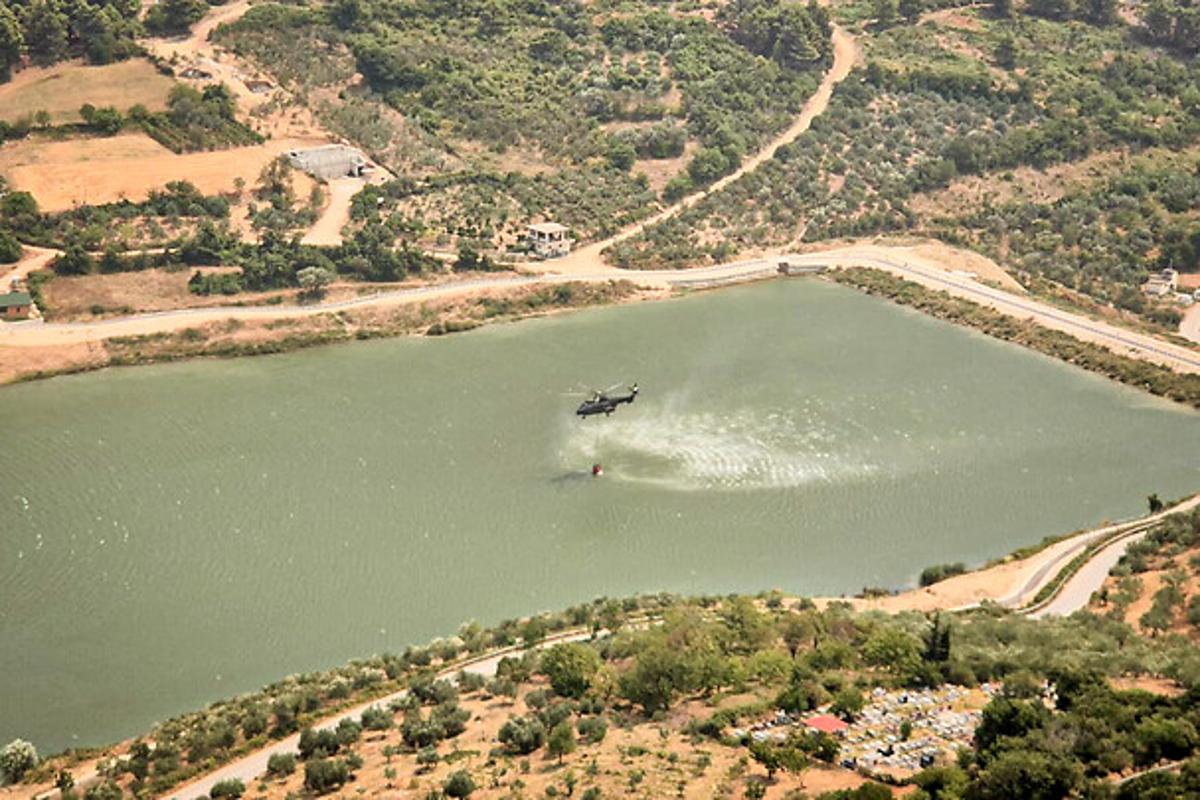
When responding to such intense fires, there isn’t a moment to lose. The Hungarian Air Force received the call for support on the afternoon of 22 July. At 5 am the following day planning and preparation began for the mission. Two H225Ms left Hungary at 10 am, which meant they could be immediately deployed. “Assigning helicopters and aircrews at short notice can be challenging even with a fleet of 16 and a relatively sizeable pool of aircrews,” notes Major Olàh. “We were able to depart at 10 am, thus enabling us to fly our first sortie on the first day of the deployment.” During a 5‑day deployment from 23‑27 July, 16 personnel were involved, completing 20 sorties and executing 300 water‑bucket drops—delivering a total of around 500,000 litres of water—going a long way to help douse the flames.
Complementing local and international rotary‑ and fixed‑wing assets, the H225Ms enhanced the flexibility of the operations, operating simultaneously across Albania. Major Olàh explains that the helicopters were a valuable support to crews in a rapidly evolving situation which necessitated quick decision making. “The crews were redirected from north of Tirana to populated areas in danger, and later had to split their efforts,” he says.
Obviously, flying in the face of such intense fires is difficult work. “Flying in a mountainous environment can be very challenging because of the turbulent winds, steep slopes, lack of space for manoeuvring, just to name a few reasons. However, my most memorable moment was when we were able to prevent the fire from reaching a village in the vicinity of Kucove Air Base. Dropping water almost next to the houses of the village required real precision flying and was a great success,” explains Olàh. Fortunately, the H225M comes equipped with state‑of‑the‑art avionics and automatic flight‑control systems that significantly reduced crew workload during these taxing operations. The major also highlights that the helicopters had technology that supported the crew’s work. “Interestingly, in such a challenging environment the Airbus performance‑planning application (on iPad) proved to be extremely valuable for complex maximum takeoff weight (MTOW), fuel and range calculations in the challenging environment, and the aircraft delivered the performance exactly as planned.”
Fighting the fires required seamless integration, with the Albanian Civil Defense providing liaison personnel for full‑scale briefings, updates and re‑tasking. As well as being ready to go to Albania, the H225M’s design allows for high readiness with minimal logistic support, even in a foreign country operating within regular maintenance procedures. Though challenging, Major Olàh believes that the mission in Albania provided Hungarian crews with invaluable experience, stating: “In order to be able to use any platform to its maximum capabilities it is essential to gain real‑life experience. Such complex missions, like firefighting, present a perfect opportunity for that. The H225M proved to be a solid, versatile and capable platform.”
Comments
Want to join the conversation?
Loading comments...