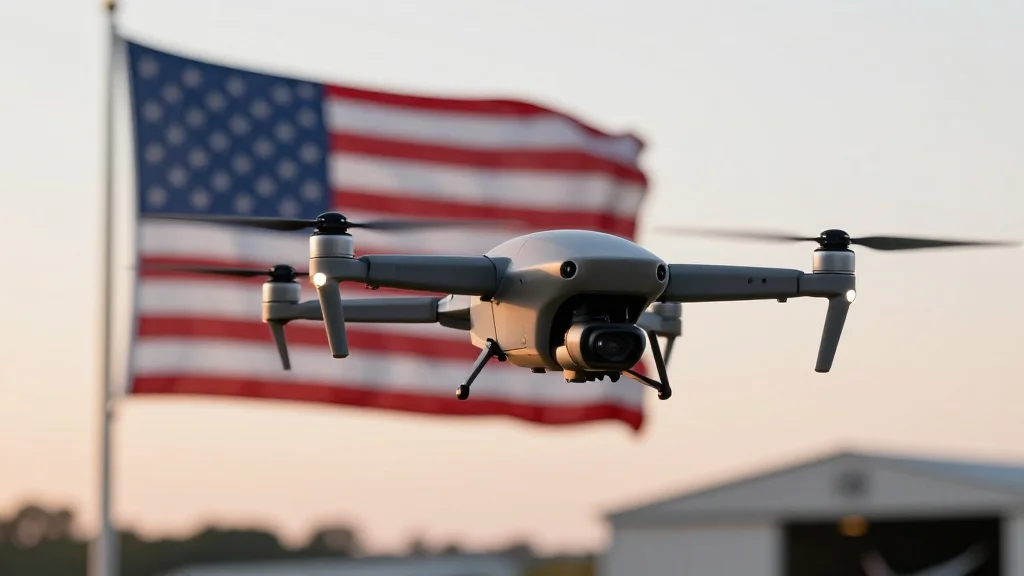
AeroVironment Stock Jumps Over 20% as Trump Admin Drone Funding Talks Ignite Market

Companies Mentioned
Why It Matters
The surge in AeroVironment’s stock highlights how policy signals can rapidly reshape investor expectations in the aerospace‑defense sector. By prioritizing domestic UAV production, the Trump administration is not only seeking to reduce reliance on foreign suppliers but also to accelerate the deployment of low‑cost, high‑volume drones that could redefine battlefield tactics. For the industry, this creates a competitive environment where firms with existing government contracts and scalable manufacturing capabilities, like AeroVironment, stand to capture a disproportionate share of future defense spend. Beyond the immediate market impact, the funding discussions signal a longer‑term strategic pivot toward integrated, AI‑enabled counter‑drone systems and advanced materials. Companies that can combine sensor‑rich platforms with next‑generation composites are likely to become essential partners in the Pentagon’s evolving procurement strategy, potentially reshaping the supply chain for both offensive and defensive UAV technologies.
Key Takeaways
- •AeroVironment shares closed up 18.3% at $214.39, a 23% weekly gain.
- •U.S. government approved a $20.2 million grant to expand AeroVironment’s Huntsville factory.
- •Air Force awarded a $20 million contract for ceramic‑matrix‑composite research.
- •Pentagon’s $1.1 billion Drone Dominance initiative targets 300,000 drones by 2027 at <$5,000 each.
- •Section 1709 of FY25 NDAA bans foreign‑made drones from U.S. defense contracts, boosting domestic makers.
Pulse Analysis
The recent rally in AeroVironment’s stock is less about a single contract and more about a confluence of policy, market psychology, and strategic positioning. Historically, defense procurement cycles have been slow and opaque, but the current administration’s explicit intent to fund drone manufacturers has injected a rare dose of certainty into an otherwise speculative market. This certainty is reflected in the rapid price appreciation across the sector, with firms like Unusual Machines and Red Cat seeing double‑digit gains on mere rumor.
AeroVironment’s advantage lies in its dual‑track approach: it is simultaneously scaling production capacity and investing in materials science that could lower unit costs and improve performance. The $20.2 million factory grant directly addresses the Pentagon’s demand for high‑volume, low‑cost UAVs, while the $20 million research contract positions the company at the forefront of next‑generation airframe technology. If the company can translate these investments into faster, cheaper drone deliveries, it will likely secure a larger slice of the projected $20.31 billion counter‑UAS market by 2030.
Looking ahead, the key risk remains the translation of policy intent into actual procurement awards. While the administration’s funding talks are encouraging, they are still in a discussion phase, and the Pentagon’s final allocation decisions could favor other niche players. AeroVironment’s ability to demonstrate rapid production ramp‑up and tangible performance gains from its composite research will be critical. Investors should monitor the timeline for the Huntsville expansion, the outcomes of the Air Force research milestones, and any formal announcements from the Office of Strategic Capital. In a landscape where defense dollars are increasingly tied to domestic supply chain resilience, AeroVironment is well‑positioned, but execution will determine whether the current hype translates into sustained earnings growth.
AeroVironment Stock Jumps Over 20% as Trump Admin Drone Funding Talks Ignite Market
Comments
Want to join the conversation?
Loading comments...