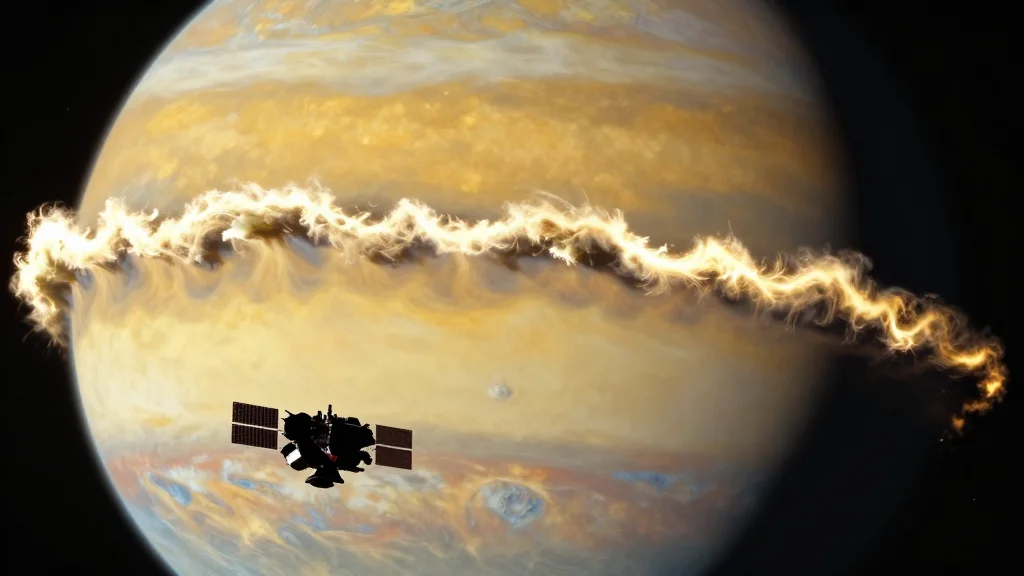
Akatsuki Probe’s Venus Cloud Wave Identified as Solar System’s Largest Hydraulic Jump

Why It Matters
The identification of a solar‑system‑scale hydraulic jump on Venus provides a concrete example of how atmospheric energy can be redistributed in thick, fast‑rotating envelopes. For aerospace engineers, the physics of such large‑scale fluid disruptions informs the design of entry, descent, and landing systems that must contend with abrupt pressure and temperature changes. Additionally, the finding enriches comparative planetology, offering a data point that can be extrapolated to the study of exoplanet atmospheres, many of which are expected to exhibit super‑rotation and dense cloud decks. From a market perspective, the result validates the scientific payloads of long‑duration orbiters, encouraging funding agencies and private investors to back missions that prioritize sustained atmospheric monitoring. The upcoming VERITAS and EnVision missions will likely attract additional contracts for instrumentation, data analysis, and modeling services, stimulating growth in the aerospace research sector.
Key Takeaways
- •Akatsuki captured a 3,700‑mile cloud wave on Venus in 2016.
- •University of Tokyo team identified the wave as a hydraulic jump, the largest in the solar system.
- •Hydraulic jump links lower‑cloud turbulence to a massive upper‑cloud updraft.
- •Finding revises models of Venusian super‑rotation and fluid dynamics.
- •Upcoming VERITAS and EnVision missions will probe similar phenomena with advanced instruments.
Pulse Analysis
The revelation of a planetary‑scale hydraulic jump on Venus underscores the value of persistent orbital observation. Akatsuki’s decade‑long dataset, originally intended to map surface topography and atmospheric composition, now serves as a cornerstone for fluid‑dynamics research under extreme conditions. Historically, hydraulic jumps have been confined to laboratory settings or Earth‑based river flows; extending the concept to a planetary atmosphere forces a re‑examination of how kinetic energy is dissipated in super‑rotating systems.
In the aerospace arena, the discovery could influence the design of future entry vehicles destined for Venus or similar worlds. Engineers must account for sudden vertical motions and pressure spikes that a hydraulic jump can generate, potentially revising heat‑shield specifications and control algorithms. Moreover, the result may catalyze interdisciplinary collaborations between planetary scientists and aerospace firms seeking to test high‑temperature, high‑pressure materials in analog environments.
Looking forward, the data from VERITAS and EnVision will likely refine the spatial and temporal resolution of such events, enabling predictive modeling. If hydraulic jumps prove to be a regular feature of Venusian weather, they could become a target for in‑situ measurements, perhaps even guiding the placement of atmospheric probes or drones. The broader implication is clear: understanding extreme atmospheric dynamics on our planetary neighbor not only satisfies scientific curiosity but also lays the groundwork for safer, more efficient exploration of hostile worlds.
Akatsuki Probe’s Venus Cloud Wave Identified as Solar System’s Largest Hydraulic Jump
Comments
Want to join the conversation?
Loading comments...