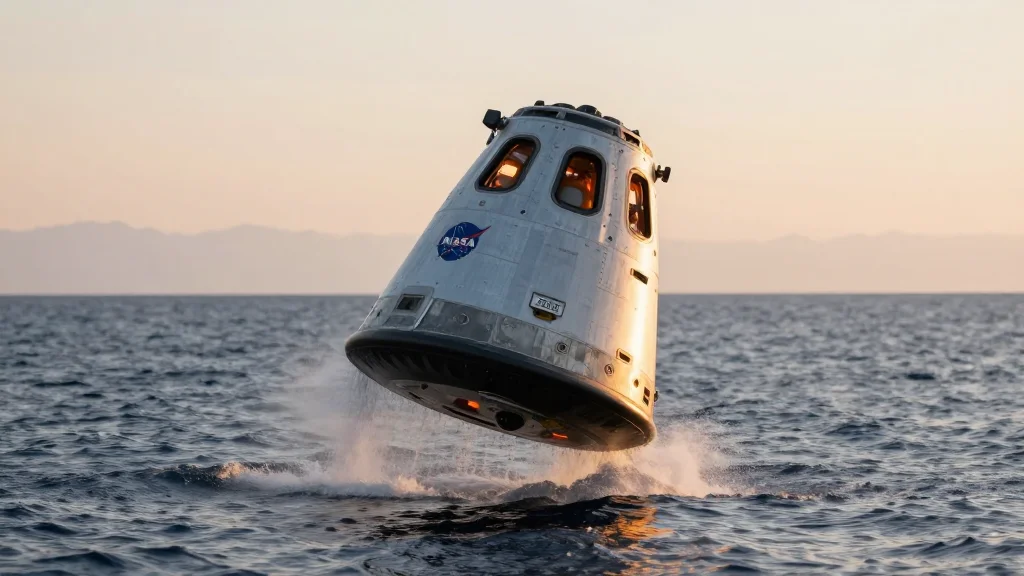
Artemis II to Splash Down Despite Heat‑shield Concerns, NASA Confident

Why It Matters
The Artemis II splashdown marks the first crewed lunar flyby since Apollo, proving that NASA can operate a crewed deep‑space vehicle with a partially compromised heat shield. Successful mitigation of the shield’s degradation demonstrates the agency’s ability to adapt flight profiles under tight schedules, a capability that will be essential for the more ambitious Artemis IV and eventual lunar‑surface missions. If NASA’s risk‑management approach holds, the Artemis program can maintain its timeline for a sustainable lunar presence, preserving billions of dollars of federal investment and supporting a growing commercial space ecosystem. Conversely, lingering doubts about the shield’s integrity could erode political and industry confidence, jeopardizing future funding and partnerships with private launch providers.
Key Takeaways
- •Artemis II crew scheduled to splash down Friday, April 10, near San Diego.
- •NASA altered re‑entry trajectory to a steeper angle to mitigate heat‑shield risk.
- •Dr. Danny Olivas labeled the shield “deviant,” while NASA officials expressed confidence.
- •Parachutes will deploy at 22,000 ft; recovery by USS John P. Murtha within two hours.
- •Heat‑shield concerns will inform design decisions for Artemis IV, targeted for 2028.
Pulse Analysis
NASA’s decision to fly Artemis II with a known heat‑shield anomaly reflects a calculated risk that balances program momentum against engineering certainty. Historically, NASA has postponed crewed flights when safety data were ambiguous—most notably after the Columbia disaster. In this case, the agency opted for a flight‑path tweak rather than a hardware redesign, a move that saves months of development but transfers risk to re‑entry dynamics. The success of this approach will be judged not only by the splashdown but by post‑flight data on thermal loads and structural integrity.
The broader commercial space market watches closely. Companies like SpaceX and Blue Origin are positioning themselves as partners for lunar logistics; any perceived safety lapse could shift contract allocations. Moreover, the heat‑shield debate underscores the importance of robust materials testing in the emerging era of rapid, reusable launch systems. If NASA can demonstrate that the Avcoat ablator can be reliably qualified under modified trajectories, it may set a precedent for future deep‑space vehicles that rely on software‑driven risk mitigation rather than costly hardware overhauls.
Looking ahead, Artemis IV will be the first mission to test the Lunar Gateway and a new lander, both of which depend on the Orion service module’s propulsion and thermal systems. The agency’s promise to fix the helium‑valve leak—though details remain sparse—signals an awareness that incremental fixes must compound into a fully reliable architecture before a crewed lunar landing. The outcome of Artemis II will therefore serve as both a technical validation and a political litmus test for the next phase of America’s return to the Moon.
Artemis II to splash down despite heat‑shield concerns, NASA confident
Comments
Want to join the conversation?
Loading comments...