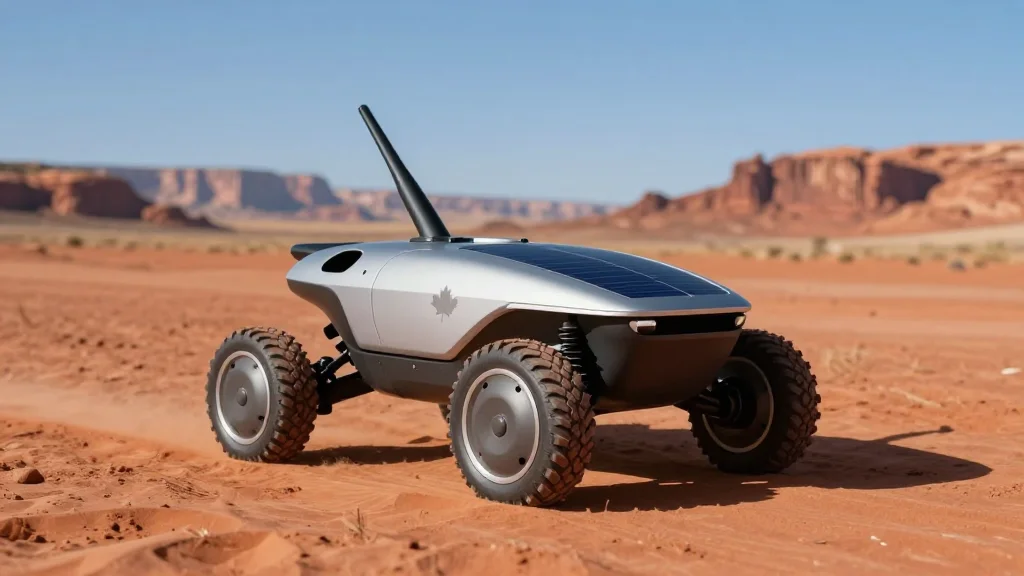
Canadian Student Teams Head to Utah for the University Rover Challenge
Why It Matters
The challenge accelerates hands‑on experience in planetary robotics, positioning Canadian students for future aerospace contracts and research collaborations. Success can boost university‑industry partnerships and showcase Canada’s emerging space‑tech talent.
Key Takeaways
- •Four Canadian teams selected as finalists for 2026 University Rover Challenge.
- •Carleton's rover "Eileen" features swerve drive and 3D‑printed TPU wheels.
- •Concordia's DEIMOS uses 6‑wheel triple‑rocker design with cycloidal arm.
- •Drones assist rover missions; Concordia's ARES provides 24 kg thrust for scouting.
- •38 teams from 18 nations vie for 500 points across missions.
Pulse Analysis
The University Rover Challenge (URC) has become a premier proving ground for next‑generation planetary robotics. Hosted at the Mars Society’s Desert Research Station, the 2026 edition draws 38 finalist teams from 18 nations, each vying for a perfect 500‑point score across four rigorous missions—science sampling, delivery, equipment servicing, and autonomous navigation. The competition’s scoring framework, which blends hardware performance with software autonomy, mirrors the operational demands NASA and commercial partners anticipate for future Mars surface operations, making URC a bellwether for emerging rover technologies.
Canada’s representation this year is notable for its breadth and interdisciplinary depth. Carleton’s rover "Eileen" leverages a four‑wheel swerve‑drive system and ultra‑flexible TPU wheels, while Concordia’s "DEIMOS" employs a six‑wheel triple‑rocker chassis and a cycloidal arm designed for precision manipulation. Both teams have integrated rotary‑wing drones—Concordia’s ARES delivering 24 kg of thrust—to extend communication range and support delivery tasks. The inclusion of students from engineering, biology, computer science, and even the humanities underscores a holistic approach to space robotics, fostering skill sets that extend beyond pure technical expertise.
The broader impact on Canada’s space ecosystem is significant. By competing on an international stage, these university teams generate real‑world data, validate novel designs, and cultivate talent that can transition into aerospace firms and research institutions. Success at URC can attract industry sponsorship, stimulate university‑industry collaborations, and reinforce Canada’s reputation as a hub for innovative space technology. As the global demand for autonomous planetary systems accelerates, the experience gained here positions Canadian graduates to lead future missions, from lunar habitats to Mars exploration initiatives.
Canadian student teams head to Utah for the University Rover Challenge
Comments
Want to join the conversation?
Loading comments...