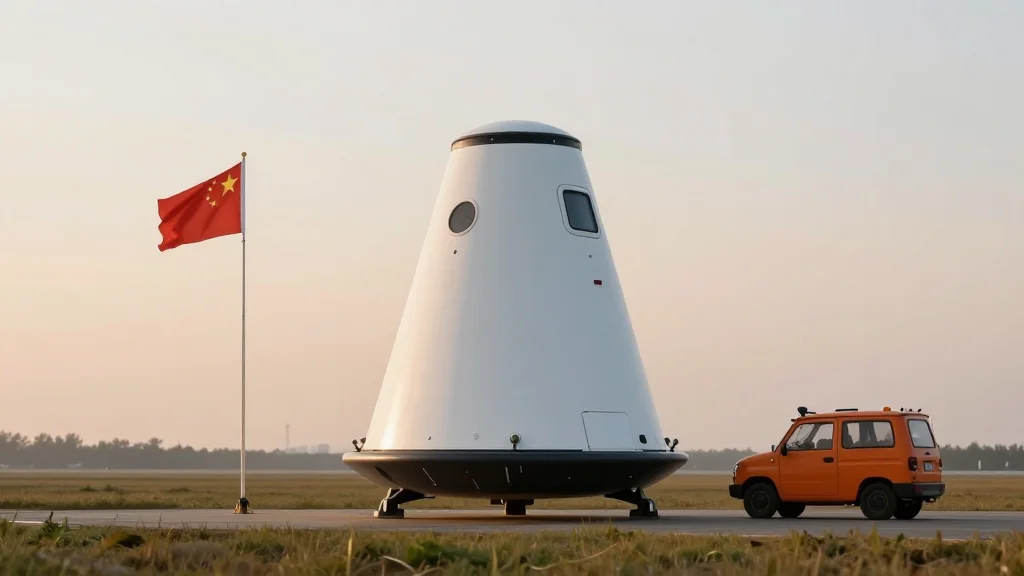
China’s Shenzhou-21 Crew Returns to Earth
Why It Matters
The episode proves China’s ability to sustain continuous station operations despite hardware failures, reinforcing its status as a long‑term space‑station operator and a strategic competitor to the ISS.
Key Takeaways
- •Shenzhou-21 crew landed in Shenzhou-22 after 210‑day mission.
- •Backup Shenzhou-22 launched 20 days after window crack discovery.
- •China’s rolling‑backup plan kept Tiangong crew safe without delay.
- •Commander Zhang Lu set Chinese record with seven total spacewalks.
- •Shenzhou-23 now docked, continuing six‑month crew rotation schedule.
Pulse Analysis
China’s latest crew rotation underscores how the nation has matured its human‑spaceflight program. The Shenzhou‑21 trio spent 210 days aboard Tiangong, completing three spacewalks and setting a new record for commander Zhang Lu’s cumulative EVA time. Their fast‑track docking—just three and a half hours after launch—mirrors the efficiency of the International Space Station’s crew exchanges, highlighting China’s growing operational parity with established space powers.
When a cracked viewport was discovered on the returning Shenzhou‑20, CMSA activated a rolling‑backup protocol that had a launch‑ready rocket and capsule on standby at Jiuquan. Within 20 days an uncrewed Shenzhou‑22 lifted off, delivered a protective cover for the damaged window, and later served as the return vehicle for the Shenzhou‑21 crew. This rapid response not only averted a potentially hazardous re‑entry but also demonstrated a level of redundancy and risk mitigation that rivals NASA’s contingency plans for the ISS.
Looking ahead, the freshly arrived Shenzhou‑23 crew continues the six‑month rotation rhythm that China has maintained since late 2022. By institutionalizing regular crew swaps and maintaining a ready‑to‑launch backup fleet, China signals its intent to keep Tiangong operational for decades, opening avenues for commercial payloads, international partnerships, and a broader geopolitical foothold in low‑Earth orbit. The successful handling of the Shenzhou‑20 anomaly reinforces confidence among potential collaborators and investors in China’s long‑term space infrastructure.
China’s Shenzhou-21 Crew Returns to Earth
Comments
Want to join the conversation?
Loading comments...