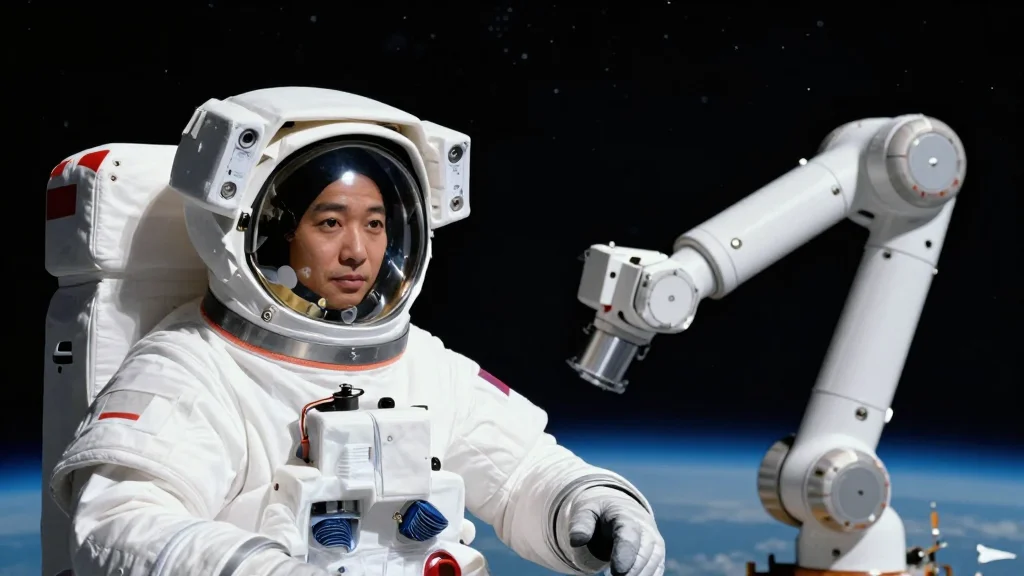
China’s Shenzhou‑21 Crew Completes Third 5.5‑Hour Spacewalk, Extending EVA Experience

Companies Mentioned

Why It Matters
The third EVA by Shenzhou‑21 marks a tangible step in China’s quest to become a leading human‑spaceflight nation. Each successful spacewalk builds confidence in the nation’s ability to conduct complex external operations, a prerequisite for assembling and maintaining large orbital habitats. By demonstrating sustained EVA capability, China strengthens its bargaining position in future international space collaborations and may attract commercial contracts for on‑orbit servicing, a market projected to exceed $10 billion by the end of the decade. Moreover, the EVA underscores the strategic competition among spacefaring powers. As the United States pushes Artemis and private firms scale crewed launches, China’s expanding EVA experience signals that it can support parallel ambitions, from lunar outposts to deep‑space habitats, potentially reshaping the balance of influence in low‑Earth orbit and beyond.
Key Takeaways
- •Shenzhou‑21 crew completed a third EVA lasting roughly 5.5 hours on April 16, 2026.
- •Astronauts Zhang Lu, Wu Fei and Zhang Hongzhang used the station’s robotic arm for assistance.
- •The EVA brings China’s cumulative EVA time to over 15 hours across three spacewalks.
- •Successful spacewalks bolster China’s credibility for future Tiangong expansion and lunar ambitions.
- •The achievement intensifies competition with NASA’s Artemis program and private crewed‑flight operators.
Pulse Analysis
China’s third EVA is more than a technical milestone; it is a strategic signal. Historically, sustained EVA capability has been a hallmark of mature space programs, from the Soviet Soyuz era to NASA’s Space Shuttle and ISS operations. By matching the duration of its longest single EVA, China demonstrates that its suit and life‑support technologies have reached a reliability threshold that supports longer, more complex missions.
The timing aligns with Beijing’s broader agenda to transition from a purely national program to a potential commercial and diplomatic player. As the Tiangong station nears full operational status, the ability to conduct routine maintenance and upgrades via EVA will be critical for attracting foreign research payloads and possibly joint missions. In the near term, the data harvested from Shenzhou‑21’s spacewalks will inform design refinements for next‑generation suits, reducing astronaut fatigue and increasing safety margins.
From a market perspective, the EVA achievement could open doors for Chinese firms to bid on emerging low‑Earth‑orbit services, such as satellite refueling, debris removal, and on‑orbit assembly—segments projected to command multi‑billion‑dollar contracts. If China can leverage its EVA expertise to offer cost‑effective solutions, it may erode the market share of established Western contractors. The next few months will reveal whether Beijing will commercialize these capabilities or keep them within a state‑driven framework, a decision that will shape the competitive dynamics of the global aerospace industry for years to come.
China’s Shenzhou‑21 Crew Completes Third 5.5‑Hour Spacewalk, Extending EVA Experience
Comments
Want to join the conversation?
Loading comments...