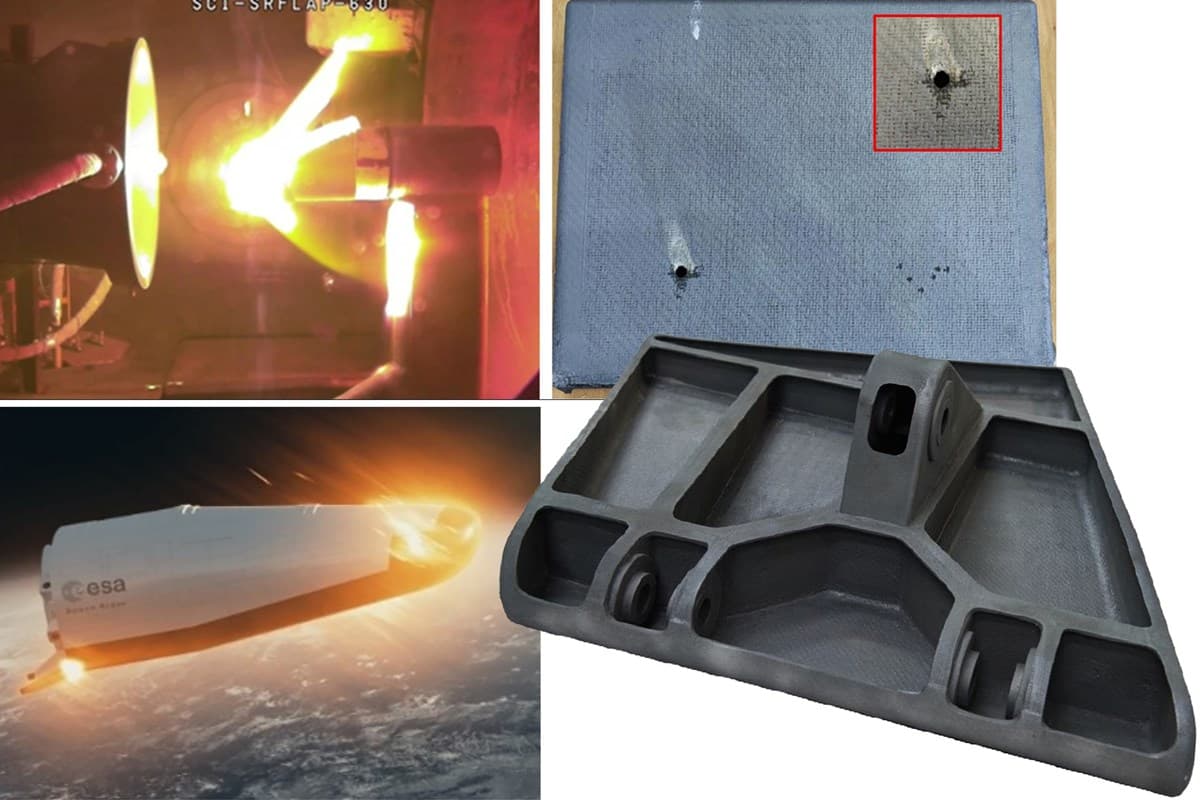
CMC Body Flap for Space Rider TPS Passes Plasma Test After Hypervelocity Impact
Companies Mentioned
Why It Matters
The results prove that CMC technology can survive micrometeoroid impacts and re‑entry heating, reducing refurbishment costs for reusable spacecraft and strengthening ESA’s roadmap for affordable, high‑frequency access to orbit.
Key Takeaways
- •ISiComp CMC flap survived 6.5 km/s impact, 1 cm hole unchanged
- •Plasma wind tunnel test held 1200 °C for over 600 seconds
- •Damage tolerance validates CMC for reusable Space Rider thermal protection
- •Test follows 2025 dynamic structural qualification of same flap design
- •Space Rider slated for Q1 2028 launch on Vega C
Pulse Analysis
The European Space Agency’s Space Rider is a pioneering reusable orbital vehicle designed to lower launch costs and increase mission cadence. Central to this ambition is a robust thermal protection system (TPS) capable of withstanding the extreme heat of atmospheric re‑entry while tolerating micrometeoroid and orbital debris (MMOD) impacts. Ceramic matrix composites (CMCs) like ISiComp, a carbon‑fiber‑reinforced carbon and silicon carbide material co‑developed by CIRA and Petroceramics, offer a unique blend of high‑temperature stability and structural resilience, making them ideal candidates for next‑generation TPS applications.
In a recent qualification campaign at CIRA’s Scirocco plasma wind tunnel, the ISiComp body flap assembly was first subjected to a hypervelocity impact test, where a 2.3 mm aluminum projectile struck the surface at 6.5 km/s, creating a 1 cm perforation. The same component was then exposed to a plasma flow replicating re‑entry conditions, reaching 1,200 °C for over 600 seconds. Despite the severe thermal load, the pre‑existing hole showed no growth, and lock‑in thermography confirmed the material’s integrity. This performance underscores the CMC’s inherent damage‑tolerance, a critical attribute for reusable vehicles that must endure multiple flight cycles without extensive refurbishment.
The successful demonstration has broader implications for ESA and the commercial space sector. By validating CMCs for both impact resistance and high‑temperature endurance, the Space Rider program reduces the need for heavy, expendable heat shields, directly translating to lower launch mass and cost. Moreover, the technology could be leveraged across other ESA projects and private ventures seeking durable, lightweight TPS solutions. As the industry pushes toward higher launch frequencies, materials that combine resilience with reusability will become a strategic differentiator, positioning Europe’s aerospace ecosystem at the forefront of sustainable space operations.
CMC body flap for Space Rider TPS passes plasma test after hypervelocity impact
Comments
Want to join the conversation?
Loading comments...