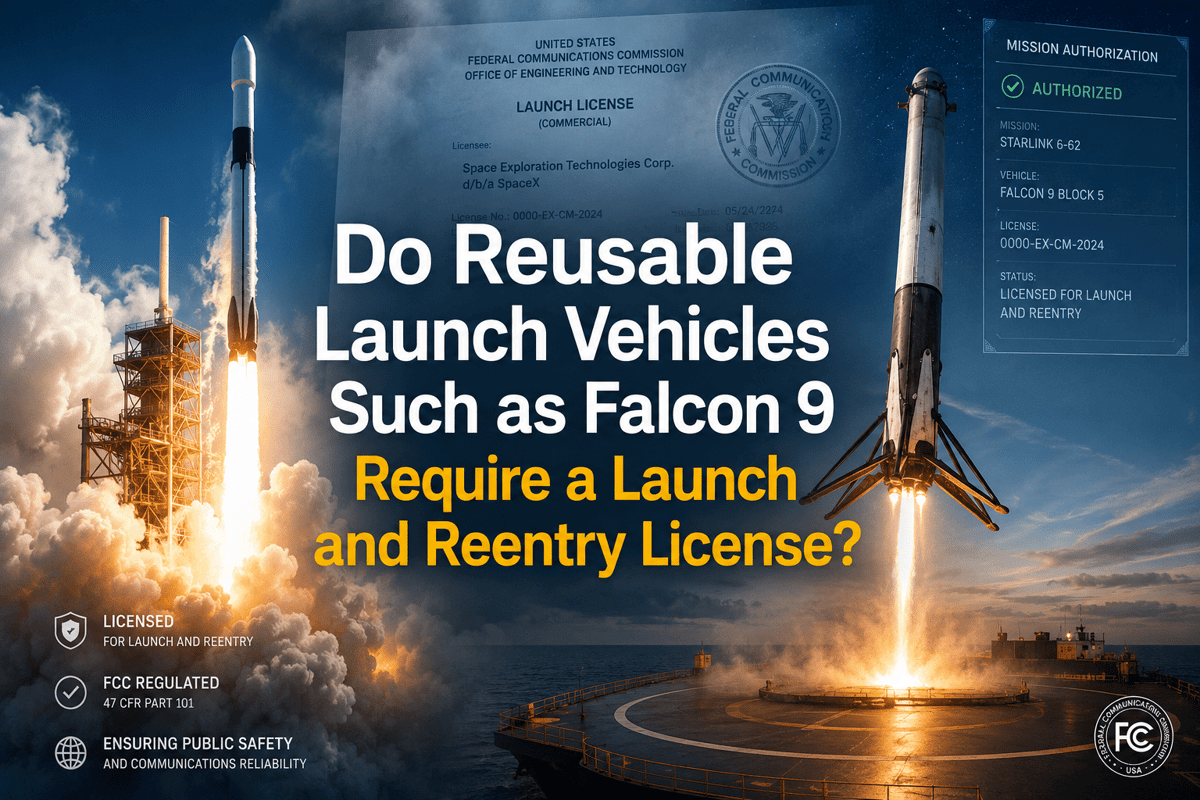
Do Reusable Launch Vehicles Such as Falcon 9 Require a Launch and Reentry License?
Why It Matters
This streamlined licensing reduces administrative overhead and accelerates flight cadence for commercial launch providers, while preserving safety oversight for high‑risk reentry operations.
Key Takeaways
- •Part 450 permits one license for multiple launch and reentry events
- •Booster landings can be included in the launch authorization scope
- •Reentry vehicles must have authorization, but not necessarily a separate license
- •License validity limited to five years, requiring periodic renewal
- •Scope changes trigger license modification or new FAA approval
Pulse Analysis
The Federal Aviation Administration’s shift to 14 CFR Part 450 marks a pivotal evolution in commercial space regulation. By consolidating launch and reentry requirements into a single performance‑based license, the agency aligns its oversight with the rapid‑turnaround model of reusable launch systems. This approach focuses on the actual risk profile of each operation—fueling, flight‑control, landing, and post‑flight safing—rather than mandating a new paperwork cycle for every flight phase. As a result, operators can present a comprehensive safety case once, and the FAA can evaluate it against a broader, yet clearly defined, operational envelope.
For reusable boosters, sub‑orbital vehicles, and orbital capsules, the practical impact is profound. A booster that returns to a droneship or landing pad can be covered under the original launch license if the landing and subsequent safing activities are described in the license scope. Sub‑orbital flights that reach apogee and descend are similarly authorized within a single vehicle operator license, provided the reentry trajectory and hazard zones are pre‑approved. Orbital spacecraft that reenter after days or weeks still need explicit reentry clearance, but that clearance can be embedded in the same Part 450 license rather than issued as a separate document, streamlining coordination among launch, payload, and reentry operators.
From a business perspective, the ability to reuse a license across multiple missions translates into faster scheduling, lower compliance costs, and greater predictability for customers. Companies can focus resources on vehicle refurbishment and mission planning instead of repetitive licensing filings. At the same time, the five‑year license term and mandatory scope reviews ensure that safety and environmental standards evolve with technology. This balance of regulatory efficiency and rigorous oversight is expected to accelerate the commercial space market’s shift toward high‑frequency, reusable launch services, reinforcing the United States’ leadership in the emerging space economy.
Do Reusable Launch Vehicles Such as Falcon 9 Require a Launch and Reentry License?
Comments
Want to join the conversation?
Loading comments...