A lunar satellite‑launch system could slash launch costs, accelerate AI compute capacity, and jump‑start a commercial lunar economy, reshaping the space‑tech industry.
Elon Musk’s latest ambition ties together two of his most publicized ventures: the AI startup xAI and SpaceX’s Starship. By positioning AI satellite production on the Moon, Musk envisions a paradigm shift where compute power is harvested in orbit, sidestepping Earth‑bound energy constraints and launch expenses. The plan leverages Starship’s projected ability to land 100‑metric‑ton payloads, delivering raw lunar materials and manufacturing equipment that could churn out thousands of AI‑optimized satellites each year. This vision aligns with Musk’s broader narrative of a self‑sustaining space infrastructure that fuels both commercial and scientific endeavors.
The technical backbone of the proposal is the electromagnetic mass driver, a rail‑gun‑like launcher first imagined by space visionary Gerard O’Neill in the 1970s. Modern prototypes, such as those developed by the Space Studies Institute and General Atomics, demonstrate that a kilometer‑scale driver could accelerate payloads to escape velocity using solar power, eliminating the need for chemical propellant. Recent Air Force‑funded studies highlight the system’s strategic value, noting its potential to deliver up to 600,000 tons of material annually to Earth‑Moon Lagrange points. Coupled with Starship’s reusable launch capability, the mass driver could become a cornerstone of a lunar‑based supply chain.
If realized, a lunar catapult network would have far‑reaching implications for the space economy and national security. Cheap, high‑bandwidth AI satellites could underpin next‑generation communications, Earth observation, and autonomous navigation services, while lunar resource extraction—silicon, titanium, aluminum, and water ice—could support in‑situ manufacturing and refueling stations. This would reduce dependence on Earth‑launched hardware, lower launch costs dramatically, and accelerate humanity’s progress toward a permanent off‑world presence. However, challenges remain, including regulatory frameworks, radiation protection for lunar workers, and the massive upfront investment required to build the infrastructure. Nonetheless, Musk’s proposal signals a decisive move toward commercializing the Moon as a launch platform and a hub for advanced space technologies.
By Leonard David · published 24 minutes ago
Last week, SpaceX founder Elon Musk advised workers at the newly acquired company xAI that he wants to set up a factory on the moon to build artificial‑intelligence (AI) satellites. He also called for a colossal catapult on the lunar surface to fling them into space.
“My estimate is that, within two to three years, the lowest‑cost way to generate AI compute will be in space,” Elon Musk wrote in a Feb. 2 update announcing SpaceX’s acquisition of xAI.
He reinforced that belief on Feb. 11 in an all‑hands meeting with xAI staff (video posted on X). Musk said that, while launching AI satellites from Earth is the immediate focus, SpaceX’s new Starship megarocket will also enable operations on other worlds.
“Thanks to advancements like in‑space propellant transfer,” Musk wrote, “Starship will be capable of landing massive amounts of cargo on the moon. Once there, it will be possible to establish a permanent presence for scientific and manufacturing pursuits.”
Factories on the moon could use lunar resources to manufacture satellites and launch them. Musk added:
“By using an electromagnetic mass driver and lunar manufacturing, it is possible to put 500 to 1 000 TW / year of AI satellites into deep space, meaningfully ascend the Kardashev scale and harness a non‑trivial percentage of the Sun’s power.”
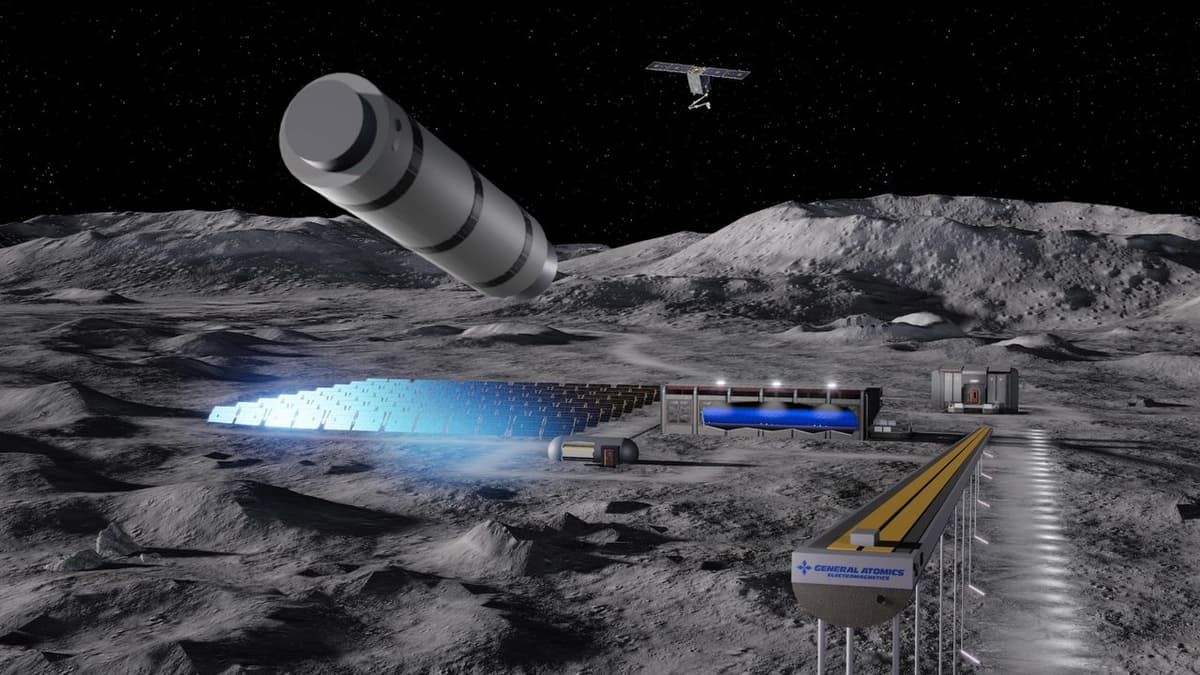
Image: painting of three large cylinders, a solar array and a long, railroad‑like structure on the moon (credit: Space Studies Institute).
Musk isn’t the first to propose lunar mass drivers—essentially railguns. Space visionary Gerard O’Neill floated the idea back in 1974, proposing an electromagnetic rail gun to lob payloads from the Moon.
“Mass drivers” based on a coil‑gun design can accelerate non‑magnetic objects. O’Neill suggested tossing baseball‑sized chunks of lunar ore into space, where the material could be used for building space colonies and solar‑power satellites.
O’Neill, along with MIT colleague Henry Kolm and student volunteers, built a prototype mass driver. Backed by the Space Studies Institute, later prototypes showed that a 520‑foot (160‑meter) driver could boost material off the lunar surface.
Kolm, O’Neil, and the student researchers later demonstrated a laboratory system they believed could scale to an operational lunar mass driver several kilometers long, capable of delivering 600 000 tons per year to an Earth‑Moon Lagrange point.
Robert Peterkin of General Atomics Electromagnetic Systems recently highlighted the promise of lunar‑based mass drivers. In a 2023 report to the Air Force Office of Scientific Research titled “Lunar Electromagnetic Launch for Resource Exploitation to Enhance National Security and Economic Growth,” he wrote:
“A modern electromagnetic launcher is a superior choice, because it can use abundant solar energy as a prime energy source instead of importing chemical rocket fuel from Earth.”
Peterkin urged the U.S. government to fund an evolution of the existing electromagnetic aircraft launch system (currently operating on the Navy’s Gerald R. Ford carrier) to achieve higher speed, lower mass, and reliable lunar launch.
Image: Space artist Pat Rawlings’ 1985 vision of a lunar catapult (credit: Lunar & Planetary Institute).
Peterkin noted that the first stage of a lunar ecosystem will rely on supplies from Earth, but a Starship capable of delivering 100 metric tons to the lunar surface would be a true enabler. He recommended that any future lunar base be selected to accommodate a reliable electromagnetic launch system.
The Moon is rich in silicon, titanium, aluminum, iron, and possibly water ice—resources that could support a lunar economy, resupplying, repairing, and refueling spacecraft in lunar orbit at lower cost than launching everything from Earth.
Image: Leonard David (author photo).
About the author
Leonard David – Space Insider Columnist
Leonard David is an award‑winning space journalist with more than 50 years of experience. He writes as Space.com’s Space Insider Columnist and has authored several books, including Moon Rush: The New Space Race (2019) and Mars: Our Future on the Red Planet (2016). He has contributed to SpaceNews, Scientific American, and Aerospace America, and received the first Ordway Award for Sustained Excellence in Spaceflight History (2015).
Comments
Want to join the conversation?
Loading comments...