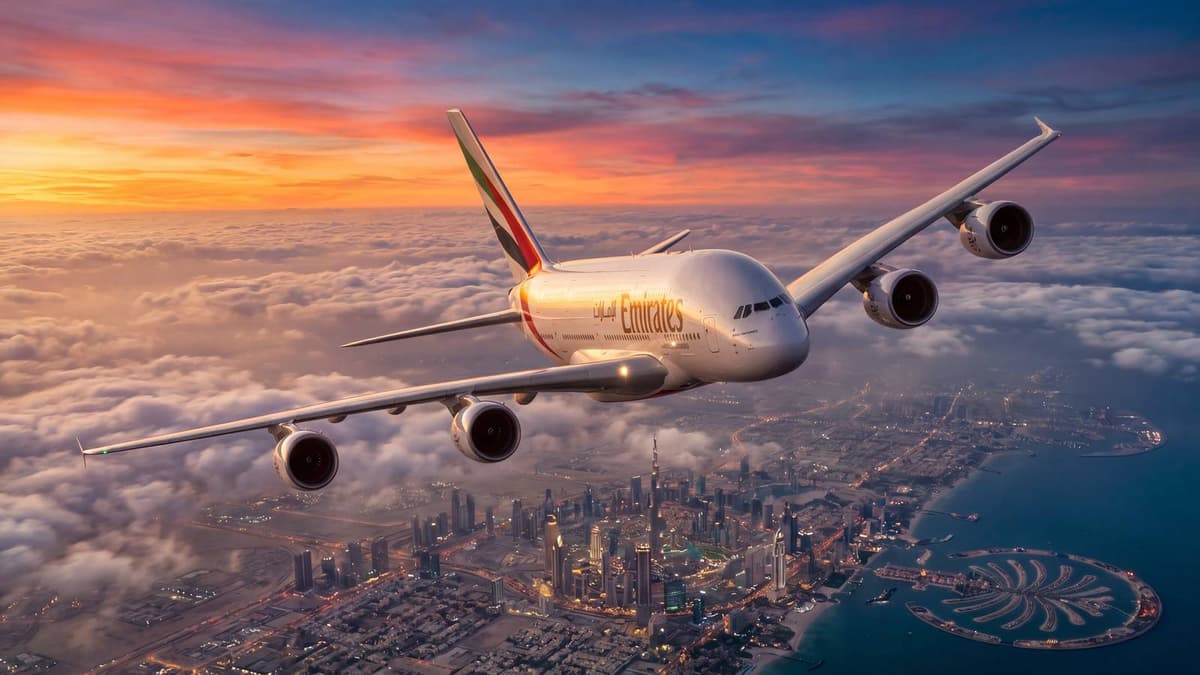
End Of An Era: Emirates' Final 12 Routes On Massive 615-Seat Airbus A380 Revealed
Companies Mentioned
Why It Matters
The re‑configuration boosts premium‑cabin revenue potential and aligns capacity with evolving leisure‑travel demand, while preserving A380 presence on key routes to maintain market share.
Key Takeaways
- •615‑seat A380s serve high‑volume leisure routes.
- •New 569‑seat layout adds business and premium economy seats.
- •Emirates will retire 615‑seaters on May 31, 2026.
- •Copenhagen retains A380 service, boosting daily seats by 20%.
- •Route changes reflect shifting demand for premium cabin space.
Pulse Analysis
Emirates’ decision to retire its 615‑seat A380s marks the end of an era for the airline’s most densely packed double‑deckers. Introduced to maximize seat count on high‑traffic, low‑premium routes, the configuration has allowed the carrier to dominate leisure corridors across Asia, the Middle East and Africa. By operating 15 A380 frames with 615 seats, Emirates could offer low fares while filling planes on routes such as Bali and Bangkok, where demand spikes during holiday seasons. The aircraft’s sheer capacity has also made it a flexible tool for special events, exemplified by its occasional use on short‑haul flights to Bahrain and Madinah.
The upcoming 569‑seat layout reflects a strategic pivot toward higher‑margin cabin classes. While the total seat count drops by roughly 46 seats, the new three‑class arrangement adds a full business class block and a dedicated premium‑economy cabin, catering to travelers willing to pay more for comfort. This shift is expected to improve yield per flight, especially on routes where premium demand is rising faster than economy volume. By balancing capacity with product differentiation, Emirates can better compete with rivals deploying newer, fuel‑efficient wide‑bodies that already emphasize premium cabins.
Operationally, the transition reshapes Emirates’ network dynamics. Copenhagen, for instance, will retain A380 service through June, then switch to the 569‑seat version, resulting in a 20% increase in daily seats when paired with an A350. Similar adjustments on other routes will allow the airline to fine‑tune frequency and capacity without sacrificing the brand cachet of the A380. Industry observers see this as a bellwether for legacy carriers: as demand for ultra‑low‑cost economy wanes, the emphasis moves toward premium products, even on the world’s largest passenger aircraft. Emirates’ re‑configuration thus signals a broader trend of maximizing revenue per seat rather than sheer seat count.
End Of An Era: Emirates' Final 12 Routes On Massive 615-Seat Airbus A380 Revealed
Comments
Want to join the conversation?
Loading comments...