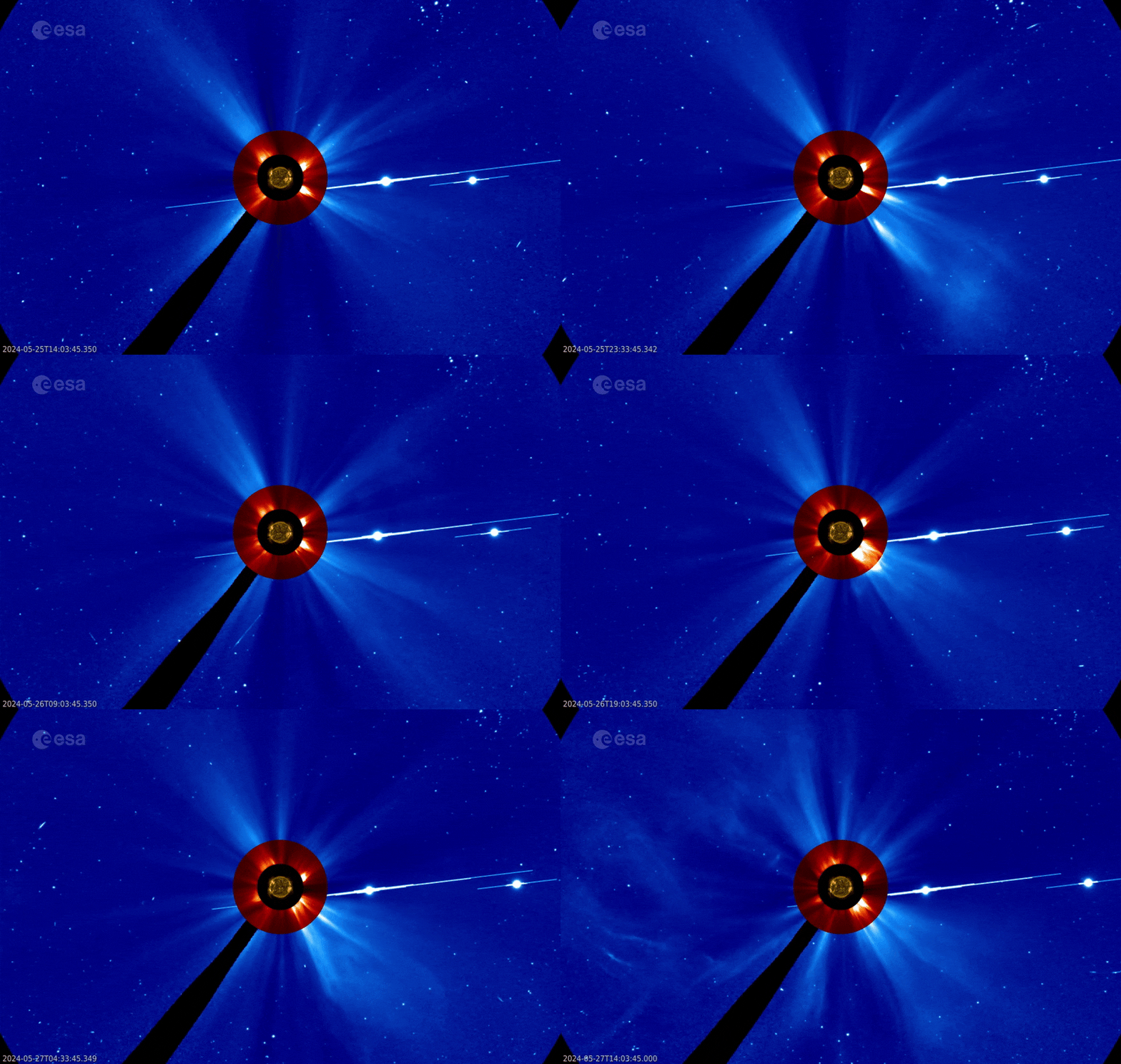
ESA’s Mars Orbiters Watch Solar Superstorm Hit the Red Planet
•March 5, 2026
0
Why It Matters
The observations provide critical data for space‑weather forecasting and inform design of resilient spacecraft and communication systems for Mars exploration.
Key Takeaways
- •Electron density rose 45% at 110 km, 278% at 130 km.
- •TGO recorded 200 Earth‑day radiation dose in 64 hours.
- •Radio occultation between orbiters enabled real‑time atmospheric profiling.
- •Storm induced computer errors, but radiation‑hard design ensured quick recovery.
- •Findings aid Mars atmospheric loss models and future mission communications.
Pulse Analysis
The May 2024 solar superstorm offered a rare natural experiment for planetary scientists. While Earth’s magnetic field softened the event’s impact, Mars—lacking a global magnetosphere—experienced a dramatic influx of energetic particles that flooded its upper atmosphere with electrons. This surge not only altered atmospheric chemistry but also amplified radiation levels to a magnitude normally accumulated over months, underscoring the vulnerability of unshielded planetary environments to extreme space weather.
ESA’s innovative use of orbiter‑to‑orbiter radio occultation transformed the event into a high‑resolution diagnostic tool. By transmitting a radio beam from Mars Express to the Trace Gas Orbiter as it slipped behind the horizon, researchers measured how the signal refracted through distinct atmospheric layers, extracting electron density profiles in near real‑time. Cross‑validation with NASA’s MAVEN data confirmed the unprecedented 45% and 278% electron spikes at 110 km and 130 km, respectively. This technique, long used for Earth‑based observations, is now proving its worth for interplanetary atmospheric science, promising more frequent and detailed monitoring of Martian weather.
The broader implications extend to both scientific inquiry and mission engineering. Accurate space‑weather models are essential for protecting satellites, crewed missions, and surface assets from radiation hazards. Moreover, heightened electron densities can degrade radar and communication signals, influencing the design of future orbiters, landers, and even crewed habitats. By linking solar storm dynamics to atmospheric escape processes, the study advances our grasp of why Mars lost most of its water and atmosphere, informing strategies to mitigate similar risks for upcoming exploration endeavors.
ESA’s Mars orbiters watch solar superstorm hit the Red Planet
0
Comments
Want to join the conversation?
Loading comments...