Aerospace News and Headlines
  • All Technology
  • AI
  • Autonomy
  • B2B Growth
  • Big Data
  • BioTech
  • ClimateTech
  • Consumer Tech
  • Crypto
  • Cybersecurity
  • DevOps
  • Digital Marketing
  • Ecommerce
  • EdTech
  • Enterprise
  • FinTech
  • GovTech
  • Hardware
  • HealthTech
  • HRTech
  • LegalTech
  • Nanotech
  • PropTech
  • Quantum
  • Robotics
  • SaaS
  • SpaceTech
AllNewsDealsSocialBlogsVideosPodcastsDigests

Aerospace Pulse

EMAIL DIGESTS

Daily

Every morning

Weekly

Sunday recap

NewsDealsSocialBlogsVideosPodcasts
AerospaceNewsExpanding 5G Connectivity with the Airbus UpNext SpaceRAN Demonstrator
Expanding 5G Connectivity with the Airbus UpNext SpaceRAN Demonstrator
AerospaceSpaceTech

Expanding 5G Connectivity with the Airbus UpNext SpaceRAN Demonstrator

•February 10, 2026
0
Airbus – Newsroom
Airbus – Newsroom•Feb 10, 2026

Companies Mentioned

Airbus

Airbus

OneWeb

OneWeb

MediaTek

MediaTek

2454

ESA

ESA

iDirect

iDirect

CesiumAstro

CesiumAstro

Radisys

Radisys

RSYS

Keysight

Keysight

KEYS

Why It Matters

By delivering true global 5G coverage and a sovereign, cost‑effective connectivity layer, the technology reshapes communications for commercial aviation, maritime, and defense sectors.

Key Takeaways

  • •Airbus demos software‑defined 5G satellite for lower latency
  • •Ground test simulates two‑satellite LEO constellation
  • •In‑orbit payload to launch 2027, test 2028
  • •Open, non‑proprietary standard aims for sovereign connectivity
  • •Collaboration spans telecom, aerospace, and defense firms

Pulse Analysis

The race to extend 5G beyond terrestrial towers is accelerating as operators seek to blanket the planet – including the sky and sea – with high‑speed, low‑latency service. Traditional cellular infrastructure cannot reach remote or airborne users, prompting a shift toward non‑terrestrial networks (NTN) that leverage low‑Earth‑orbit satellites. While existing satellite links provide coverage, they often act as simple repeaters, adding latency and limiting data rates. Integrating 5G protocols into satellite constellations promises to bridge this gap, but it requires sophisticated on‑board processing and flexible network management.

Airbus’s UpNext SpaceRAN demonstrator tackles those challenges by deploying a software‑defined satellite capable of decoding, processing, and regenerating 5G signals in space. This approach transforms the satellite from a passive relay into an active node, enabling real‑time beam steering, inter‑satellite routing, and dynamic handovers. The ground‑based simulation of a two‑satellite LEO constellation validates key functions such as seamless handover and beam management, while the planned 2027 in‑orbit test will demonstrate a fully operational 5G base station in space. By reducing reliance on ground stations, the system cuts operational costs and improves resilience against terrestrial outages.

Beyond the technical breakthrough, the project signals a strategic move toward an open, sovereign 5G NTN ecosystem. Airbus, together with partners like Eutelsat, Deutsche Telekom, and ST Engineering iDirect, is shaping a non‑proprietary standard that can be adopted by commercial airlines, maritime fleets, and defense users seeking secure, independent communications. This collaborative model lowers entry barriers, drives down the cost per gigabit, and positions Europe as a leader in next‑generation space‑based connectivity, potentially reshaping global telecom markets for years to come.

Expanding 5G connectivity with the Airbus UpNext SpaceRAN demonstrator

Satellite connectivity is essential for global communications, and Airbus is leveraging its experience in satellites to test the capabilities of a 5G non‑terrestrial network.

The need for 5G non‑terrestrial networks

There are two primary ways to send and receive digital communications. The oldest is through terrestrial networks (TN), which use ground‑based infrastructure like cellular towers or fibre‑optic cables. For locations that can’t be reached by cables – such as the skies – the only way to communicate is through satellites. Non‑terrestrial networks (NTN) thus rely on satellites to provide connectivity unbound by location and available everywhere: on land, at sea and in the sky.

5G, the fifth generation of cellular network technology, represents a significant leap forward from its predecessor, 4G. It was designed to enhance mobile broadband through extremely high data rates, enable massive machine‑type communications for a high number of connected devices, and provide ultra‑reliable and low‑latency communications for critical applications. Latency is the time delay between reception and response of a computing system.

As a cellular network, 5G primarily uses TNs to operate in populated areas, which consist of cellular towers connected by high‑speed fibre optic cables. However, to provide blanket 5G coverage everywhere on earth, a necessity for continuous connectivity in flight, 5G is being integrated into NTNs that use satellites as ‘floating’ cell towers.

The initial steps towards developing this NTN have already been taken: Airbus, Eutelsat, MediaTek, ITRI and ESA announced the successful trial of 5G NTN technology at the end of February 2025. The test used Eutelsat’s OneWeb LEO satellite constellation, built by Airbus. However, to optimise routing and reduce end‑to‑end latency, software‑defined capabilities are required.

Testing advanced software‑defined satellite technology

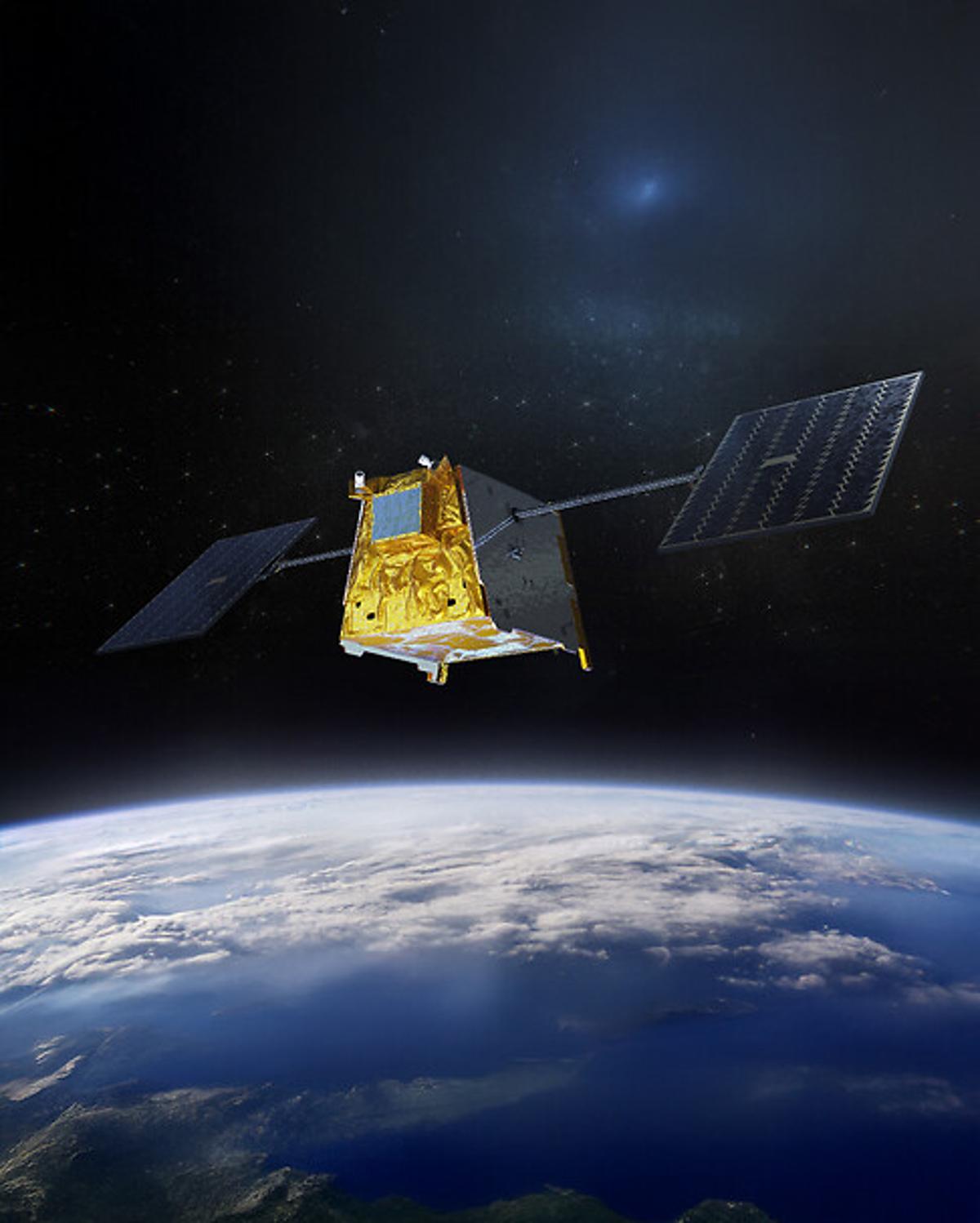
Enter the Airbus UpNext SpaceRAN demonstrator, which will use a software‑defined satellite to process signals that can be reprogrammed from the ground after launch. Software‑defined means that instead of simply acting as a signal repeater, the satellite actively processes the signal onboard: first it receives the signal and breaks it down, then it processes it, before regenerating the signal to be sent out again.

The ability for satellites to process and regenerate signals on‑board is a game‑changer. It reduces latency, increases data throughput and enables more efficient network management. By using inter‑satellite links to allow satellites to ‘speak’ to each other, the traffic can be routed directly and the number of ground stations needed and thus the overall cost of operations is reduced. A successful demonstration of a 5G NTN software‑defined satellite therefore has the potential to expand network coverage and resilience, improve service quality and enable new applications.

The Airbus UpNext SpaceRAN demonstrator will test the 5G connection on two different platforms. The first is a ground demonstration that will simulate a two‑satellite constellation in low‑Earth orbit (LEO), testing key features like beam and satellite handovers, which are crucial for maintaining smooth and continuous connection. The second is an in‑orbit demonstration that will place a 5G non‑terrestrial network payload on an Airbus LEO satellite, to act as a 5G base station in space. This phase is scheduled to launch in 2027, with in‑orbit testing scheduled for 2028.

A strategic and collaborative approach

In the coming years, aircraft operations will become increasingly connected and digitised as connectivity is firmly established. By actively developing and standardising 5G NTN capabilities, Airbus, together with some key 5G players, is leading the development of an open and non‑proprietary standard for satellite communications. This is key to ensuring connected Airbus products and platforms are linked to a secure, global and resilient connectivity solution that is not dependent on an external provider’s technology, ensuring long‑term autonomy and flexibility.

A non‑proprietary and sovereign connectivity solution is also essential to give countries autonomy over critical communications infrastructure. Developing this standard is a collaborative effort with many major industry players, including Aalyria, AccelerComm, CesiumAstro, Deutsche Telekom, Eutelsat, the Industrial Technology Research Institute (ITRI), Keysight Technologies, Onati, Radisys, Sener and ST Engineering iDirect. It goes beyond simply exploring new technology, with the ultimate goal of creating and maintaining an entire 5G NTN ecosystem, which would include managing satellites, ground segments, user terminals and launches.

It also positions Airbus to provide customers with a standardised and competitive alternative to existing proprietary solutions on the market. This is essential for customers who need their satellite systems to function as a communication layer within a comprehensive space and ground network. It will apply to both commercial and military customers, with the latter seeking sovereign, global and secure connectivity services. Standardisation will also reduce the cost per gigabit per second, increasing the accessibility of this technology.

Read Original Article
0

Comments

Want to join the conversation?

Loading comments...