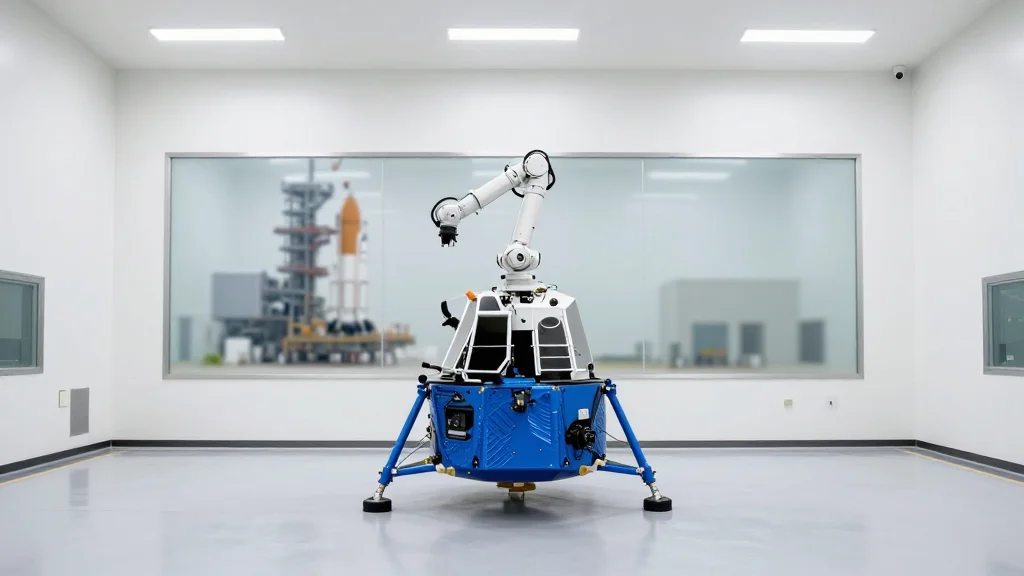
Firefly Aerospace Expands Texas Campus to Launch Multi‑Vehicle Production Line

Companies Mentioned
Why It Matters
Firefly’s expansion marks a rare instance of a private launch‑service provider building a dedicated, high‑throughput spacecraft assembly line in the United States. By moving from prototype‑scale to serial production, the company could lower unit costs for lunar landers and orbital transfer vehicles, making cislunar logistics more economically viable for both government and commercial customers. The Texas Space Commission’s grant underscores growing state-level support for the domestic space supply chain, potentially encouraging other regional players to invest in similar infrastructure. If Firefly can deliver multiple lunar missions per year, it would challenge the current reliance on a handful of legacy contractors for cislunar payload delivery. This could accelerate the development of a lunar economy, spur competition, and diversify the risk profile for NASA’s Artemis program and related commercial ventures.
Key Takeaways
- •Cedar Park campus expanded to 144,000 sq ft for spacecraft assembly and testing
- •New cleanroom is four times larger than Firefly’s previous facility
- •Texas Space Commission grant partially funds the expansion
- •Rocket Ranch launch‑vehicle integration footprint now totals 217,000 sq ft
- •Parallel production lines target Blue Ghost lunar lander and Elytra orbital transfer vehicle
Pulse Analysis
Firefly’s decision to double its spacecraft infrastructure reflects a broader industry shift toward mass‑production models that were once the exclusive domain of legacy aerospace giants. Historically, private launch firms have focused on building rockets on a per‑mission basis; moving to a high‑rate assembly line suggests Firefly is betting on a future where lunar and cislunar traffic becomes routine. This mirrors the automotive industry’s transition from hand‑built prototypes to assembly‑line manufacturing, a change that historically drives down costs and improves reliability.
The timing aligns with NASA’s Artemis program ramp‑up and the Pentagon’s renewed interest in rapid‑response launch capabilities. By offering a standardized, scalable platform, Firefly could become a go‑to supplier for both civilian and defense customers seeking quick turnaround for lunar payloads. However, the company faces steep challenges: maintaining quality across parallel lines, securing a steady stream of launch contracts, and competing with established players like SpaceX and Blue Origin that already operate high‑throughput facilities.
If Firefly can meet its production cadence goals, the ripple effects could be significant. Lower launch costs and increased cadence would enable more frequent scientific experiments, commercial telecommunications satellites, and even tourism ventures in cislunar space. Conversely, any bottleneck or quality issue could erode confidence in the nascent mass‑production model, reinforcing the status quo of bespoke spacecraft builds. The next 12‑18 months will be a critical proving ground for Firefly’s vision of a scaled‑up, vertically integrated space manufacturing ecosystem.
Firefly Aerospace Expands Texas Campus to Launch Multi‑Vehicle Production Line
Comments
Want to join the conversation?
Loading comments...