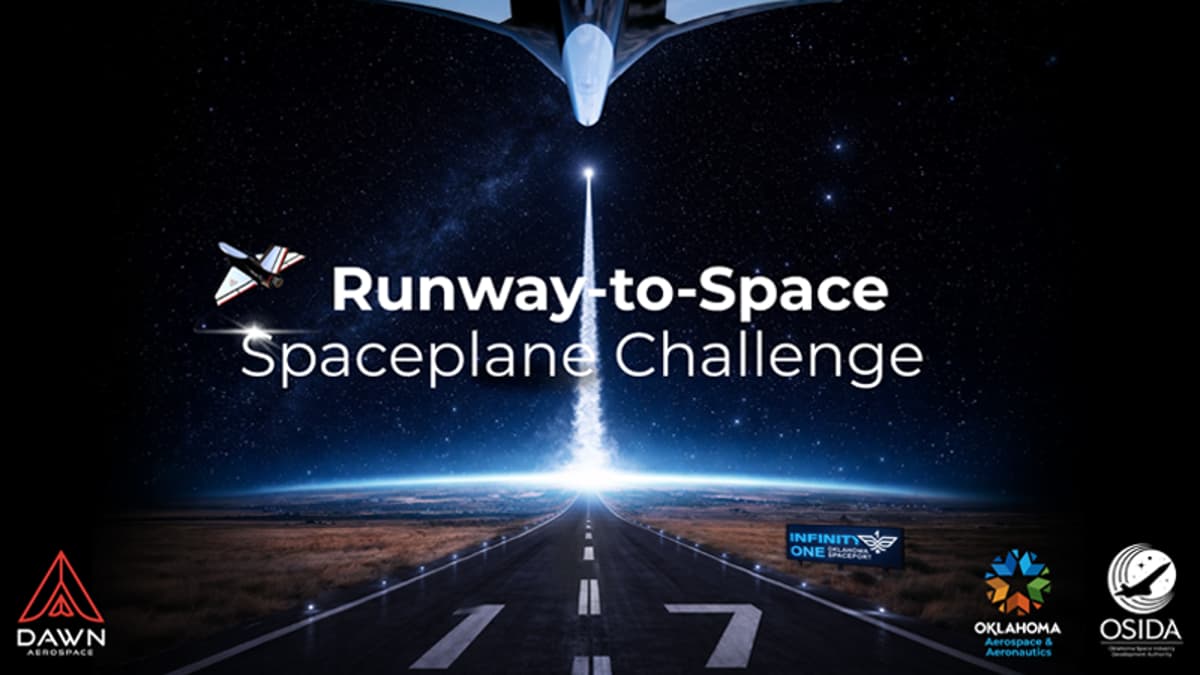
First U.S. ‘Runway-to-Space’ Challenge for Spaceplane Payload Test Flights, Flying From Infinity One Oklahoma Spaceport
Companies Mentioned
Why It Matters
The challenge delivers low‑cost, rapid‑turnaround microgravity access, accelerating U.S. research cycles and reinforcing America’s leadership in commercial space innovation.
Key Takeaways
- •Up to 25 Aurora flights offered for Oklahoma‑led research teams
- •Payload capacity limited to 15 kg, reaching 100 km altitude
- •Aurora turnaround measured in hours, enabling iterative experiments
- •$30 million spaceport upgrades support future commercial space operations
- •Applications close Sept. 25, 2026; flights start mid‑2027
Pulse Analysis
Runway‑to‑space concepts are reshaping how scientists reach the edge of space. Dawn Aerospace’s Aurora spaceplane combines aircraft‑style runway operations with suborbital performance, allowing multiple flights per day rather than the weeks‑long lead times of traditional rockets. This model reduces launch costs and opens the microgravity market to projects that previously could not justify an orbital mission, creating a new tier of affordable, repeatable access for academia and early‑stage startups.
For Oklahoma’s research community, the challenge offers a tangible pathway to test hardware, conduct fluid‑dynamics experiments, and validate materials under near‑space conditions without the logistical overhead of full‑scale launch providers. The 15‑kg payload limit and 127‑second microgravity window are sufficient for many proof‑of‑concept studies, while the rapid turnaround encourages iterative design cycles. By anchoring the program to a state‑funded spaceport, OSIDA ensures that local universities can retain talent and intellectual property, fostering a regional innovation ecosystem that could spin out commercial spin‑offs.
Beyond the immediate scientific benefits, the $30 million investment in Infinity One’s infrastructure signals Oklahoma’s ambition to become a hub for advanced aerospace operations. The upcoming automated detect‑and‑avoid system and dedicated Aurora complex will support not only the challenge but also future commercial air‑mobility and satellite launch services. As private spaceflight matures, runway‑to‑space platforms may bridge the gap between low‑earth orbit and atmospheric testing, positioning the United States to maintain a competitive edge in the global space economy.
First U.S. ‘Runway-to-Space’ Challenge for Spaceplane Payload Test Flights, Flying from Infinity One Oklahoma Spaceport
Comments
Want to join the conversation?
Loading comments...