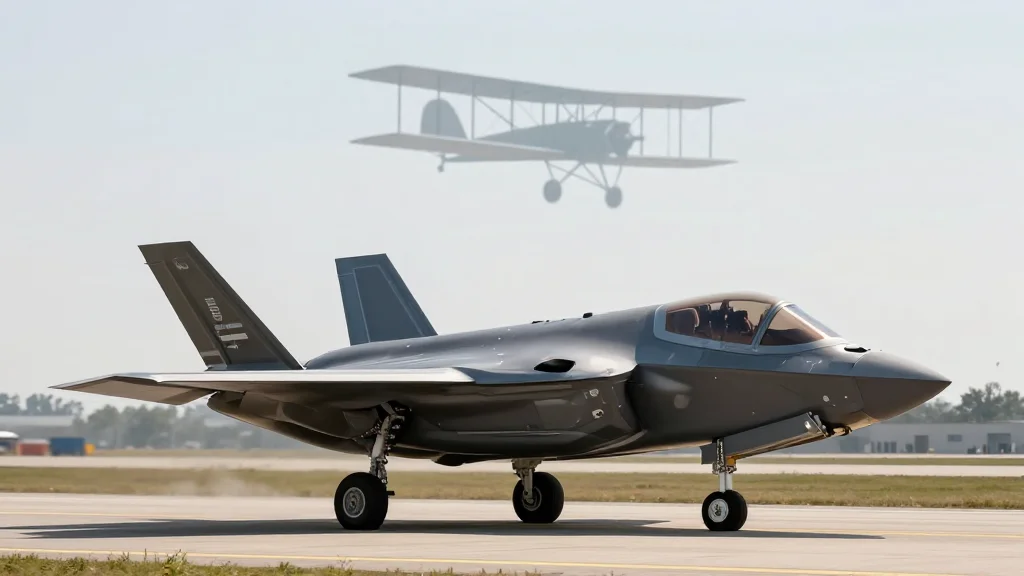
From Kitty Hawk to Space, America Showcases Milestones in Aviation Innovation
Why It Matters
U.S. aviation breakthroughs drive economic growth, national security and global competitiveness, while shaping the future of space exploration and high‑speed travel.
Key Takeaways
- •Wright brothers' 1903 flight launched U.S. aviation era
- •F-35 variants illustrate modern stealth, multirole performance
- •NASA's Mars rovers prove robotic vehicle capabilities beyond Earth
- •Federal funding exceeds $10 billion for advanced air‑space programs
- •Industry aims for hypersonic travel and reusable launch systems
Pulse Analysis
America’s aviation story is a testament to relentless innovation, beginning with the Wright brothers’ 12‑second, gasoline‑powered flight in 1903. That modest triumph sparked a century‑long trajectory of research, engineering and policy that now fuels a multi‑billion‑dollar aerospace sector. Today, the F‑35 Lightning II family epitomizes this evolution, integrating stealth, sensor fusion and network‑centric warfare into a single platform that serves the Air Force, Navy and Marine Corps. The aircraft’s global deployment underscores how legacy milestones translate into modern defense capabilities, reinforcing U.S. deterrence and allied interoperability.
Beyond the atmosphere, NASA’s Mars rovers extend the nation’s aerospace pedigree into interplanetary realms. These robotic explorers, built on decades of aeronautical expertise, demonstrate precision landing, autonomous navigation and scientific instrumentation that were unimaginable a generation ago. Their success not only advances planetary science but also drives spin‑off technologies—such as advanced robotics, AI and materials—that permeate commercial aviation and defense. The synergy between space exploration and terrestrial flight illustrates a feedback loop where breakthroughs in one domain accelerate progress in the other.
Federal commitment remains a cornerstone of this ecosystem, with annual appropriations surpassing $10 billion for research, development and procurement across air, sea and space platforms. This funding fuels ambitious programs like hypersonic weapons, electric propulsion and reusable launch vehicles, positioning the United States to maintain its strategic edge. As private firms join the effort, the collaborative landscape promises faster commercialization of high‑speed travel and more resilient supply chains, ensuring that the legacy of Kitty Hawk continues to shape the skies and beyond.
From Kitty Hawk to Space, America Showcases Milestones in Aviation Innovation
Comments
Want to join the conversation?
Loading comments...