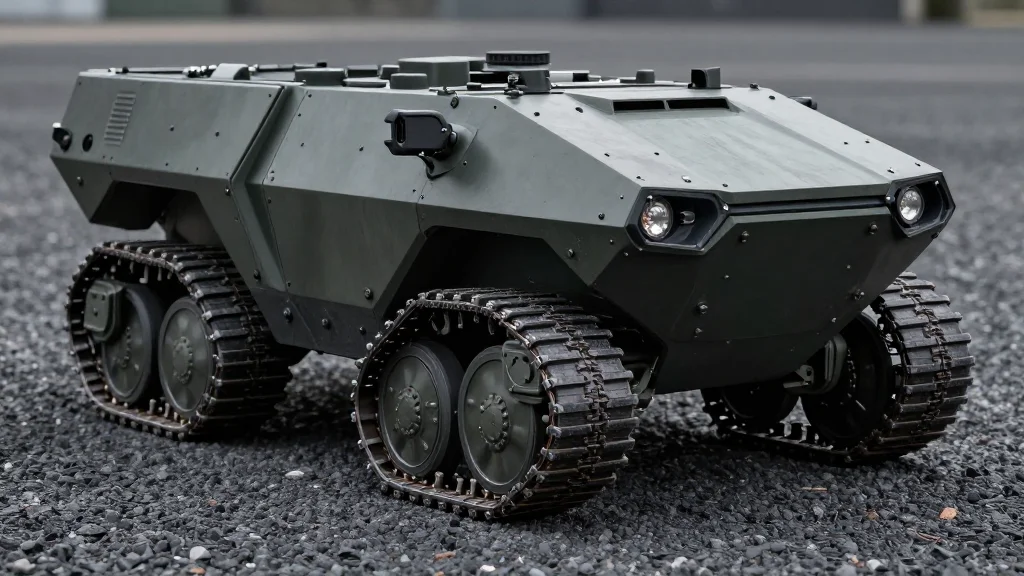
Hanwha Aerospace, Milrem Robotics Join Forces on Romanian UGV Program

Companies Mentioned
Why It Matters
The Hanwha‑Milrem partnership marks a rare convergence of Asian and European defense expertise, directly addressing NATO’s push for interoperable unmanned ground systems. By localising production in Romania, the deal not only strengthens the country’s defense industrial base but also creates a supply hub that could serve other Eastern European allies seeking rapid UGV deployment. The collaboration also demonstrates how defense firms are adapting to market volatility—using strategic joint ventures to diversify revenue streams amid fluctuating stock performance. Furthermore, the hybrid wheeled‑tracked architecture could set a new standard for modularity in UGV design, allowing armed forces to field a single platform family across diverse terrains. If the integrated system proves successful, it may accelerate the adoption of similar collaborative models, prompting other OEMs to pursue cross‑border technology transfers to meet NATO’s evolving operational requirements.
Key Takeaways
- •Hanwha Aerospace and Milrem Robotics signed a three‑way agreement at BSDA 2026 in Bucharest.
- •The partnership will integrate Milrem’s THeMIS tracked UGV into Hanwha’s Arion‑SMET and GRUNT wheeled platforms.
- •Hanwha Aerospace’s share price fell 6.89% as the KOSPI index dropped over 6% on the same day.
- •Both firms plan to establish local production in Romania within 12‑18 months, targeting NATO contracts.
- •Milrem’s THeMIS is among the first European UGVs to reach mass‑production status.
Pulse Analysis
The Hanwha‑Milrem deal illustrates a strategic pivot for defense manufacturers toward collaborative, cross‑regional development. Historically, South Korean defense firms have relied on domestic contracts and export deals with traditional allies. By partnering with an Estonian specialist, Hanwha is tapping into Europe’s growing demand for modular, terrain‑agnostic UGVs—a market segment that has been fragmented across multiple niche players. This joint venture not only mitigates the risk of over‑reliance on any single market but also positions Hanwha to benefit from Europe’s defense‑spending surge driven by heightened security concerns in the Black Sea region.
From a competitive standpoint, the hybrid approach—marrying wheeled agility with tracked robustness—could give the duo a distinct edge over pure‑track or pure‑wheel competitors. NATO’s recent doctrine emphasizes interoperability and rapid fielding, and a platform that can be reconfigured on‑the‑fly aligns with those priorities. If the Romanian production line proves efficient, it could become a template for other joint ventures, encouraging further technology transfer agreements that lower entry barriers for emerging defense markets.
However, the partnership also faces challenges. The timing coincides with a volatile equity market, as evidenced by Hanwha’s share slide and the broader KOSPI sell‑off. Investor sentiment may pressure the companies to deliver tangible milestones quickly. Moreover, integrating two distinct engineering cultures—Hanwha’s aerospace‑derived systems and Milrem’s robotics focus—requires rigorous testing and certification processes that could delay deployment. Success will hinge on the ability to harmonise supply chains, meet NATO certification timelines, and demonstrate operational superiority in field trials. Should these hurdles be cleared, the Hanwha‑Milrem alliance could reshape the European UGV market, prompting rivals to pursue similar cross‑border collaborations to stay competitive.
Hanwha Aerospace, Milrem Robotics Join Forces on Romanian UGV Program
Comments
Want to join the conversation?
Loading comments...