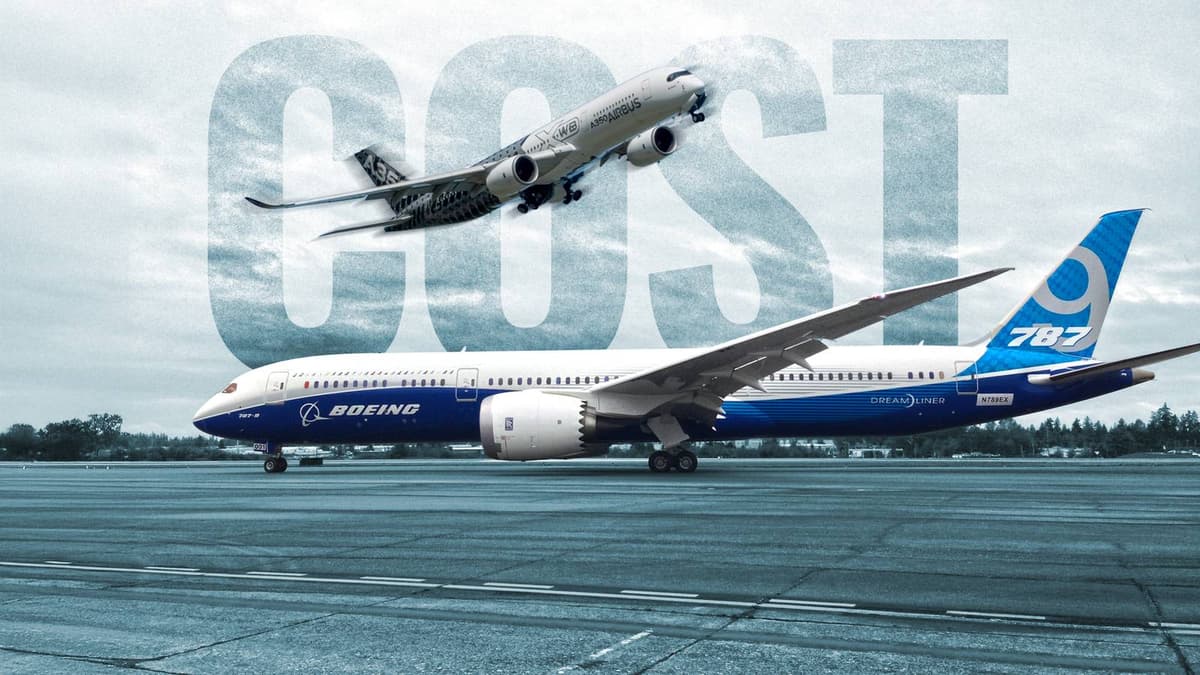
Here's How Much A Boeing 787 Costs Compared To An Airbus A350
Companies Mentioned

Why It Matters
Lower acquisition costs can accelerate fleet renewal, but higher per‑seat operating expenses can erode profitability on dense routes, making the cost trade‑off critical for airline economics.
Key Takeaways
- •787‑8 list price $248 million, cheapest Dreamliner variant.
- •A350‑900 list price $317 million, higher than 787‑8.
- •A350 per‑seat cost $22.81/hr, lower than most 787 variants.
- •787‑10 per‑seat cost $19.54/hr, beats A350 on efficiency.
- •Singapore Airlines cuts A350 costs via route optimization and premium pricing.
Pulse Analysis
Airlines evaluating next‑generation wide‑bodies face a classic price‑performance dilemma. The Boeing 787 series, with list prices ranging from $248 million for the 787‑8 to $338 million for the 787‑10, offers a clear upfront advantage over Airbus’s A350‑900 ($317 million) and A350‑1000 ($367 million). While manufacturers quote list prices, real‑world transactions often involve 30‑50 % discounts, especially for bulk orders, meaning the headline gap can narrow. Still, the Dreamliner’s lower capital outlay makes it attractive for carriers seeking rapid fleet expansion or replacement of aging narrow‑bodies without over‑leveraging balance sheets.
Beyond purchase price, per‑seat operating costs drive long‑term profitability. Airbus claims a $22.81 per seat‑hour figure for the A350, undercutting the 787‑8’s $30 and the 787‑9’s $25.86, thanks to aerodynamic refinements and newer engine efficiencies. The 787‑10, however, flips the script with $19.54 per seat‑hour, leveraging its higher capacity to spread fixed costs. Charter markets reflect this parity, with hourly rates hovering around $30,000‑$31,000 for both types, indicating that operators factor fuel, crew, and maintenance similarly when leasing these jets.
Strategically, the cost calculus influences route planning and fleet commonality. Singapore Airlines, the world’s largest A350 operator, extracts value by deploying the aircraft on high‑yield, ultra‑long‑haul sectors and capitalizing on premium cabin revenue, while standardizing training and spares across its fleet. As Boeing prepares the 777X to enter service, airlines will reassess the 787‑10’s niche versus the 777‑300ER’s capacity and range. Ultimately, the decision hinges on whether carriers prioritize lower upfront spend, per‑seat efficiency, or the flexibility to serve diverse market segments in a post‑pandemic, sustainability‑driven environment.
Here's How Much A Boeing 787 Costs Compared To An Airbus A350
Comments
Want to join the conversation?
Loading comments...