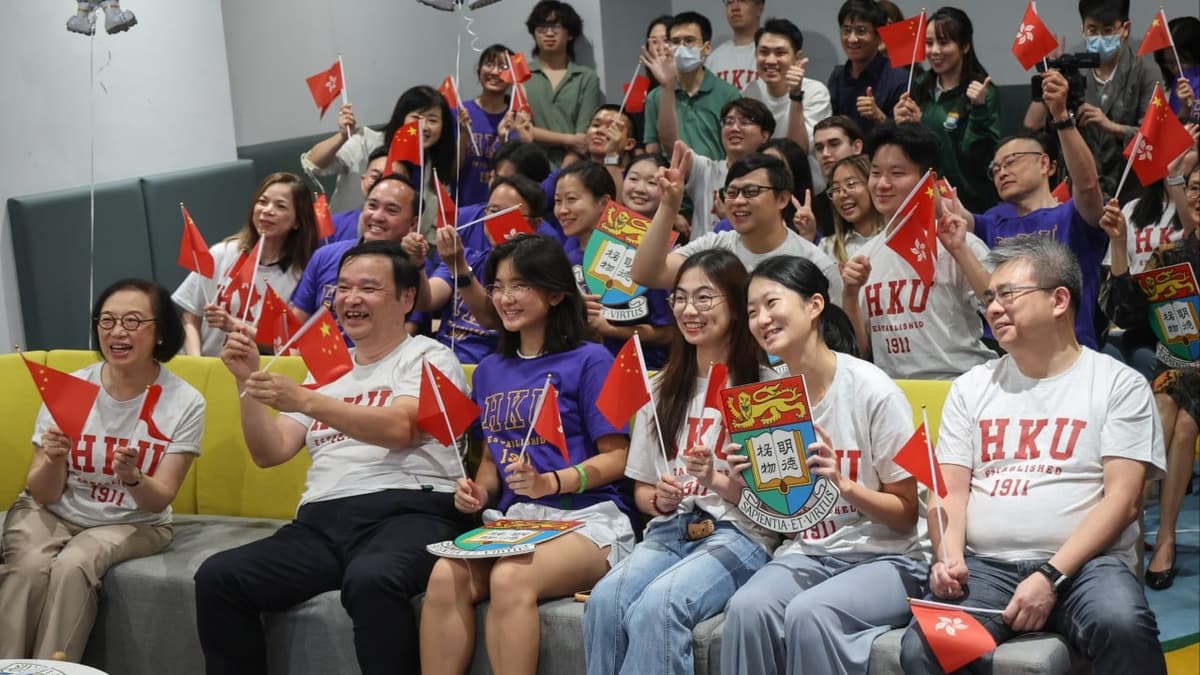
Hong Kong’s First Astronaut Success Is Also a Story of Youth Potential
Why It Matters
The flight proves Hong Kong can deliver high‑tech space capabilities, strengthening its role in China’s strategic aerospace agenda and signaling a growing pipeline of skilled talent for the region’s innovation economy.
Key Takeaways
- •Dr Lai Ka‑Ying is Hong Kong’s first astronaut, payload specialist.
- •HKUST’s Musico observatory will monitor greenhouse‑gas emissions from Tiangong.
- •HK government pledged US$63.8 million for AI integration in schools.
- •New aerospace programmes launched at CUHK and HKU to train future talent.
- •Mission aligns with China’s 15th Five‑Year Plan for tech self‑reliance.
Pulse Analysis
The launch of Shenzhou‑23 marked a historic milestone for Hong Kong when Dr Lai Ka‑Ying boarded the Tiangong space station as the city’s first astronaut and the fourth female astronaut from China. Trained as a payload specialist, she will operate the Multi‑Spectral Imaging Carbon Observatory (Musico) built by the Hong Kong University of Science and Technology, a sensor designed to quantify greenhouse‑gas concentrations from orbit. The mission showcases how Hong Kong’s research institutions can translate laboratory expertise into operational assets for a national space programme, reinforcing the city’s emerging reputation as a niche contributor to high‑profile scientific endeavors.
Beyond the flight, the achievement dovetails with a wave of policy initiatives aimed at cultivating a home‑grown talent pipeline. In 2024, the Chinese University of Hong Kong introduced a double‑major in Aerospace Science and Earth Informatics, while HKU launched the Institute for Astronomy and Astrophysics to foster international collaboration. The Hong Kong government has earmarked roughly US$63.8 million to embed artificial‑intelligence tools across classrooms, a key component of the “AI + Education” action plan that aligns with China’s 15th Five‑Year Plan for technological self‑reliance. These investments signal a coordinated effort to embed cutting‑edge science into curricula and research labs.
From a business perspective, the convergence of space research, AI‑driven education, and government funding creates new market opportunities for startups and established firms alike. Companies that can supply satellite payload components, data‑analytics platforms for emissions monitoring, or AI‑enhanced learning solutions stand to benefit from a growing ecosystem that the Hong Kong authorities are actively nurturing. As more students engage in science fairs and university programmes, the talent pool will expand, potentially feeding a regional hub for aerospace innovation that complements mainland China’s broader ambitions. Dr Lai’s flight therefore serves as both a symbolic and practical catalyst for future economic diversification.
Hong Kong’s first astronaut success is also a story of youth potential
Comments
Want to join the conversation?
Loading comments...