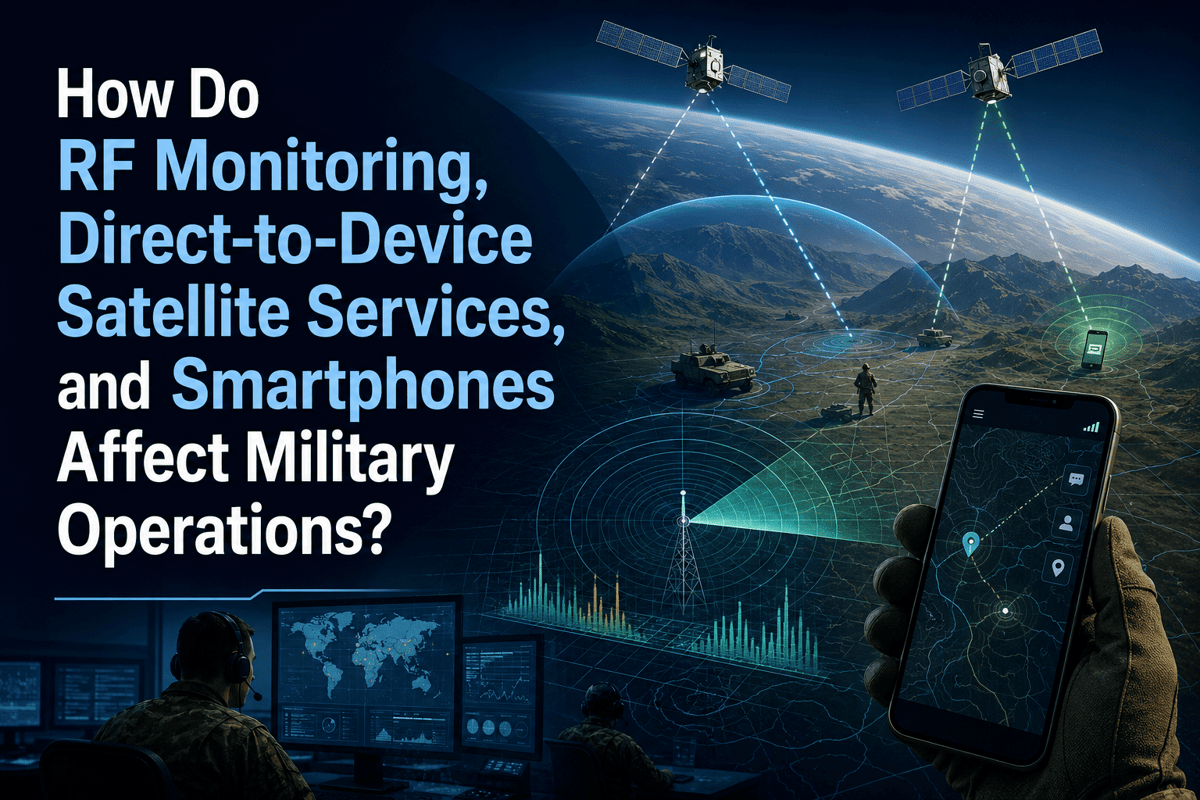
How Do RF Monitoring, Direct-to-Device Satellite Services, and Smartphones Affect Military Operations?
Why It Matters
They give commanders near‑real‑time insight into hidden threats and enable resilient communications, but also force forces to manage the security trade‑offs of using consumer‑grade devices in contested environments.
Key Takeaways
- •HawkEye 360 and Unseenlabs sell space‑based RF emitter geolocation data
- •D2D services let standard smartphones connect directly to satellites for fallback messaging
- •RF monitoring reveals hidden vessels and radars missed by optical or AIS data
- •Military adoption requires new policies to mitigate handset metadata exposure
Pulse Analysis
Space‑based RF monitoring has moved from a classified intelligence niche to a commercial data service, driven by companies like HawkEye 360 and Unseenlabs. By detecting, geolocating and characterizing emissions from radars, transponders, and even low‑power handheld radios, these satellites provide a layer of geospatial intelligence that complements traditional optical and SAR imagery. The ability to spot a radar pulse before a platform becomes visible, or to identify a dark vessel that has turned off AIS, gives planners a proactive edge in maritime security, border surveillance and battlefield planning. This emerging market also reduces reliance on costly, classified satellite constellations, allowing defense agencies to purchase data on demand and fuse it with existing sensor feeds.
Direct‑to‑device (D2D) satellite services further reshape military communications by eliminating the need for bulky terminals. Services from T‑Mobile, AST SpaceMobile and Lynk enable ordinary smartphones to send text or limited‑bandwidth data directly to orbiting satellites when terrestrial networks fail. For dispersed units, disaster‑response teams, or coalition partners lacking dedicated SATCOM gear, D2D offers a resilient, low‑cost fallback channel that aligns with the Joint All‑Domain Command and Control (JADC2) vision of seamless data flow across domains. However, consumer‑grade links lack the encryption, anti‑jamming and traffic‑management controls of military‑grade systems, so they are best suited for welfare, emergency alerts or low‑sensitivity traffic.
The operational upside comes with new OPSEC challenges. Every handset that connects to a satellite emits metadata—registration events, signal strength, timing and location—that adversaries can exploit. Integrating RF data with SAR, optical imagery, AIS and historical patterns creates a richer picture, but analysts must guard against over‑interpreting ambiguous signals. The DoD’s Commercial Space Integration Strategy now emphasizes clear rules for collection, retention and sharing of commercial RF products, ensuring legal compliance while leveraging the speed and persistence of private constellations. As commercial D2D coverage expands and RF monitoring becomes more granular, militaries will need disciplined training, hardened device policies and interoperable standards to reap the benefits without compromising operational security.
How Do RF Monitoring, Direct-to-Device Satellite Services, and Smartphones Affect Military Operations?
Comments
Want to join the conversation?
Loading comments...