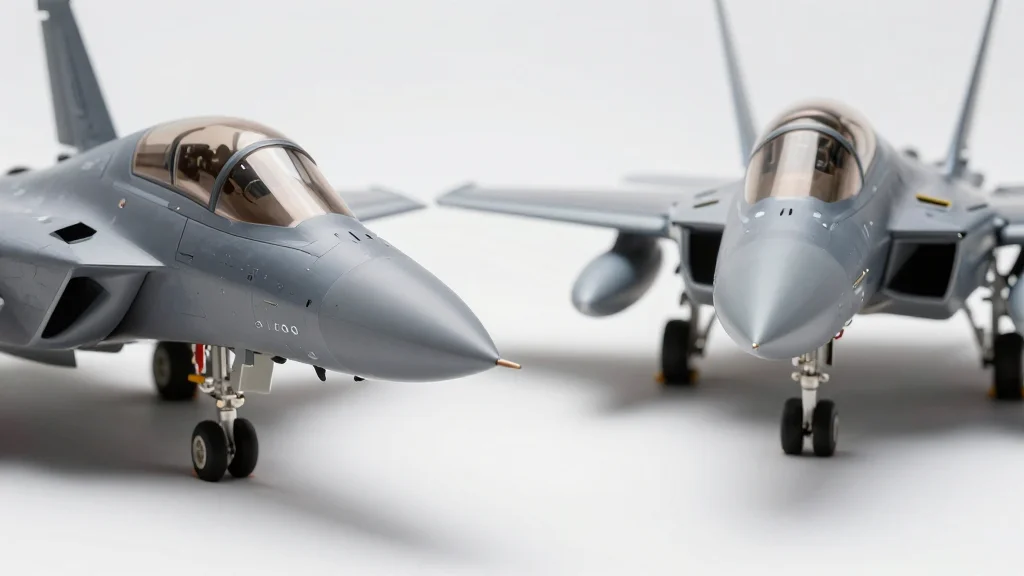
How The Boeing F-15EX Eagle II Stacks Up Against The Eurofighter Typhoon
Companies Mentioned

Why It Matters
Understanding the performance gap and deployment scale of the F‑15EX and Typhoon informs defense budgeting and alliance planning as the U.S. and Europe confront high‑end threats in Europe and the Indo‑Pacific.
Key Takeaways
- •F‑15EX carries up to 29,500 lb payload, outmatching Typhoon’s 19,842 lb.
- •F‑15EX’s AN/APG‑82(V)1 AESA radar offers longer‑range detection than Typhoon’s Captor‑E.
- •F‑15 family has over 100 aerial kills; Typhoon has none confirmed.
- •Europe operates ~610 Typhoons; USAF fields 400‑450 F‑15s, EX entering service.
- •Continuous upgrades keep both fighters viable through the 2030s.
Pulse Analysis
The legacy of Cold‑War competition still shapes today’s air superiority fleets. The United States built the F‑15 line to dominate Soviet fighters, evolving into the F‑15EX with advanced avionics and a massive payload capacity. Europe’s response, the Typhoon, emerged from a multinational effort to replace aging aircraft and emphasizes agility and multirole flexibility. Continuous block upgrades—such as the F‑15EX’s AN/APG‑82(V)1 radar and the Typhoon’s Captor‑E—ensure each platform can meet modern sensor‑dense battlefields while integrating NATO‑standard weapons.
From a technical standpoint, the F‑15EX’s larger airframe accommodates a heavier radar array and up to 29,500 lb of ordnance, enabling deep‑strike missions and robust air‑to‑air loadouts. The Typhoon, limited to roughly 19,842 lb, excels in high‑G maneuverability and rapid target engagement, supported by a swiveling AESA radar that maintains situational awareness during aggressive turns. These differences translate into distinct mission profiles: the F‑15EX serves as a long‑range penetrator and escort for high‑value assets, whereas the Typhoon is optimized for air‑superiority patrols and precision strike in contested European airspace.
Strategically, fleet size and deployment patterns underscore each aircraft’s role in allied defense. Europe fields about 610 Typhoons, scrambling them regularly to counter Russian incursions, while the U.S. maintains 400‑450 F‑15s, with the EX variant rotating through forward bases like Kadena to reassure Indo‑Pacific partners. Ongoing modernization programs suggest both jets will remain operational into the 2030s, influencing procurement decisions, joint training exercises, and the balance of power across two critical theaters.
How The Boeing F-15EX Eagle II Stacks Up Against The Eurofighter Typhoon
Comments
Want to join the conversation?
Loading comments...