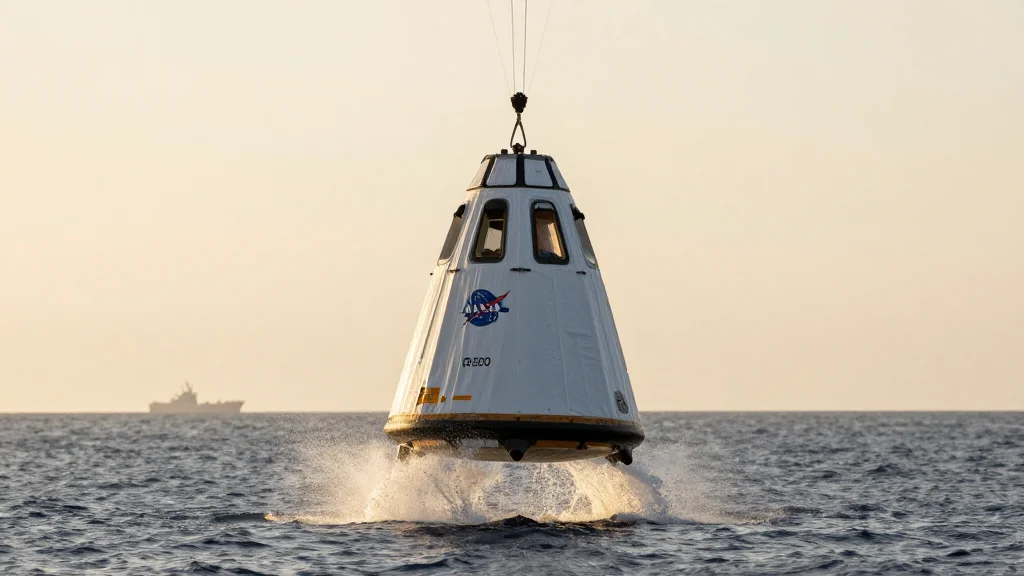
How to Watch the Artemis 2 Splashdown
Companies Mentioned
Why It Matters
Artemis 2 demonstrates the United States’ ability to return a crewed spacecraft from beyond Earth orbit, validating systems for the upcoming lunar landing pipeline and revitalizing public interest in deep‑space exploration.
Key Takeaways
- •Artemis 2 will splash down near San Diego at 8:07 p.m. EDT
- •Crew completed a lunar flyby, passing 4,067 miles from the Moon
- •Live streaming available on NASA+ and major platforms like Amazon Prime
- •Final correction burn precedes service module separation before re‑entry
- •Artemis 3 lunar‑lander demo slated for next year, Artemis 4 landing 2028
Pulse Analysis
The Artemis 2 mission marks the first crewed return from a deep‑space trajectory since Apollo, reaching speeds of 23,864 mph as Orion loops around the Moon and heads back to Earth. By relying on a single translunar injection burn and minimal correction maneuvers, NASA showcases a streamlined flight profile that reduces propellant consumption and operational complexity. This efficiency not only cuts costs but also builds confidence in the Orion spacecraft’s thermal protection and parachute systems—critical components for the upcoming Artemis 3 lunar‑lander docking and future surface missions.
Public engagement has surged, with the splashdown becoming a multi‑platform event. NASA’s decision to stream on its YouTube channel and partner with services such as NASA+, Amazon Prime, Apple TV, Netflix, HBO Max, Discovery+, Peacock and Roku reflects a broader trend of democratizing access to space milestones. The wide distribution amplifies viewership, attracts younger audiences, and offers advertisers a premium real‑time audience, potentially unlocking new sponsorship models for government‑run missions.
Looking ahead, Artemis 2 serves as a stepping stone toward a sustainable lunar presence. Artemis 3 will test a lunar‑lander docking in 2027, while Artemis 4 aims for a crewed landing near the Moon’s south pole in 2028. These milestones are expected to catalyze commercial lunar activities, from mining to tourism, and solidify the United States’ leadership in the emerging space economy. The successful splashdown will therefore be measured not only by its scientific merit but also by its ability to galvanize investment and policy support for the next decade of exploration.
How to watch the Artemis 2 splashdown
Comments
Want to join the conversation?
Loading comments...