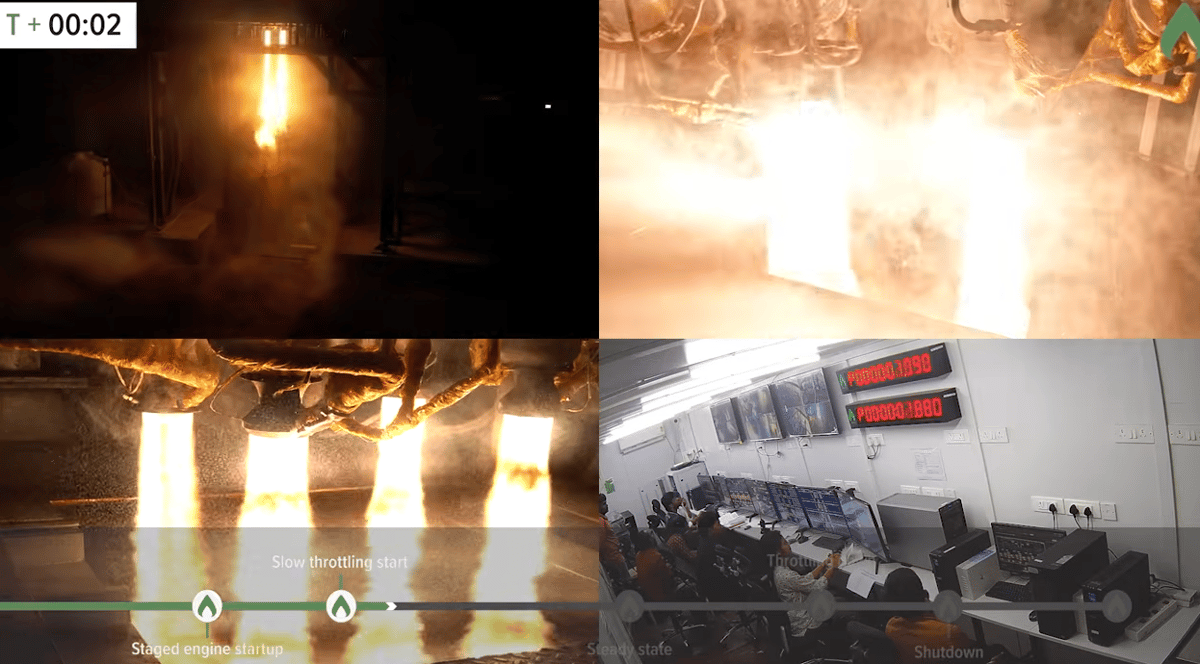
India’s First Four-Engine Cluster Firing Marks New Frontier for Agnikul Cosmos
Companies Mentioned
Why It Matters
The demonstration validates clustered electric‑pump propulsion, a technology that could dramatically reduce launch costs and increase cadence for Indian and global small‑sat markets. It positions Agnikul as a rare player capable of scaling this architecture beyond single‑engine flights.
Key Takeaways
- •Agnikul achieved India's first four-engine semi‑cryogenic cluster test
- •Test synchronized eight pumps, motors, and control algorithms in real time
- •Electric pump‑fed design cuts complexity versus traditional turbopumps
- •3D‑printed engines produced in days, enabling rapid launch cadence
- •Success positions Agnikul among few firms validating clustered electric propulsion
Pulse Analysis
India’s launch ecosystem has long relied on foreign‑sourced propulsion, but Agnikul Cosmos is rewriting that narrative with its home‑grown, electric pump‑fed engines. By 3D‑printing each semi‑cryogenic engine as a single piece and integrating them into a four‑engine cluster, the company demonstrates a manufacturing cadence measured in days rather than months. This approach aligns with the broader industry shift toward additive manufacturing, which reduces part count, shortens supply chains, and enables rapid design iterations—critical advantages for a market hungry for frequent, low‑cost access to orbit.
The technical feat of synchronizing eight pumps, eight motors and eight control loops cannot be overstated. Traditional turbopumps demand intricate plumbing and high‑pressure plumbing, creating bottlenecks in both performance and refurbishment. Agnikul’s electric pump architecture, by contrast, offers granular throttle control through motor speed adjustments, simplifying the propulsion system and improving reliability. The successful hot‑fire of four engines in concert proves that the company can manage the complex timing and thermal dynamics required for clustered operation, a hurdle that has limited many launch startups from scaling beyond single‑engine designs.
Commercially, the breakthrough opens doors to a new class of medium‑lift launch services from India, where demand for dedicated small‑sat rides is surging. With the ability to produce engines on demand, Agnikul can match customer launch windows more closely than competitors tied to legacy manufacturing timelines. Moreover, the validation of clustered electric propulsion places the firm alongside a select group of global players—such as Rocket Lab and New Frontier Aerospace—positioning it to attract both domestic satellite operators and international investors seeking diversified, cost‑effective launch options.
India’s First Four-Engine Cluster Firing Marks New Frontier for Agnikul Cosmos
Comments
Want to join the conversation?
Loading comments...