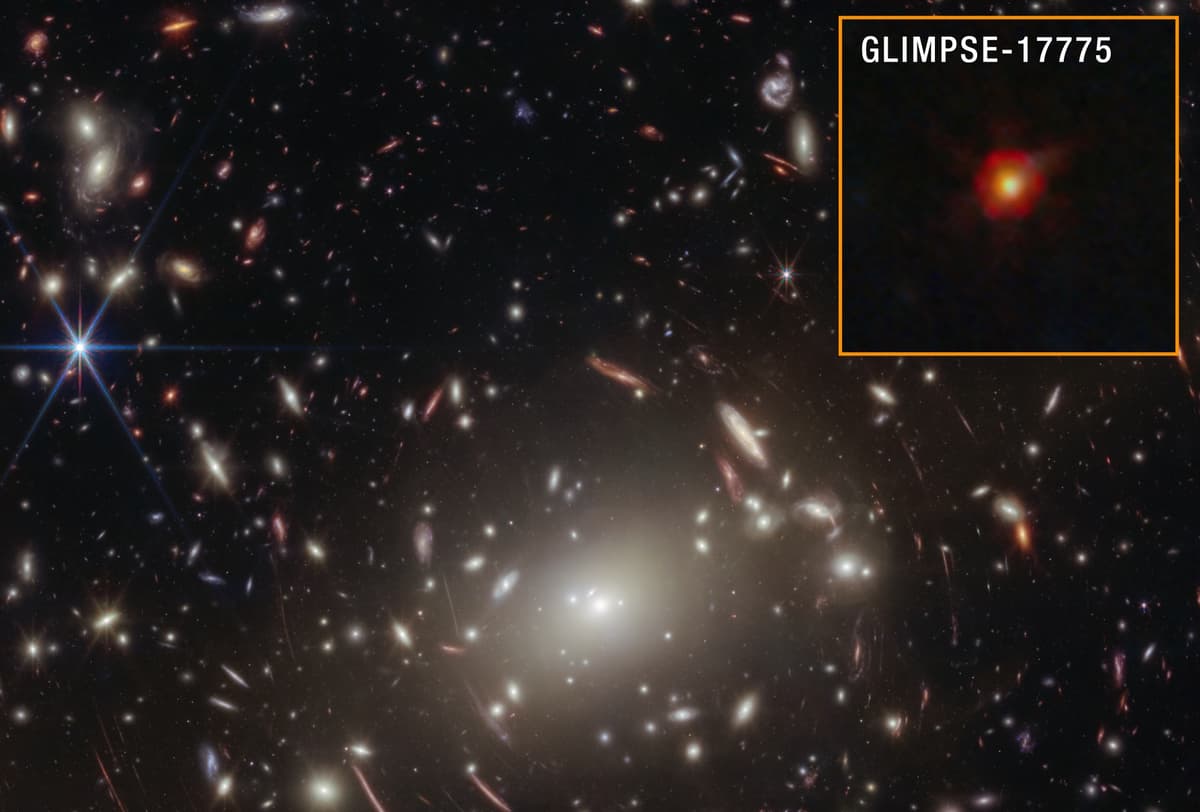
James Webb Reveals a Black Hole Star Inside a Little Red Dot
Companies Mentioned

Why It Matters
Identifying black‑hole stars in early‑universe objects reshapes models of rapid black‑hole growth and galaxy evolution, closing a long‑standing gap in cosmology.
Key Takeaways
- •Webb captured 40+ spectral lines, the most from a little red dot
- •Spectrum shows broadened iron, oxygen, helium lines indicating hot gas
- •Gravitational lensing acted as a natural magnifier for GLIMPSE‑17775
- •Discovery links little red dots to fast‑growing supermassive black holes
Pulse Analysis
The James Webb Space Telescope’s infrared eye has turned a long‑standing mystery into a concrete case study. By dissecting the light from GLIMPSE‑17775, Webb recorded an unprecedented suite of spectral fingerprints—over forty distinct lines of iron, oxygen and helium. This level of detail, amplified by a fortuitous gravitational lens, reveals a dense, turbulent cocoon of gas feeding a supermassive black hole. The observation demonstrates Webb’s unique ability to combine high‑resolution spectroscopy with natural cosmic magnification, delivering insights that were impossible with previous observatories.
Beyond the technical triumph, the discovery carries weighty implications for our understanding of the early universe. Little red dots, first spotted in infrared surveys, have puzzled astronomers for years, with some proposing they represented a new class of primordial galaxies. The black‑hole star model, now bolstered by Webb’s data, shows that these compact red beacons can be powered by rapidly accreting black holes, accelerating galaxy formation far earlier than standard theories predict. This aligns with emerging models that posit aggressive black‑hole growth within the first two billion years, reshaping timelines for star formation and mass assembly.
Looking ahead, the GLIMPSE‑17775 case sets a template for future investigations. Researchers will target additional little red dots with Webb’s spectrographs, seeking similar line forests to map the prevalence of black‑hole stars across cosmic time. Coupled with upcoming data from the Nancy Grace Roman Space Telescope, the field is poised to refine the census of early supermassive black holes and their host environments. In doing so, the community moves closer to answering how the universe built its massive structures so quickly after the Big Bang.
James Webb Reveals a Black Hole Star Inside a Little Red Dot
Comments
Want to join the conversation?
Loading comments...