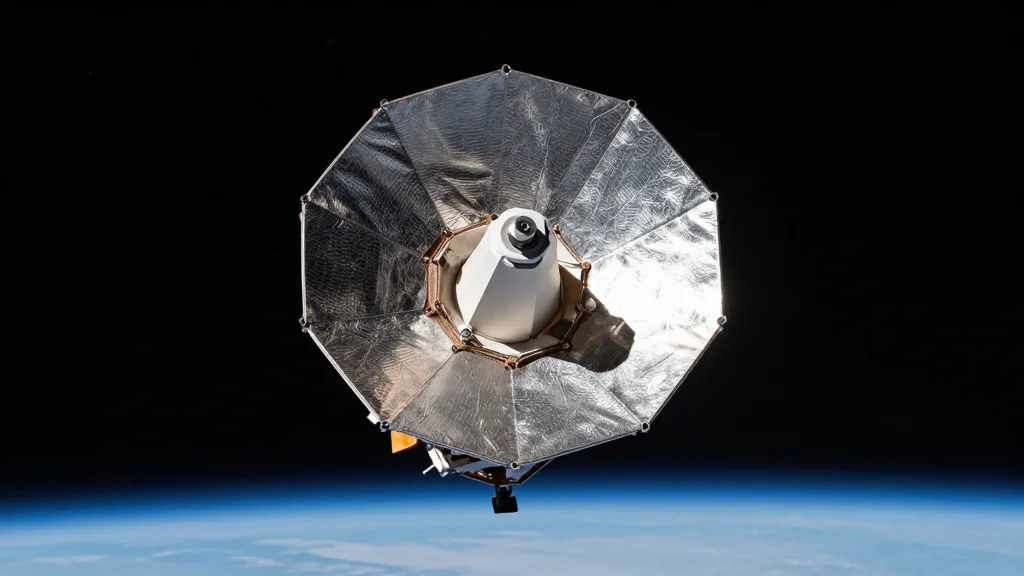
JAXA’s OrigamiSat‑2 Expands 25‑Fold in Orbit, Showcasing Deployable CubeSat Tech

Companies Mentioned
Why It Matters
The OrigamiSat‑2 test demonstrates that high‑performance antenna systems can be packaged into the smallest class of satellites, dramatically lowering the barrier to entry for space‑based services. By slashing mass and volume requirements, the technology could accelerate the rollout of global broadband, remote sensing, and scientific constellations, especially for nations and startups with limited budgets. Beyond cost, the ability to deploy large structures from a CubeSat form factor reshapes mission architecture. Designers can now consider multi‑function payloads—combining communications, power generation, and sensing—without the need for separate, larger buses. This flexibility may spur innovation in fields ranging from disaster monitoring to deep‑space CubeSat probes, where every gram saved translates into longer mission lifetimes or additional scientific instruments.
Key Takeaways
- •OrigamiSat‑2, a 10‑cm CubeSat, unfolded a 60‑foot (18 m) reflectarray antenna 25 times its folded size.
- •Deployment occurred 53 minutes after launch on April 23 from New Zealand, into a 540 km sun‑synchronous orbit.
- •The Miura fold, invented in 1970, underpins the deployment mechanism and has heritage in IKAROS and Space Flyer Unit.
- •CubeSat development costs can be as low as a few thousand dollars, versus $290‑$390 million for traditional satellites.
- •JAXA plans a 30‑meter solar sail test in late 2026 using an enhanced kirigami‑Miura design.
Pulse Analysis
JAXA’s OrigamiSat‑2 marks a turning point not because it is the first deployable CubeSat, but because it proves that a truly large‑aperture antenna can be hidden inside a standard 1U form factor. Historically, the small‑sat market has been constrained by limited power and communication bandwidth, forcing operators to accept low‑data‑rate links or rely on ground‑based relay networks. The 18‑meter antenna demonstrated here bridges that gap, offering a path to high‑throughput links without the expense of dedicated communications satellites.
From a competitive standpoint, the United States and Europe have invested heavily in deployable antenna technologies, but most solutions still require multiple CubeSat units to achieve comparable gain. Japan’s approach leverages decades of origami research, turning a cultural art form into a practical engineering advantage. If JAXA can commercialize the folding process, it could undercut Western providers on both price and performance, prompting a wave of partnerships and licensing deals.
Looking ahead, the real test will be durability. The space environment subjects materials to thermal cycling, atomic oxygen, and micrometeoroid impacts that can degrade thin membranes. JAXA’s upcoming 30‑meter solar sail will provide the long‑duration data needed to assess wear and tear. Should the technology survive, we may see a new generation of ultra‑light, high‑gain CubeSats that enable everything from real‑time global IoT connectivity to low‑cost deep‑space science missions, fundamentally reshaping the economics of access to space.
JAXA’s OrigamiSat‑2 Expands 25‑Fold in Orbit, Showcasing Deployable CubeSat Tech
Comments
Want to join the conversation?
Loading comments...