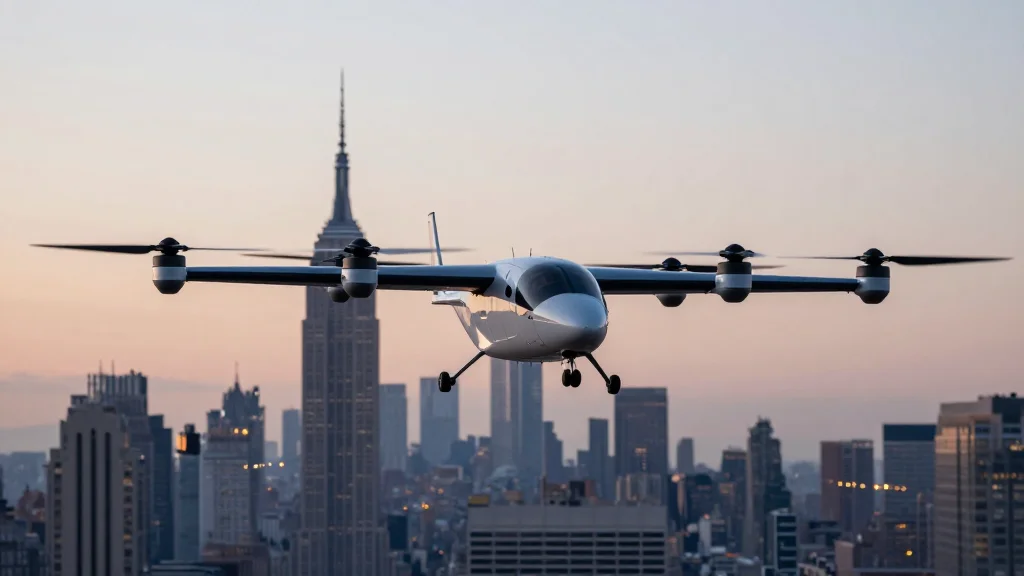
Joby Aviation Completes First Point‑to‑point eVTOL Air‑taxi Flight in New York

Companies Mentioned
Why It Matters
The New York flight moves the eVTOL industry from laboratory prototypes to real‑world operations, giving regulators, cities, and investors concrete evidence that point‑to‑point urban air mobility is technically feasible. By shaving travel time from over an hour to under ten minutes, Joby’s demonstration could reshape commuter behavior in megacities, reduce surface congestion, and create a new high‑value transportation segment. If Joby secures FAA certification and scales production, the company could capture a sizable share of a market some analysts value at trillions of dollars over the next decade. The flight also pressures rivals such as Archer Aviation to accelerate their own testing programs, intensifying competition and potentially speeding up the overall rollout of commercial eVTOL services.
Key Takeaways
- •Joby flew its six‑rotor eVTOL from JFK to Manhattan in under 10 minutes, the first point‑to‑point demonstration in New York.
- •The test lifted Joby's share price more than 30% and coincided with a $2.5 billion cash balance.
- •Ark Invest added 119,000 shares, bringing its total Joby holding to nearly 6.3 million shares across two ETFs.
- •FAA type certification is targeted for mid‑2027; commercial service in Dubai is planned for late 2026.
- •Competitor Archer Aviation still lacks a piloted transition flight, giving Joby a perceived technical advantage.
Pulse Analysis
Joby Aviation’s New York flight is a watershed moment for urban air mobility, but the headline‑grabbing demonstration is only the first rung on a long ladder. The eVTOL sector has been plagued by a classic chicken‑and‑egg problem: manufacturers need certification and a proven market to attract capital, while regulators demand operational data before granting approval. By delivering a full vertical‑takeoff, forward‑flight, and vertical‑landing sequence in a dense urban corridor, Joby supplies the data regulators have asked for and gives investors a tangible proof point that the technology works outside a test‑range.
The market reaction—over 30% stock appreciation and renewed institutional buying—reflects a shift from speculative bets to a more confidence‑driven valuation. Ark Invest’s sizable stake signals that sophisticated investors see Joby as the likely first mover to achieve type certification and commercial scale. However, the company still faces steep hurdles: the unit cost of each eVTOL remains high, vertiport infrastructure is nascent, and consumer acceptance is untested. Scaling manufacturing to the projected thousands of aircraft per year will require significant capital expenditures and supply‑chain coordination, especially for battery packs and electric propulsion components.
Competitors like Archer Aviation are racing to close their own technical gaps, but Joby’s early demonstration gives it a narrative advantage that could translate into partnership opportunities with cities, airlines, and logistics firms. If Joby can secure FAA certification by 2027 and launch revenue‑generating routes in Dubai and U.S. test markets, it could lock in first‑mover benefits, command premium pricing, and set the standards for safety and noise that will shape the regulatory framework for the entire industry. The next 12‑18 months will be decisive: certification milestones, production ramp‑up, and real‑world passenger trials will either cement Joby’s leadership or expose the fragility of its business model.
Joby Aviation completes first point‑to‑point eVTOL air‑taxi flight in New York
Comments
Want to join the conversation?
Loading comments...