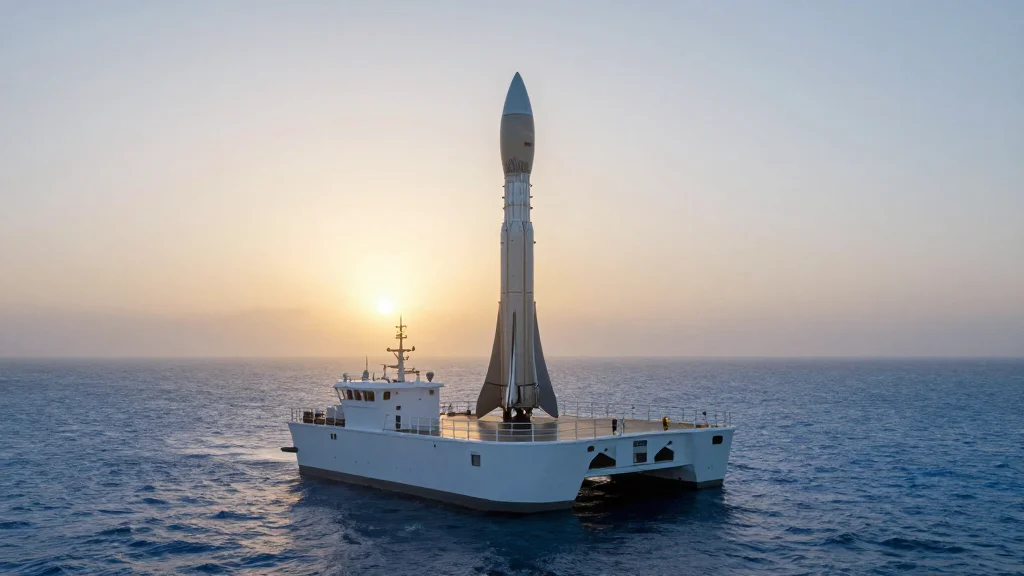
Lockheed Martin, Firefly and Seagate Team Up for Sea‑Based National‑Security Launches

Companies Mentioned
Why It Matters
The partnership introduces a new launch architecture that could dramatically reduce the time between mission need and orbital insertion for U.S. defense assets. By moving launch operations to the open ocean, the United States gains a degree of strategic ambiguity and resilience that land‑based sites cannot provide, potentially safeguarding critical satellite constellations against adversary anti‑satellite capabilities. If successful, the sea‑based model may trigger a broader shift in the commercial launch market, encouraging other providers to develop maritime platforms and prompting the DoD to rethink its procurement criteria. The move also aligns with the Pentagon’s broader push toward distributed, agile space capabilities, reinforcing the United States’ ability to maintain space superiority in contested environments.
Key Takeaways
- •Lockheed Martin, Firefly Aerospace and Seagate announced a sea‑based launch partnership targeting operational capability by late 2027
- •Gateway offshore launch platform received Approval in Principle from ABS in December 2025
- •Firefly Alpha’s "Stairway to Seven" mission in March 2026 validated Block II upgrades
- •Partnership aims to support the DoD’s Tactically Responsive Space (TacRS) vision for rapid orbital access
- •Future plans include a network of staging and recovery assets to enable high‑cadence sea launches
Pulse Analysis
The sea‑based launch concept represents a strategic pivot from the traditional, ground‑centric launch paradigm that has dominated U.S. space operations for decades. Historically, the Department of Defense has relied on a handful of fixed launch sites, which, while proven, are vulnerable to weather, range congestion and, increasingly, anti‑satellite threats. By leveraging a mobile maritime platform, the Lockheed‑Firefly‑Seagate consortium is effectively creating a floating launch pad that can be repositioned to avoid predictable patterns, thereby complicating adversary targeting.
From a market perspective, the collaboration could carve out a niche for small‑lift, rapid‑response launch services that sit between the high‑volume, low‑cost offerings of SpaceX and the heavy‑lift, government‑focused contracts of United Launch Alliance. The partnership’s emphasis on defense‑grade reliability and rapid integration may attract other branches of the military seeking to field responsive satellite constellations for communications, ISR and missile warning. If the offshore platform demonstrates cost‑effective reusability, it could also pressure commercial players to accelerate their own sea‑launch initiatives, potentially driving down launch costs across the board.
Looking ahead, the key risk factors revolve around technical integration and regulatory approval. Coordinating launch operations from a semi‑submersible vessel requires robust command‑and‑control links, precise navigation and reliable recovery systems—all under the harsh conditions of the open ocean. Moreover, the partnership will need sustained funding from the Pentagon and possibly congressional support to transition from demonstration to full‑scale operations. Should these hurdles be cleared, the sea‑based launch architecture could become a cornerstone of the United States’ tactical space strategy, offering a resilient, on‑demand pathway to orbit that aligns with the broader shift toward distributed, agile space capabilities.
Lockheed Martin, Firefly and Seagate Team Up for Sea‑Based National‑Security Launches
Comments
Want to join the conversation?
Loading comments...