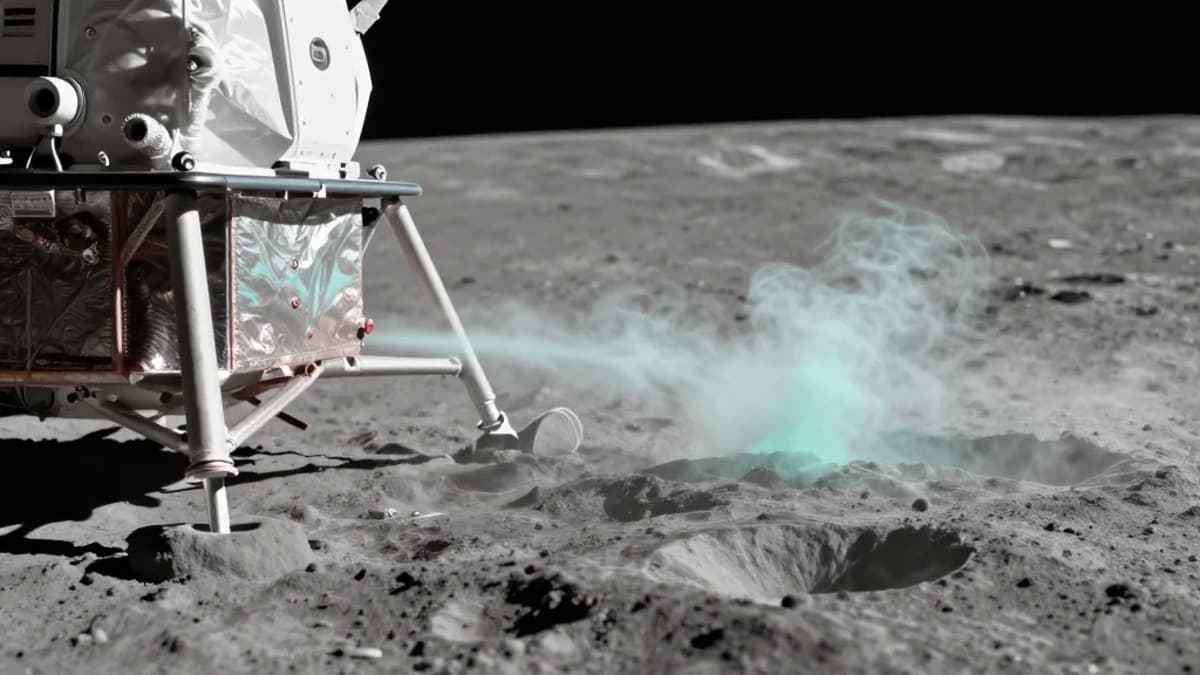
Lunar Spacecraft Exhaust Could Obscure Clues to Origins of Life
•March 5, 2026
0
Why It Matters
Contamination could mask the Moon’s pristine organic record, undermining efforts to understand life’s beginnings and jeopardizing future scientific returns from lunar missions.
Key Takeaways
- •Methane exhaust can travel Moon-wide within two lunar days.
- •Over 50% exhaust trapped at poles within seven lunar days.
- •Contamination threatens detection of prebiotic molecules in PSRs.
- •Colder landing sites may reduce spread but not eliminate it.
- •Study calls for planetary protection rules and on‑site validation.
Pulse Analysis
The renewed wave of lunar missions—driven by NASA, ESA, China, and commercial firms—has turned the Moon’s permanently shadowed regions into a scientific gold mine. These cold traps preserve ice that may contain pre‑biotic organics delivered by comets and asteroids billions of years ago, offering a rare window into the chemistry that preceded life on Earth. However, every landing introduces propulsion by‑products, chiefly methane, that can coat the surface. If such contaminants mingle with native compounds, they could mask the subtle isotopic signatures researchers rely on to trace the origins of life.
The recent study published in JGR: Planets modeled the Argonaut lander’s exhaust and tracked thousands of methane molecules across the airless lunar terrain. Because the Moon lacks an atmosphere, the molecules follow ballistic trajectories, hopping from sun‑lit regolith to shadowed craters. Simulations showed that within two lunar days the exhaust reaches the opposite pole, and after a week more than half of the released methane becomes cold‑trapped—42 % at the South Pole and 12 % at the North. These findings overturn earlier assumptions that contamination would remain localized near the touchdown site.
To safeguard the Moon’s scientific value, agencies are now urged to embed planetary‑protection measures into mission design. Options include selecting colder landing zones, using methane‑free propulsion, or shielding exhaust with deployable booms. More critically, future landers must carry instruments capable of measuring in‑situ contamination levels, turning model predictions into empirical data. As lunar exploration accelerates, establishing clear contamination standards will be essential not only for preserving pristine samples but also for maintaining public confidence in the search for life’s origins.
Lunar spacecraft exhaust could obscure clues to origins of life
0
Comments
Want to join the conversation?
Loading comments...