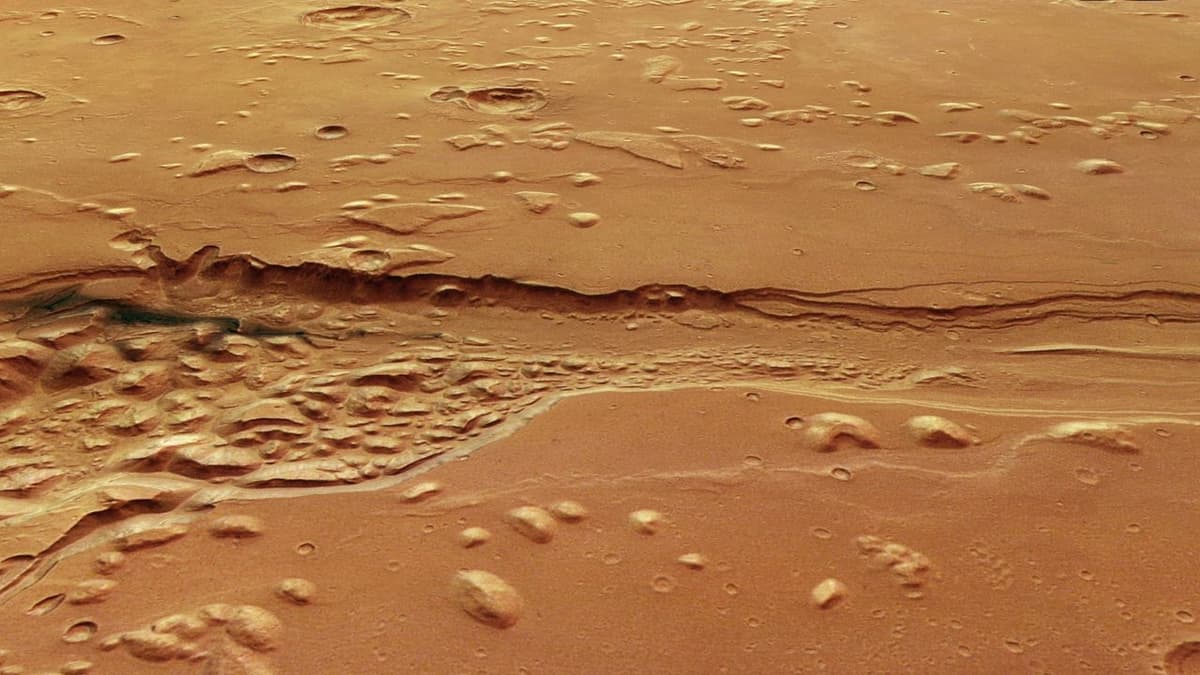
Mars Orbiter Captures Striking Images of 'Chaos and Craters' Carved by Ancient Floods
Why It Matters
The images provide concrete proof of catastrophic flooding on early Mars, reshaping our understanding of the planet’s climate evolution and its potential to have supported life. They also highlight the enduring scientific value of long‑duration missions like Mars Express for planetary exploration.
Key Takeaways
- •Shalbatana Vallis spans ~1,300 km, comparable to Italy's length
- •Channel is up to 10 km wide and 500 m deep
- •Images reveal layered sediments, volcanic ash, and impact craters
- •Findings support theories of ancient Martian oceans in Chryse Planitia
Pulse Analysis
The newly released high‑resolution views of Shalbatana Vallis underscore a pivotal chapter in Mars’ geological record: a period when massive groundwater releases carved deep, chaotic valleys across the planet’s surface. By mapping a channel that rivals the length of Italy, scientists can quantify the volume of water that once surged through the Martian crust, reinforcing models that suggest a significantly warmer and wetter early climate. These flood‑formed features, combined with volcanic ash layers and preserved impact craters, act as a stratigraphic archive, allowing researchers to reconstruct the sequence of hydrologic, volcanic, and erosional events that shaped the region over billions of years.
Mars Express, launched in 2003, continues to demonstrate the scientific payoff of long‑duration orbital missions. Its High‑Resolution Stereo Camera (HRSC) delivers three‑dimensional color imaging that reveals subtle topographic variations invisible to earlier instruments. Over two decades, the spacecraft has cataloged mineral deposits formed in water, identified buried ice reservoirs, and even hinted at subsurface liquid water beneath the southern polar cap. The recent Shalbatana Vallis images add another layer to this legacy, providing a detailed case study of flood dynamics that can be cross‑referenced with data from NASA’s Perseverance rover and the ExoMars Trace Gas Orbiter.
Understanding ancient Martian flood systems has direct implications for future exploration and astrobiology. Regions like Shalbatana Vallis, where water‑related sediments are preserved, become prime targets for sample‑return missions seeking biosignatures. Moreover, the confirmation of extensive past water flow informs landing‑site selection for crewed missions, as water‑rich terrains may host accessible resources for in‑situ utilization. As planetary scientists refine climate models, the flood‑carved valleys of Mars serve as natural laboratories, bridging the gap between Earth’s own fluvial history and the Red Planet’s enigmatic past.
Mars orbiter captures striking images of 'chaos and craters' carved by ancient floods
Comments
Want to join the conversation?
Loading comments...