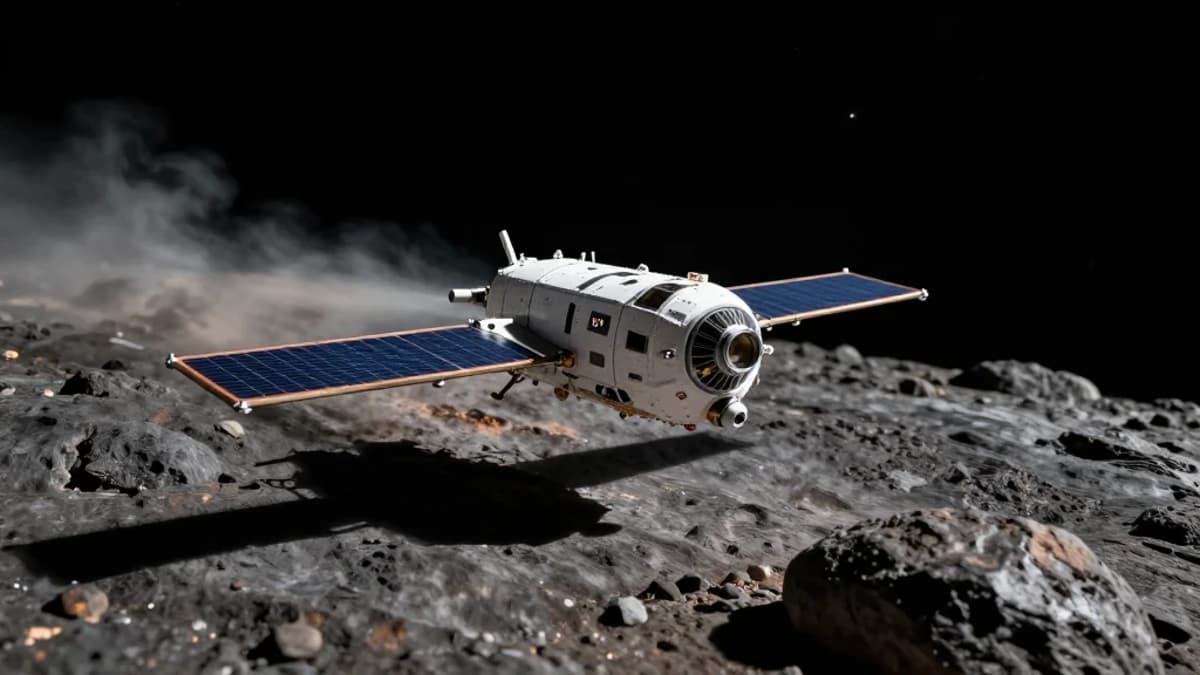
NASA Changed an Asteroid’s Orbital Path Around the Sun, a First for Humankind
•March 6, 2026
0
Why It Matters
The result proves humanity can deliberately shift an asteroid’s path around the Sun, bolstering confidence in deflection techniques that could protect Earth from future impact threats.
Key Takeaways
- •DART impact slowed binary's heliocentric speed by 12 microns/s
- •Momentum enhancement factor doubled thrust from spacecraft alone
- •Measured orbital change validates planetary defense predictions
- •ESA's Hera mission will independently verify DART results
- •Mass and density estimates improve asteroid formation models
Pulse Analysis
The Double Asteroid Redirection Test (DART) was designed as a proof‑of‑concept for planetary defense, targeting the binary asteroid system Didymos‑Dimorphos. By colliding a 570‑kilogram spacecraft at 22,530 km/h with Dimorphos, NASA aimed to nudge the moonlet’s orbit around its primary. The mission’s success demonstrated that kinetic impact can measurably alter an asteroid’s trajectory, a milestone that resonates across the aerospace industry, insurance underwriting, and governmental risk‑assessment frameworks.
A recent study in Science Advances extends that milestone by showing the impact also decelerated the entire binary’s heliocentric velocity by about 12 microns per second—equivalent to a 370‑metre annual slowdown. Researchers used radar tracking and solar‑transit observations to compare pre‑ and post‑impact orbits, confirming a momentum‑enhancement factor that effectively doubled the spacecraft’s push due to ejecta. The analysis also yielded the first independent mass estimates for each body, refining models of binary asteroid composition and formation, which are critical for designing future deflection missions.
Looking ahead, ESA’s Hera mission, slated for launch later this year, will rendezvous with Didymos‑Dimorphos to map the impact crater and independently verify the DART measurements. The combined data set will inform next‑generation kinetic‑impact strategies, influence policy on near‑Earth object mitigation, and potentially open commercial opportunities for asteroid‑resource extraction. For investors and stakeholders, the ability to predict and control asteroid trajectories translates into reduced existential risk and new avenues for space‑based ventures.
NASA changed an asteroid’s orbital path around the sun, a first for humankind
0
Comments
Want to join the conversation?
Loading comments...