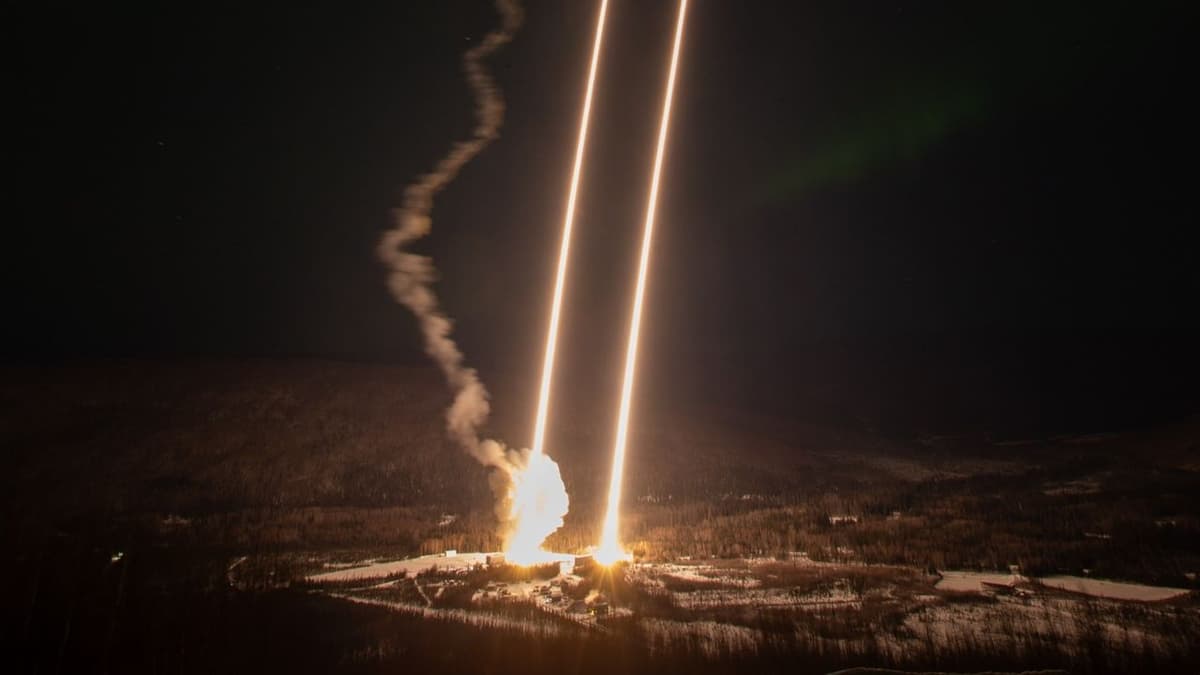
NASA Launches Twin Rocket Missions From Alaska to Study Mysterious Black Auroras
Companies Mentioned

CNET
CNET

Future
Why It Matters
The data provides critical insight into space weather processes that can disrupt satellite operations and terrestrial power systems, enhancing predictive capabilities for geomagnetic storms.
Key Takeaways
- •BADASS rocket reached 224 miles altitude
- •GNEISS rockets achieved 198 miles altitude each
- •Missions target black auroras and electric currents
- •Data will improve space weather forecasting
- •Findings aid satellite and power grid protection
Pulse Analysis
Auroras are more than a visual spectacle; they are the visible imprint of complex plasma interactions between the solar wind and Earth’s magnetosphere. Among these displays, black auroras—regions where electrons are propelled upward rather than precipitating—remain poorly understood, yet they signal a reversal in the usual energy flow that can amplify geomagnetic disturbances. By probing these elusive features, scientists hope to decode the underlying electrodynamic circuitry that governs how energy is transferred from space to the upper atmosphere, a key factor in space‑weather modeling.
The twin missions launched from the Poker Flat Research Range employed sounding rockets equipped with high‑resolution electric field sensors, particle detectors, and imaging spectrometers. BADASS ascended to 360 km, directly sampling the plasma environment of a black aurora, while the GNEISS pair reached 319 km and flew in formation to triangulate current pathways, effectively producing a three‑dimensional “CT scan” of the auroral column. Coupled with a ground‑based receiver network, the measurements will allow researchers to reconstruct the spatial distribution of currents and assess how they dissipate through the ionosphere.
Understanding these current systems has immediate commercial relevance. Accurate forecasts of geomagnetic storms can protect satellite constellations, mitigate radiation exposure for astronauts, and prevent cascading failures in power grids and aviation communications. The insights gained from BADASS and GNEISS will feed into next‑generation space‑weather models, enabling utilities and satellite operators to adopt proactive mitigation strategies. Moreover, the missions demonstrate the value of low‑cost, rapid‑turnaround rocket experiments, paving the way for more frequent, targeted investigations of transient space‑environment phenomena.
NASA launches twin rocket missions from Alaska to study mysterious black auroras


Comments
Want to join the conversation?
Loading comments...