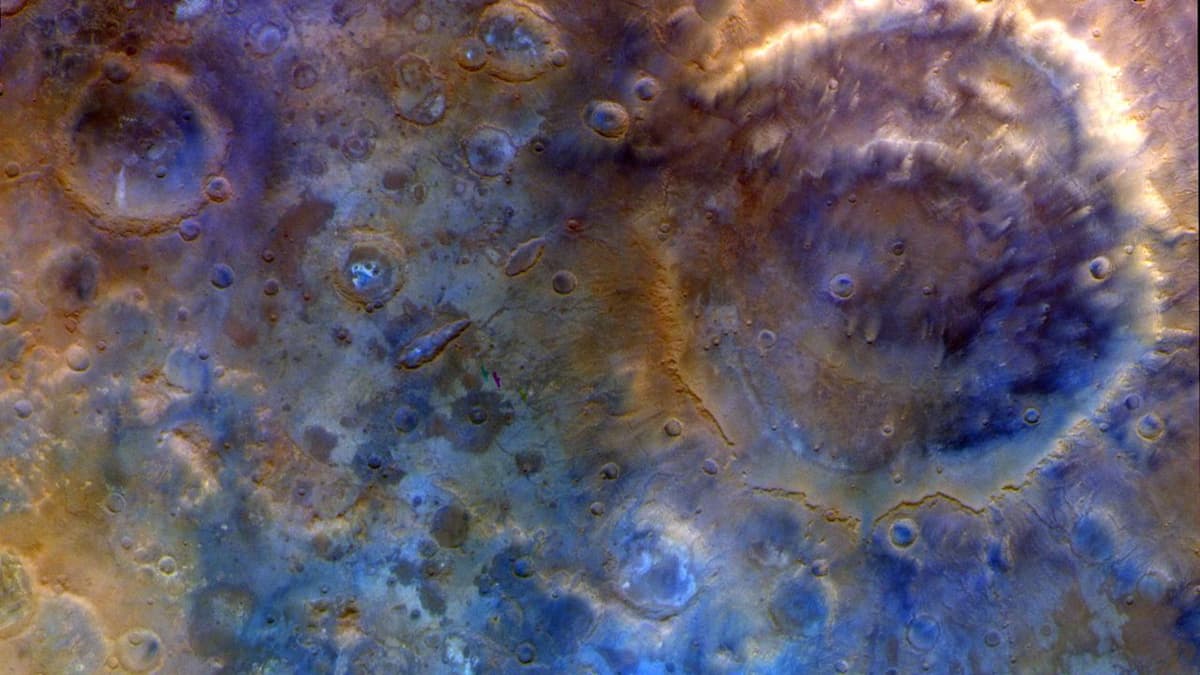
NASA Spacecraft Beams Back Blue Images of Mars on Its Way to a Metal Asteroid — Space Photo of the Week
Why It Matters
The successful flyby proves Psyche’s imaging payload and trajectory work, safeguarding the August 2029 arrival at a planetary core analogue. Simultaneously, the Martian observations enrich our understanding of surface erosion and atmospheric scattering, offering science beyond the mission’s primary goal.
Key Takeaways
- •Psyche passed 4,609 km above Mars, capturing Huygens crater.
- •Flyby added ~1,600 km/h speed, shifting orbital plane 1°.
- •Mission stays on track for 16 Psyche arrival August 2029.
- •Images show wind‑blown streaks and bright atmospheric glow.
- •NASA will continue Mars calibration imaging through May.
Pulse Analysis
The Psyche mission illustrates how modern deep‑space probes leverage planetary flybys to conserve propellant while gathering ancillary science. By threading a tight 2,864‑mile pass of Mars, engineers harvested a gravity boost that trims travel time to the main‑belt target. This approach mirrors historic maneuvers—such as Voyager’s Jupiter slingshot—but adds the twist of a solar‑powered spacecraft equipped with high‑resolution multispectral cameras, turning a navigation step into a data‑rich opportunity.
Beyond trajectory benefits, the Martian snapshots reveal dynamic processes rarely seen from orbit. High‑contrast images of wind‑eroded crater walls in Syrtis Major and the reflective edge of the south polar cap expose how dust and ice interact under thin atmospheric conditions. The observed bright halo around the planet’s limb, caused by sunlight scattering off suspended particles, offers a natural calibration source for Psyche’s sensors, sharpening future measurements of the metallic asteroid’s surface.
Looking ahead, Psyche’s arrival at 16 Psyche in August 2029 promises unprecedented insight into planetary differentiation. The asteroid is believed to be the exposed nickel‑iron core of a protoplanet, a laboratory for studying the building blocks of terrestrial worlds. While speculative estimates place its metal wealth in the quadrillions of dollars, the mission’s true value lies in testing theories of core formation and informing future resource‑utilization concepts. Successful navigation and imaging on the Mars flyby reinforce confidence that Psyche will fulfill its scientific mandate, potentially reshaping our view of early solar‑system evolution.
NASA spacecraft beams back blue images of Mars on its way to a metal asteroid — Space photo of the week
Comments
Want to join the conversation?
Loading comments...