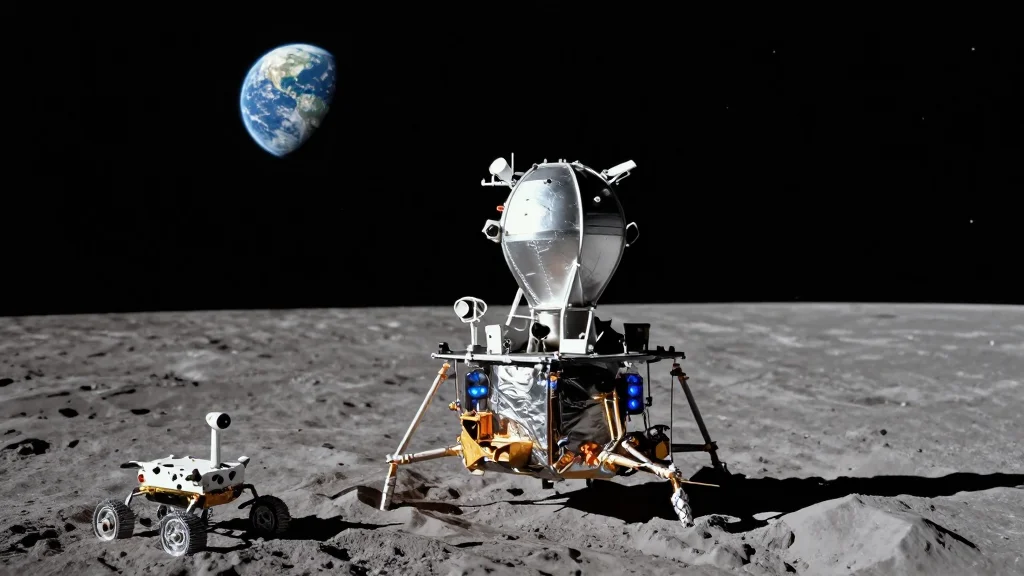
NASA’s Artemis Era May Finally Solve Three Major Moon Mysteries
Why It Matters
Resolving the Moon’s interior, formation, and water sources will sharpen planetary‑science theory and enable reliable in‑situ resources for future lunar habitats and deep‑space missions.
Key Takeaways
- •Artemis IV will place seismometers on lunar south pole
- •Farside seismic suite will enable global moonquake network
- •New samples could reveal recent volcanism and mantle composition
- •Water ice mapping supports sustainable lunar base and fuel production
- •Findings will refine giant-impact theory of Moon’s origin
Pulse Analysis
The Artemis era is redefining lunar exploration by shifting from short‑term flybys to a permanent scientific infrastructure. By deploying the Lunar Environment Monitoring Station on the south‑pole highlands and planning a farside seismic array, NASA will finally achieve three‑dimensional imaging of the Moon’s core and mantle. This network will capture moonquakes generated by meteoroid impacts and internal stresses, allowing researchers to distinguish between residual primordial heat, radioactive decay, and tidal flexing as drivers of any lingering volcanism. The resulting seismic tomography will settle debates over whether the Moon still harbors a liquid outer core and how deep‑seated heat sources sustain surface activity.
Beyond interior dynamics, the new data set promises to clarify the Moon’s birth narrative. Competing hypotheses—ranging from the classic Theia giant‑impact model to variations involving Earthshine‑induced crustal asymmetry—predict distinct internal layering and compositional signatures. High‑resolution gravity maps paired with seismic velocity profiles will reveal the thickness of the farside crust versus the nearside mare basalts, testing whether differential heating after impact created the Moon’s iconic two‑faced appearance. Moreover, mantle samples returned by future robotic missions could expose unexpected concentrations of radioactive isotopes, reshaping our understanding of early solar‑system chemistry.
Equally transformative is the hunt for water ice at the permanently shadowed craters near the lunar south pole. Instruments aboard the VIPER rover and the Lunar Dielectric Analyzer will quantify ice abundance, depth, and purity, data essential for in‑situ resource utilization. Confirming substantial, accessible ice deposits would underpin life‑support systems, agricultural experiments, and propellant production, dramatically lowering the cost of sustained lunar operations. At the same time, isotopic analyses of lunar ice may trace the provenance of Earth’s oceans, offering clues about whether comets or water‑rich asteroids delivered the planet’s life‑supporting liquid. In short, Artemis‑driven science is poised to turn the Moon into a living laboratory for planetary evolution and a stepping‑stone for humanity’s next leap into the cosmos.
NASA’s Artemis era may finally solve three major moon mysteries
Comments
Want to join the conversation?
Loading comments...