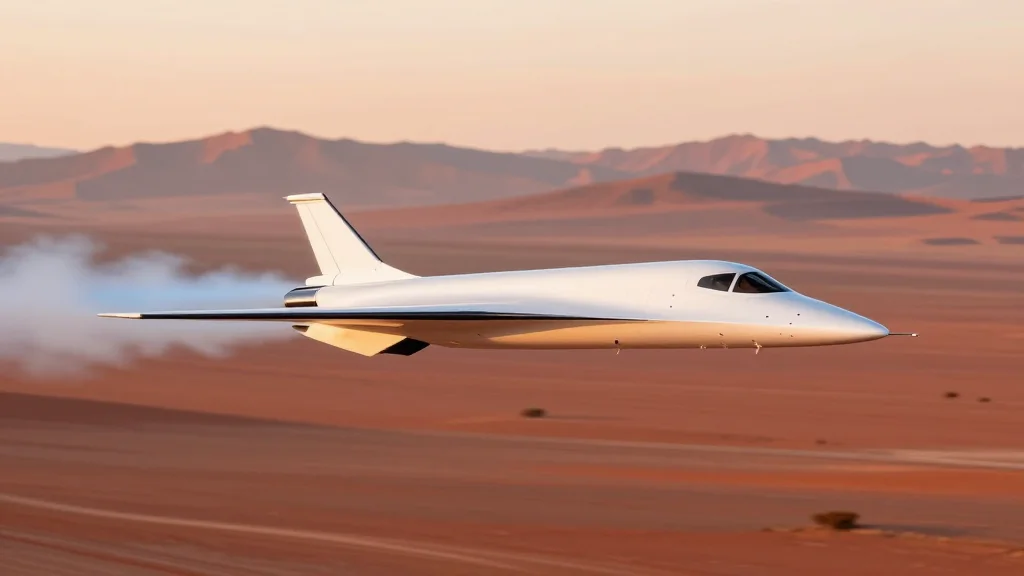
NASA’s X‑59 Quiet Supersonic Transport Executes Near‑Supersonic Maneuver Test Over Mojave

Companies Mentioned
Why It Matters
The X‑59 test flight is a pivotal step toward overturning the decades‑old FAA prohibition on supersonic travel over land. By demonstrating that a commercial‑grade aircraft can fly at or above Mach 1 while limiting ground‑level noise to a barely perceptible thump, NASA is addressing the primary barrier—public disturbance—that halted previous supersonic programs. A successful outcome could unlock a new market for airlines seeking to halve trans‑continental flight times, stimulate investment in advanced aerodynamics and materials, and drive a wave of innovation across the aerospace supply chain. Beyond commercial prospects, the data gathered will inform future military and civilian aircraft designs that require high‑speed performance without compromising community acceptance. The X‑59’s envelope‑expansion tests also contribute to a broader understanding of flutter dynamics and control‑law robustness at high Mach numbers, knowledge that is directly applicable to hypersonic vehicle development and next‑generation spaceplane concepts.
Key Takeaways
- •NASA conducted a high‑speed maneuver test of the X‑59 on April 14, 2024, over the Mojave desert
- •The flight included roller‑coaster pitch, bank‑to‑bank roll and flutter‑excitation maneuvers to expand the aircraft’s envelope
- •Lockheed Martin built the X‑59 under a $518 million NASA contract
- •The X‑59 aims to replace the traditional sonic boom with a low‑level “sonic thump,” enabling over‑land supersonic flight
- •Future tests will fly the X‑59 over U.S. communities to assess public response to the reduced‑boom signature
Pulse Analysis
NASA’s X‑59 program represents a strategic pivot from pure research to a market‑oriented technology demonstrator. The $518 million investment signals confidence that the agency can de‑risk the most contentious aspect of supersonic flight—noise—thereby lowering the regulatory hurdle that has kept commercial supersonic services grounded for half a century. Historically, attempts like the Concorde succeeded technically but failed economically, largely because the sonic boom limited route options and provoked public backlash. By engineering a design that reshapes shock waves, NASA is tackling the externality that made the business model untenable.
From a competitive standpoint, the X‑59 positions the United States to lead a nascent quiet‑supersonic market that could attract major OEMs such as Boeing, Airbus and emerging players like Boom Supersonic. If NASA’s data validate the low‑boom claim, certification pathways could open within the next five years, prompting airlines to invest in fleet upgrades and creating a supply chain for specialized airframes, engines and acoustic monitoring systems. The test also underscores the importance of public‑acceptance testing; community over‑flight trials will generate empirical data that regulators can use to craft nuanced noise standards, rather than blanket bans.
Looking forward, the X‑59’s success could catalyze a cascade of related technologies—advanced composite structures, active aeroelastic control, and high‑efficiency turbofan engines optimized for low‑boom operation. These advances would not only benefit supersonic transport but also improve fuel efficiency and noise reduction for subsonic aircraft, delivering broader environmental benefits. In short, the April 14 flight is more than a technical rehearsal; it is a litmus test for the commercial viability of a new class of aircraft that could redefine long‑distance travel.
NASA’s X‑59 Quiet Supersonic Transport Executes Near‑Supersonic Maneuver Test Over Mojave
Comments
Want to join the conversation?
Loading comments...