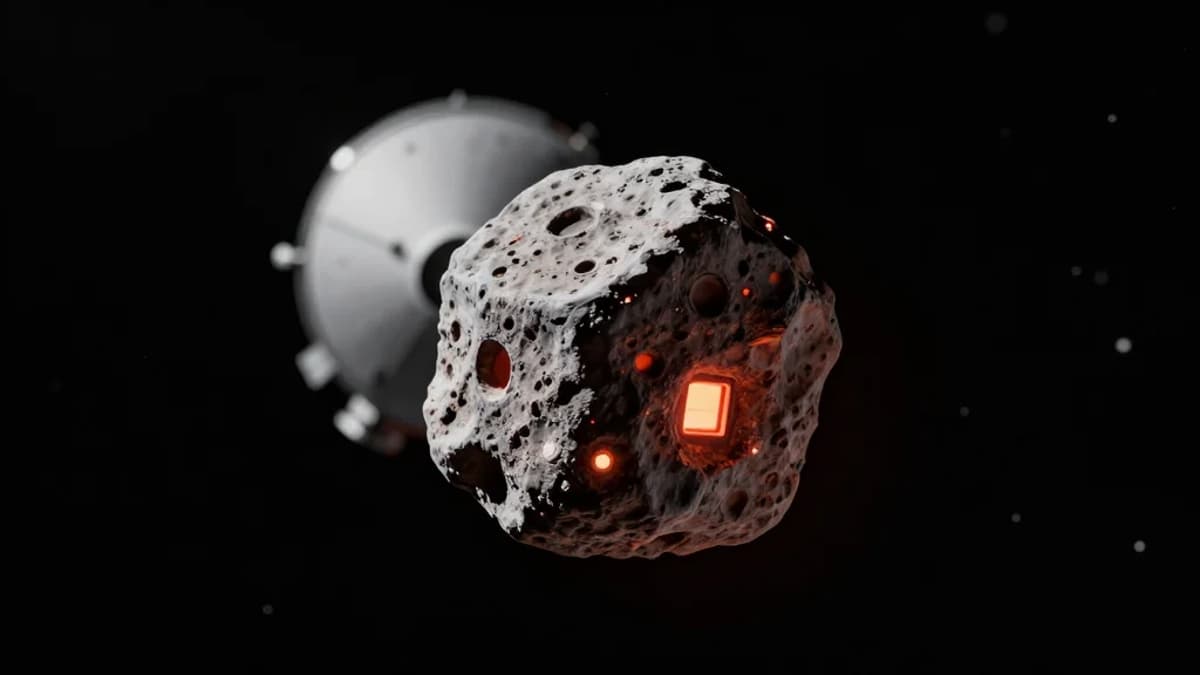
New Webb Data Says Asteroid 2024 YR4 Will Miss the Moon in 2032
•March 5, 2026
0
Why It Matters
The updated trajectory removes an imminent lunar hazard and sharpens planetary‑defense models, informing future risk assessments for Earth encounters.
Key Takeaways
- •Webb observations refined 2024 YR4 orbit to high precision.
- •Lunar miss distance set at 13,200 miles (21,200 km).
- •Prior 4.3% Moon impact probability now zero.
- •Potential 2032 impact would have offered valuable scientific data.
- •Future Earth encounter risk remains uncertain after orbit change.
Pulse Analysis
The James Webb Space Telescope, primarily known for its deep‑space discoveries, has become a critical asset for near‑Earth object (NEO) surveillance. By capturing mid‑infrared signatures of asteroid 2024 YR4, Webb provided precise measurements of the object's size, albedo, and thermal properties, which translate into a dramatically tighter orbital solution. This level of accuracy, unattainable with ground‑based telescopes alone, allows scientists at NASA’s Center for Near‑Earth Object Studies to rule out previously modeled impact scenarios and to update risk tables used by planetary‑defense agencies worldwide.
Eliminating the 4.3% lunar impact probability carries both relief and a hint of scientific regret. A direct hit on the Moon would have generated a bright, observable flash and ejecta plume, offering a natural laboratory for impact physics, crater formation, and lunar surface composition. Researchers could have coordinated a global network of telescopes to capture high‑speed data, enriching models that predict damage from asteroid strikes on Earth. Although the asteroid will safely pass, the refined trajectory still flags a potential Earth approach in 2047, albeit with uncertainties introduced by the 2032 fly‑by, underscoring the need for continuous monitoring.
The broader implication is a reaffirmation of international collaboration in NEO detection and characterization. Webb’s contribution exemplifies how space‑based infrared platforms complement radar and optical surveys, filling observational gaps for objects on Earth‑crossing paths. As the asteroid population catalog expands, sustained investment in both ground and space assets will be essential to maintain early‑warning capabilities. Public confidence in planetary defense hinges on transparent, data‑driven updates like this, reinforcing the importance of agencies sharing precise orbital information promptly.
New Webb data says asteroid 2024 YR4 will miss the Moon in 2032
0
Comments
Want to join the conversation?
Loading comments...