Aerospace News and Headlines
  • All Technology
  • AI
  • Autonomy
  • B2B Growth
  • Big Data
  • BioTech
  • ClimateTech
  • Consumer Tech
  • Crypto
  • Cybersecurity
  • DevOps
  • Digital Marketing
  • Ecommerce
  • EdTech
  • Enterprise
  • FinTech
  • GovTech
  • Hardware
  • HealthTech
  • HRTech
  • LegalTech
  • Nanotech
  • PropTech
  • Quantum
  • Robotics
  • SaaS
  • SpaceTech
AllNewsDealsSocialBlogsVideosPodcastsDigests

Aerospace Pulse

EMAIL DIGESTS

Daily

Every morning

Weekly

Sunday recap

NewsDealsSocialBlogsVideosPodcasts
AerospaceNews‘No Strangers to Drones’: Singapore Eyes Unmanned Surge with Israeli Tech
‘No Strangers to Drones’: Singapore Eyes Unmanned Surge with Israeli Tech
AerospaceRobotics

‘No Strangers to Drones’: Singapore Eyes Unmanned Surge with Israeli Tech

•February 5, 2026
0
Defense News
Defense News•Feb 5, 2026

Why It Matters

The initiative positions Singapore as a leading urban drone operator, enhancing its defence resilience and creating demand for advanced UAV and counter‑UAV technologies across the region.

Key Takeaways

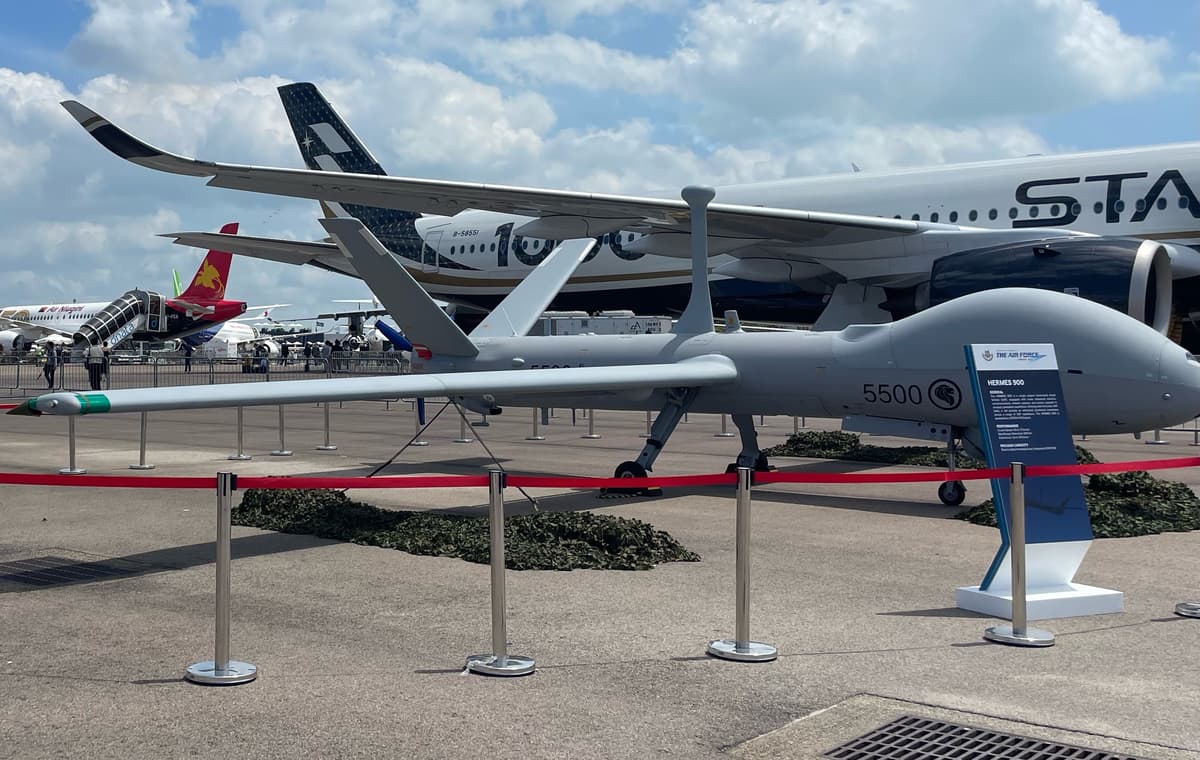
  • •Singapore adopts Israeli Orbiter 4 and Hermes 900 UAVs
  • •New DROID unit to test and field micro‑drones
  • •All reservists will receive drone operation training starting 2026
  • •Counter‑drone shield development targets low‑cost swarm threats
  • •Urban landscape drives unique UAV tactics and sensor research

Pulse Analysis

Singapore’s decision to lean heavily on Israeli‑manufactured drones underscores a broader strategic pivot toward autonomous systems in a highly urbanised theatre. The Orbiter 4’s 24‑hour endurance and the Hermes 900’s 36‑hour loiter capability give the Republic of Singapore Air Force (RSAF) persistent surveillance over maritime choke points and dense cityscapes. By integrating these platforms, Singapore not only modernises its aerial reconnaissance but also builds a testbed for next‑generation swarm‑defense concepts that other city‑states can emulate.

Training is a cornerstone of the transformation. The RSAF’s plan to embed drone instruction into the national service curriculum means that every reservist will graduate with basic UAV handling skills, a move that expands the talent pool and accelerates operational readiness. The newly formed Drone Rapid Operational, Integration, and Deployment (DROID) unit, alongside the UAS Warfare and Tactics Centre, will spearhead experimentation with micro‑drones, simulation environments, and urban flight‑path optimisation. This institutional framework ensures rapid doctrine development and seamless integration of emerging technologies into frontline units.

Regionally, Singapore’s drone‑centric approach signals a growing market for both commercial and defence UAV solutions in Southeast Asia. Israeli firms like Aeronautics Group and Elbit Systems stand to benefit from increased orders, while local defence contractors may seek partnerships to tailor systems for dense urban terrains. Moreover, the emphasis on counter‑drone shields—encompassing sensors, jammers, and kinetic interceptors—highlights a rising demand for integrated air‑defence layers capable of neutralising low‑cost swarms, a capability that could become a exportable niche for Singapore’s defence industry.

‘No strangers to drones’: Singapore eyes unmanned surge with Israeli tech

SINGAPORE — Singapore’s military is implementing new doctrines to counter swarms of low-cost drones and boosting its drone capabilities by relying largely on Israeli-made systems as the baseline of its fleet, the Air Force chief said.

“We’re no strangers to drones, having used them for almost 40 years, but they will play a much bigger role in the Republic of Singapore Air Force in terms of scale,” Maj. Gen. Kelvin Fan, the chief of Singapore’s Air Force, told Defense News. “We are currently operationalizing our Orbiter 4 and Hermes 900 UAVs.”

Both drones are produced by Israeli-based companies, namely Aeronautics Group and Elbit Systems, and were center-stage at the static display of this year’s Singapore Airshow.

The Orbiter 4 is a close-range drone for maritime and land operations, designed for surveillance and intelligence-gathering missions. It can fly for up to 24 hours and has a maximum range of 150 kilometers, according to a fact sheet from the Singapore Ministry of Defense.

The country purchased an undisclosed number of the drone in 2022 and acquired the variant that is launched via a catapult and recovered with a parachute.

Although the manufacturer advertises that it can operate in harsh weather, some RSAF operators here told Defense News that it has struggled in windy conditions.

Singapore confirmed last year, meanwhile, that it bought the medium-altitude long-endurance Hermes 900. Elbit lists the system as having a maximum takeoff weight of 1,180 kilograms, or 2,601 pounds, and an endurance of up to 36 hours.

In a 2024 interview, the former RSAF chief stated that the service’s fleet of Hermes 450 and IAI Heron 1 drones needed to be replaced, with the former having entered into service in 2007.

As part of the country’s move to becoming more drone-centric, Singapore will implement drone training for all operationally ready national service members, known as the trained reservist force that has already completed their two-year full-time national service duty.

The first units are set to begin training in mid-2026. The preparation will include videos and theory, simulations and flying drones in urban environments. It will then move on to operating them in the field.

Fan also highlighted that in July, the island country established a new Drone Rapid Operational, Integration, and Deployment, or DROID, unit tasked with experimenting, modifying and operationalizing small drones.

It also created a dedicated UAS Warfare and Tactics Centre, whose role is in part to support research and trials of micro and mini drones.

Singapore is unique in that it is an entirely urbanized city-state, where all of its population of over 5.6 million resides in urban areas. According to the World Bank, the vast majority of its land is dedicated to non-rural infrastructure and industry.

This environment makes operating military drones vastly different and in many ways more challenging than in open-field operations, considering the complexity of obstacles, risks to civilians and signal interference.

“Just as we harness the potential of drones, we are also developing the counter-drone shield, especially against low-cost and swarm attacks,” Fan added.

In a speech given in Parliament last year, Singaporean Minister for Defense Ng Eng Hen said that the country’s air force is focused on developing sensors, jammers and other weapons to detect and counter smaller drones in addition to existing air defense capabilities.

Read Original Article
0

Comments

Want to join the conversation?

Loading comments...