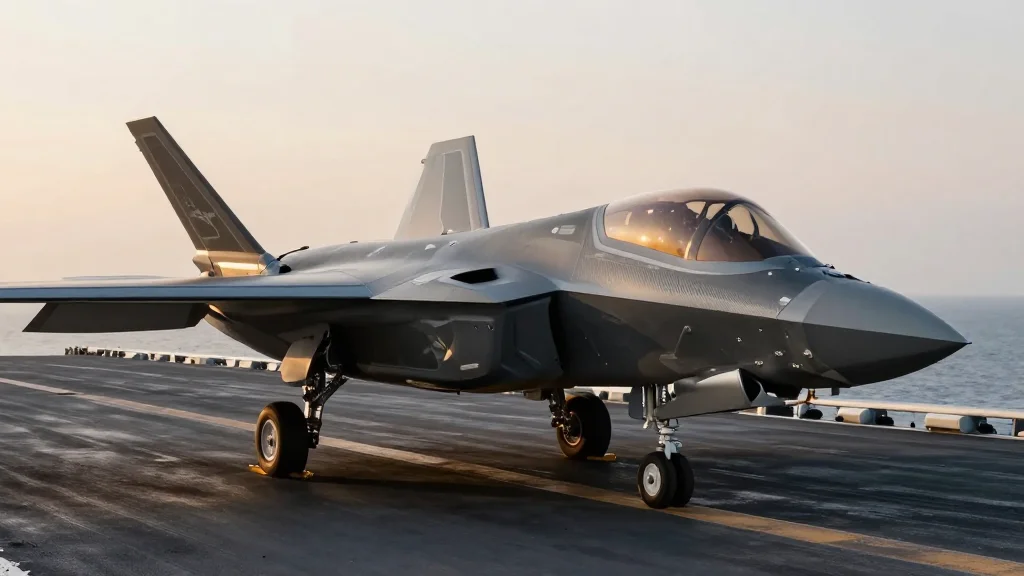
Northrop Grumman Unveils Detailed F/A-XX Design Ahead of Navy Selection

Companies Mentioned
Why It Matters
The F/A‑XX program represents the U.S. Navy’s most consequential procurement decision in decades, with implications for force structure, industrial base competition and U.S. power projection in contested maritime regions. A successful selection of Northrop’s design could accelerate the integration of autonomous systems into carrier operations, reshaping doctrines around man‑on‑the‑loop control and networked warfare. If the Navy opts for Boeing’s competing concept, the competitive dynamics could shift funding and talent toward a different set of technologies, potentially altering the pace of stealth and AI integration across the fleet. Either outcome will influence allied procurement plans, as partner navies watch closely to align their own carrier‑based fighter strategies.
Key Takeaways
- •Northrop Grumman released a detailed F/A‑XX concept video on X, showing a tailless, stealth‑focused design.
- •U.S. Navy expects to select a contractor for the F/A‑XX program in August 2026, with Northrop and Boeing as final contenders.
- •The aircraft aims for a combat radius about 25 % greater than the F/A‑18E/F Super Hornet, roughly 1,250 nautical miles.
- •F/A‑XX is planned to serve as a network hub, linking pilots with MQ‑25 Stingray and other unmanned platforms, expanding strike group coverage from 8 M to 11 M square miles.
- •If awarded, Northrop would begin prototype development in late 2027, marking the first step toward a sixth‑generation carrier fighter.
Pulse Analysis
Northrop’s decision to unveil a dynamic video rather than a static rendering signals a shift in how defense contractors communicate technical maturity. By showcasing moving images, the firm is attempting to convey confidence in aerodynamic stability and systems integration—key concerns for a carrier‑based platform where space, weight and stealth are tightly constrained. This visual strategy may also be aimed at swaying undecided Navy officials by reducing perceived risk.
Historically, carrier fighter programs have been protracted and costly, with the F‑14, F/A‑18 and F‑35C each encountering schedule overruns and budget escalations. The F/A‑XX’s emphasis on a “man‑on‑the‑loop” architecture reflects lessons learned from the F‑35’s sensor‑fusion challenges and the growing need to incorporate unmanned assets without overburdening pilots. If Northrop can deliver a design that balances low observability with the flexibility to host autonomous wing‑men, it could set a new benchmark for future carrier aviation.
From an industry perspective, the head‑to‑head with Boeing revives a rivalry that has defined naval aviation for decades. Boeing’s legacy in carrier aircraft—most notably the Super Hornet—offers a proven production pipeline, while Northrop brings expertise in stealth and networked systems. The outcome will likely influence not just the U.S. Navy’s budget allocations but also the strategic posture of allied navies that depend on American carrier groups for regional security.
Northrop Grumman Unveils Detailed F/A-XX Design Ahead of Navy Selection
Comments
Want to join the conversation?
Loading comments...