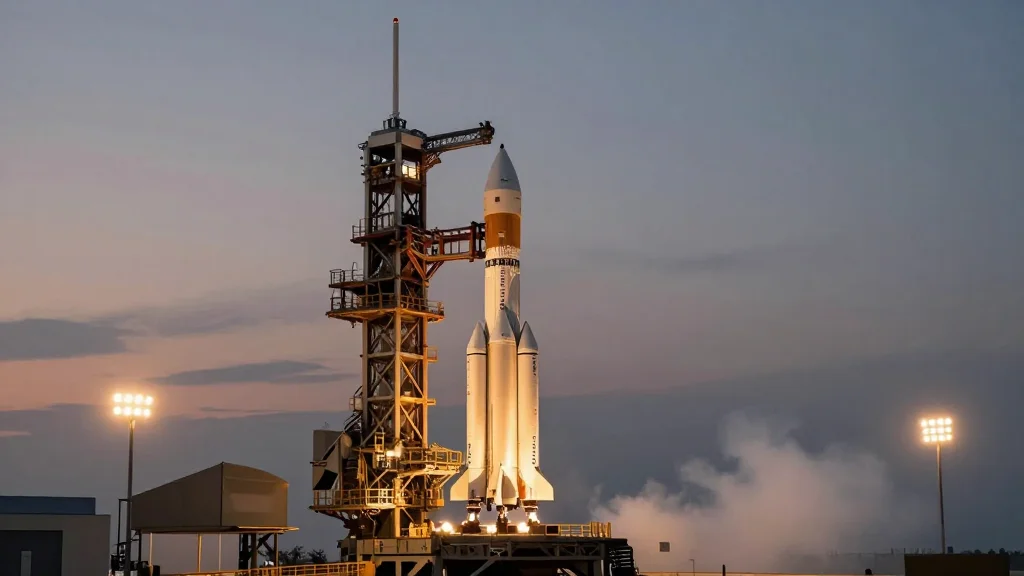
Northrop Grumman’s Minotaur IV Launch Propels USSF Tech Demo Toward 1,000‑Satellite Goal

Companies Mentioned
Why It Matters
The Minotaur IV launch demonstrates that the U.S. military can field experimental satellites at a pace previously reserved for commercial ventures, accelerating the development of a distributed LEO architecture that promises greater survivability against anti‑satellite threats. By validating new communications waveforms and sensor payloads, the mission reduces technical risk for the Space Development Agency’s ambitious 1,000‑satellite constellation, a cornerstone of the United States’ strategy to maintain dominance in the contested space domain. Beyond the immediate tactical benefits, the launch signals a shift in how defense agencies procure launch services—favoring heritage, cost‑effective rockets that can be rapidly re‑tasked. This approach could reshape the launch market, prompting commercial providers to tailor services for short‑notice, high‑frequency military missions, and potentially driving down launch costs across the sector.
Key Takeaways
- •Northrop Grumman launched Minotaur IV carrying STP‑S29A payload for USSF.
- •STPSat‑7 hosts five experiments, including three from the U.S. Naval Research Laboratory.
- •Mission supports Space Development Agency’s goal of 1,000 LEO satellites by end‑2026.
- •Minotaur IV uses three retired Peacekeeper ICBM motors and an Orion 38 upper stage, delivering ~1,730 kg to LEO.
- •On‑orbit operations will be managed by SSC’s System Delta 89, with data feeding future satellite tranches.
Pulse Analysis
The launch of STP‑S29A marks a pivotal moment in the militarization of low‑Earth orbit, where legacy launch vehicles are being repurposed to meet the rapid prototyping needs of the Space Force. Historically, the Minotaur family has served niche government customers, but the frequency of launches—now two in four months—suggests a scaling of that niche into a core capability. This shift is driven by the Space Development Agency’s aggressive timeline to field a dense, resilient satellite mesh, a strategy designed to counter the growing anti‑satellite capabilities of near‑peer adversaries.
From a market perspective, the success of a heritage system like Minotaur IV could pressure newer commercial launch providers to lower prices and improve responsiveness. Companies such as SpaceX and Rocket Lab have already been courting defense contracts, but the cost‑effectiveness of using de‑commissioned ICBM stages offers a compelling alternative for smaller, experimental payloads. If the Space Force continues to prioritize rapid, low‑cost access, we may see a bifurcation in the launch market: high‑capacity, high‑cost vehicles for large constellations and a parallel stream of heritage‑based, quick‑turnaround rockets for technology demonstrators.
Looking ahead, the real test will be how quickly the data from STPSat‑7 translates into operational capability. The Space Force’s ability to integrate new waveforms, improve Link 16 interoperability, and scale the constellation will determine whether the 1,000‑satellite target is a realistic milestone or an aspirational benchmark. The upcoming data release later this year will be a litmus test for the program’s technical viability and could either accelerate funding for the next tranche or prompt a reassessment of the proliferated architecture’s feasibility.
Northrop Grumman’s Minotaur IV Launch Propels USSF Tech Demo Toward 1,000‑Satellite Goal
Comments
Want to join the conversation?
Loading comments...